The Russian Ruble is Set to Strengthen. Possible Capital Inflow from Russia to Armenia
🔵➡️ The ruble is highly likely to strengthen.
🔵➡️ We may see an inflow of capital (dollars) from Russia to Armenia.
Three days ago, the Russian Federation imposed capital controls on some of its largest exporters.
These exporters will be required to deposit no less than 80% of their foreign currency earnings in Russian banks, and then sell at least 90% of those proceeds on the domestic market within two weeks. This means exporters must convert 75% of their foreign currency earnings into rubles on the market. More on reuters.com.
This step will increase the amount of foreign currency in the Russian market and strengthen the ruble. This time last year, the dollar was roughly 60 rubles per dollar. Over the past two months, 1 dollar has crossed the 100 ruble mark several times.
This was the main reason why the key interest rate in Russia was raised from 7.5% to 13% within two months. More on my website.
Since this measure will increase the quantity of dollars in the Russian market, we can expect the ruble to strengthen to approximately 88-92 rubles per dollar within 2-3 months, after which it will most likely begin to depreciate again. This is the first conclusion.
The second conclusion is that large Russian businesses currently facing restrictions may seek other countries for their capital activities.
We may now see a second outflow of capital from the Russian Federation, similar to what we observed in mid-2022. This outflow will be smaller than the previous one. However, our economic indicators are currently declining, and if this scenario materializes, it would provide an additional boost for our economy and banking system.
Analysis of International Money Transfers
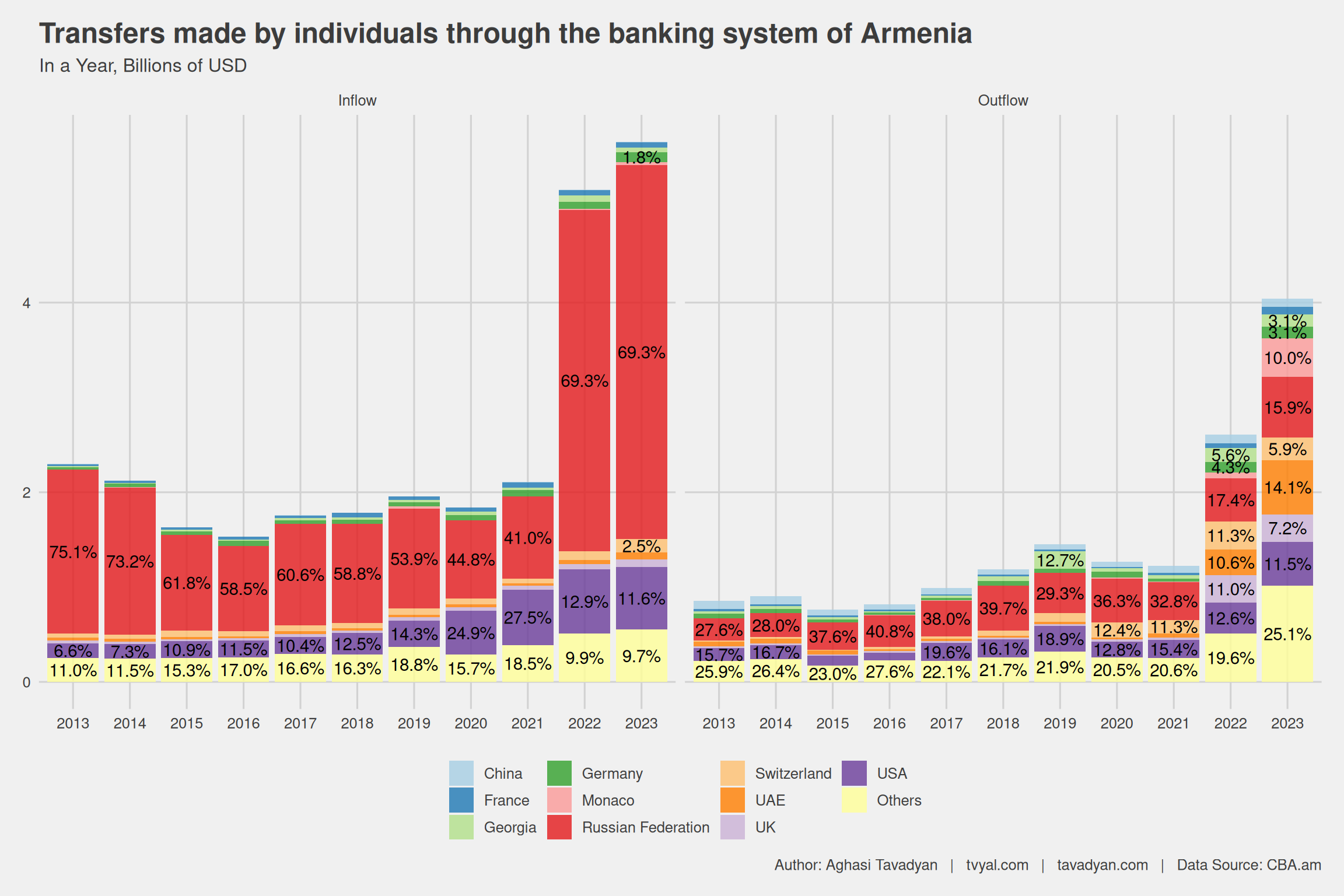
2022 was an unprecedented year for the growth of bank transfers from individuals to Armenian banks; they increased 2.5 times, from $2.1 billion to $5.2 billion. This growth was primarily due to bank transfers received from Russia, which quadrupled from $865 million to $3.6 billion. As a result, a significant amount of money, mainly in dollars, was transferred to Armenia, leading to an increase in dollar supply and the devaluation of the dollar against the dram (see Plot 1.). Economic factors are highly interconnected. In 2022, foreign currency inflow into the banking system increased 2.5 times, while outflow increased approximately 2 times. In 2022, inflow amounted to $5.2 billion, and outflow was $2.7 billion.
Plot 1. Money Transfers through the RA Banking System (Annual, Billion USD).
To study this dynamic, let us also consider the monthly indicators of transfers made by individuals through Armenia’s banking system. It should be noted that at the time of this report, data on bank transfers for 2023 up to April is available. As can be seen from Plot 8.2., the dynamic of positive inflow growth has stabilized at a new level in 2023, and there is currently no decreasing trend. With a certain lag, a significant increase in bank outflows to other countries has also been recorded, which indicates that the Armenian economy cannot accommodate the incoming funds, which are mostly transferred to other countries.
Plot 2. Money Transfers through the RA Banking System (12-Month Period, Billion USD).

Plot 3. Money Transfers through the RA Banking System (Monthly, Million USD).
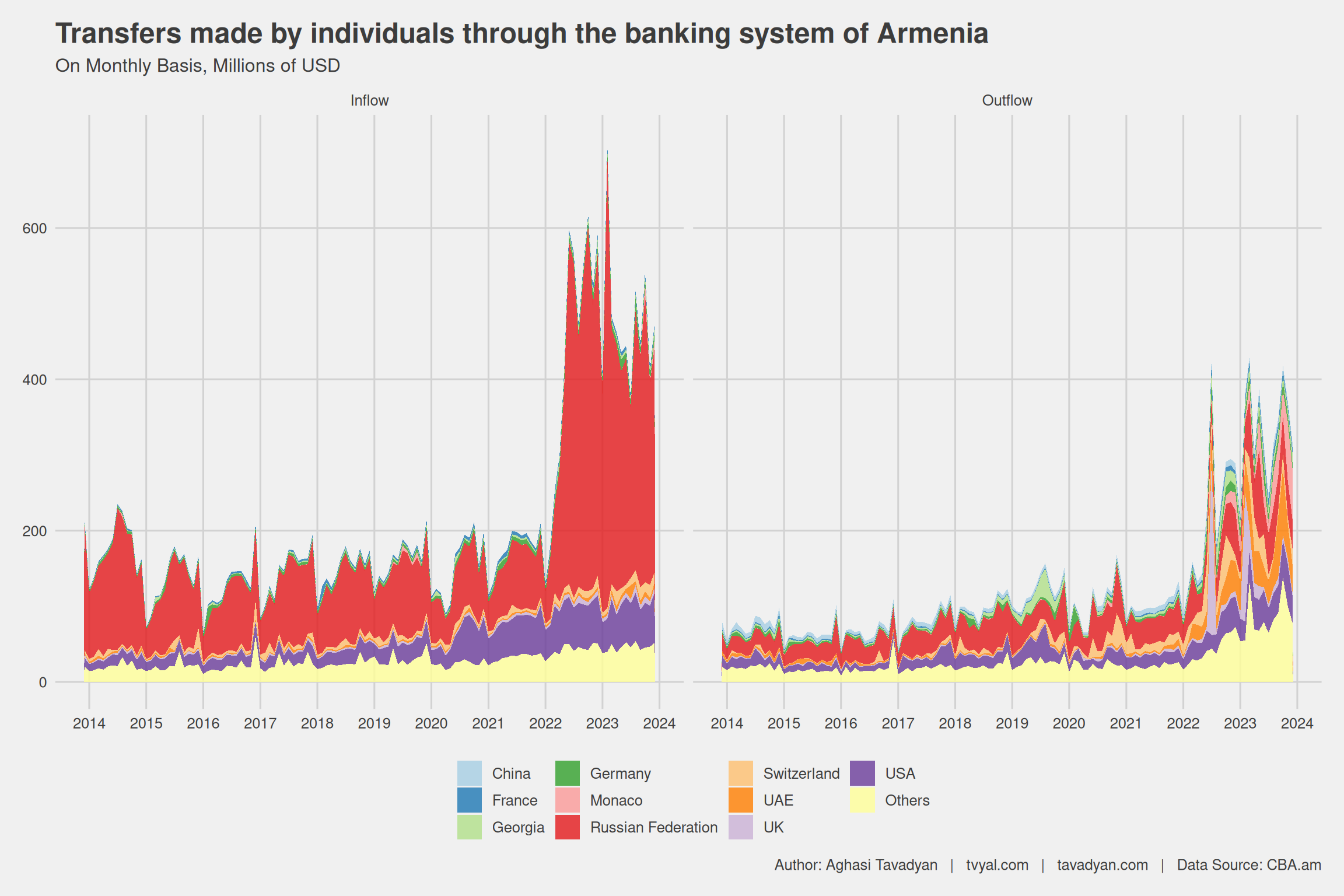
As can be seen from the plot, bank transfers reached their peak at the beginning of 2023, and their volume is now decreasing. Here, two scenarios are possible: either transfers continue to decline, and by the end of 2023, bank transfers will be 10-25 percent less than last year, or the scenario described in the first section materializes, and this year’s bank transfers will be equivalent to or somewhat exceed last year’s figures.
Since about 70 percent of bank transfers come from the Russian Federation, let us also look separately at bank transfers made from Russia.
Plot 4. Non-Commercial and Total Bank Transfers Received from Russia (Monthly, Million USD).
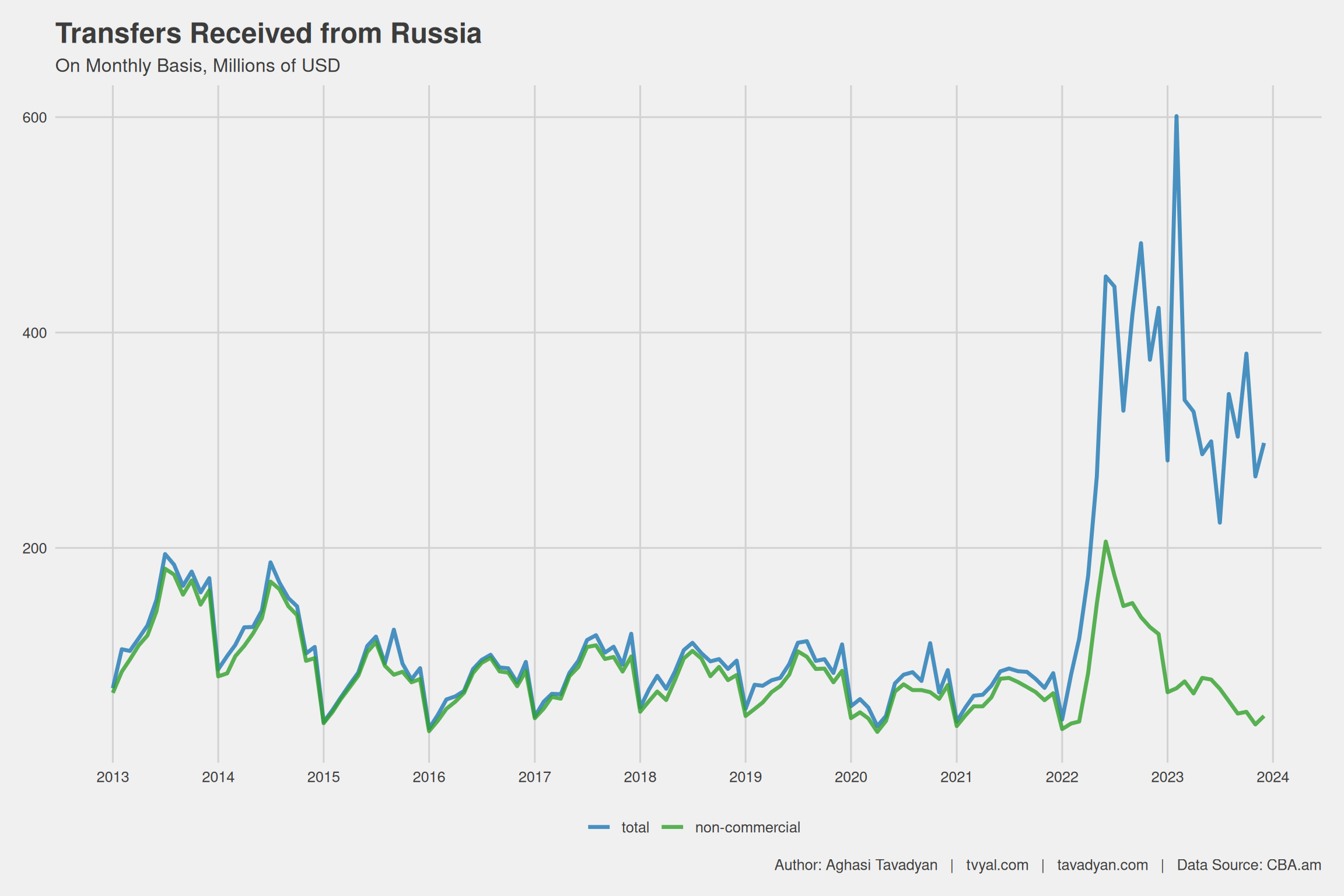
As can be seen from the plot, until 2022, the majority of transfers were non-commercial, but starting from 2022, the majority of transfers became commercial in nature. I should also note that the ratio of non-commercial transfers to GDP has declined and is currently at a record low level of 8 percent.
Media Communications, Gasoline Price
The solution to the gasoline price issue is more political.
Read my new interview.
- In one year, the price of gasoline has risen from 380 drams to 580 drams per liter. The latest increase is linked to the devaluation of the dram and global oil market dynamics. The dram’s fluctuations also contributed to rising gasoline prices.
- Global factors, such as OPEC+ oil production restrictions, also affect prices. Despite low demand, artificial supply restrictions keep prices high. The situation is also exacerbated by Russia’s recent embargo on gasoline exports.
- Russia’s struggle against ruble depreciation and for oil exports has led to a domestic gasoline deficit, which has also impacted our market.
To learn more about this issue, read the interview.
Full English Translation of Previous Sections
🔵➡️ The ruble is highly likely to strengthen.
🔵➡️ We may see an inflow of capital (dollars) from Russia to Armenia.
Three days ago, the Russian Federation imposed capital controls on some of its largest exporters.
These exporters will be required to deposit no less than 80% of their foreign currency earnings in Russian banks, and then sell at least 90% of those proceeds on the domestic market within two weeks. This means exporters must convert 75% of their foreign currency earnings into rubles on the market. More on reuters.com.
This step will increase the amount of foreign currency in the Russian market and strengthen the ruble. This time last year, the dollar was roughly 60 rubles per dollar. Over the past two months, 1 dollar has crossed the 100 ruble mark several times.
This was the main reason why the key interest rate in Russia was raised from 7.5% to 13% within two months. More on my website.
Since this measure will increase the quantity of dollars in the Russian market, we can expect the ruble to strengthen to approximately 88-92 rubles per dollar within 2-3 months, after which it will most likely begin to depreciate again. This is the first conclusion.
The second conclusion is that large Russian businesses currently facing restrictions may seek other countries for their capital activities.
We may now see a second outflow of capital from the Russian Federation, similar to what we observed in mid-2022. This outflow will be smaller than the previous one. However, our economic indicators are currently declining, and if this scenario materializes, it would provide an additional boost for our economy and banking system.
2022 was an unprecedented year for the growth of bank transfers from individuals to Armenian banks; they increased 2.5 times, from $2.1 billion to $5.2 billion. This growth was primarily due to bank transfers received from Russia, which quadrupled from $865 million to $3.6 billion. As a result, a significant amount of money, mainly in dollars, was transferred to Armenia, leading to an increase in dollar supply and the devaluation of the dollar against the dram (see Plot 1.). Economic factors are highly interconnected. In 2022, foreign currency inflow into the banking system increased 2.5 times, while outflow increased approximately 2 times. In 2022, inflow amounted to $5.2 billion, and outflow was $2.7 billion.
Plot 1. Money Transfers through the RA Banking System (Annual, Billion USD).
To study this dynamic, let us also consider the monthly indicators of transfers made by individuals through Armenia’s banking system. It should be noted that at the time of this report, data on bank transfers for 2023 up to April is available. As can be seen from Plot 8.2., the dynamic of positive inflow growth has stabilized at a new level in 2023, and there is currently no decreasing trend. With a certain lag, a significant increase in bank outflows to other countries has also been recorded, which indicates that the Armenian economy cannot accommodate the incoming funds, which are mostly transferred to other countries.
Plot 2. Money Transfers through the RA Banking System (12-Month Period, Billion USD).
Plot 3. Money Transfers through the RA Banking System (Monthly, Million USD).
As can be seen from the plot, bank transfers reached their peak at the beginning of 2023, and their volume is now decreasing. Here, two scenarios are possible: either transfers continue to decline, and by the end of 2023, bank transfers will be 10-25 percent less than last year, or the scenario described in the first section materializes, and this year’s bank transfers will be equivalent to or somewhat exceed last year’s figures.
Since about 70 percent of bank transfers come from the Russian Federation, let us also look separately at bank transfers made from Russia.
Plot 4. Non-Commercial and Total Bank Transfers Received from Russia (Monthly, Million USD).
As can be seen from the plot, until 2022, the majority of transfers were non-commercial, but starting from 2022, the majority of transfers became commercial in nature. I should also note that the ratio of non-commercial transfers to GDP has declined and is currently at a record low level of 8 percent.
The solution to the gasoline price issue is more political.
Read my new interview.
- In one year, the price of gasoline has risen from 380 drams to 580 drams per liter. The latest increase is linked to the devaluation of the dram and global oil market dynamics. The dram’s fluctuations also contributed to rising gasoline prices.
- Global factors, such as OPEC+ oil production restrictions, also affect prices. Despite low demand, artificial supply restrictions keep prices high. The situation is also exacerbated by Russia’s recent embargo on gasoline exports.
- Russia’s struggle against ruble depreciation and for oil exports has led to a domestic gasoline deficit, which has also impacted our market.
To learn more about this issue, read the interview.