Dollarization and Monetization Levels in Armenia
I must confess, it is easier for me to draw charts,
analyze data, build relatively complex machine learning
models, and write code than to write text.
Writing text is hard.
Currently, I am in transit at a foreign airport, waiting for my next flight.
Today's text will be brief, but I hope the charts will be useful to you.

-Agassi
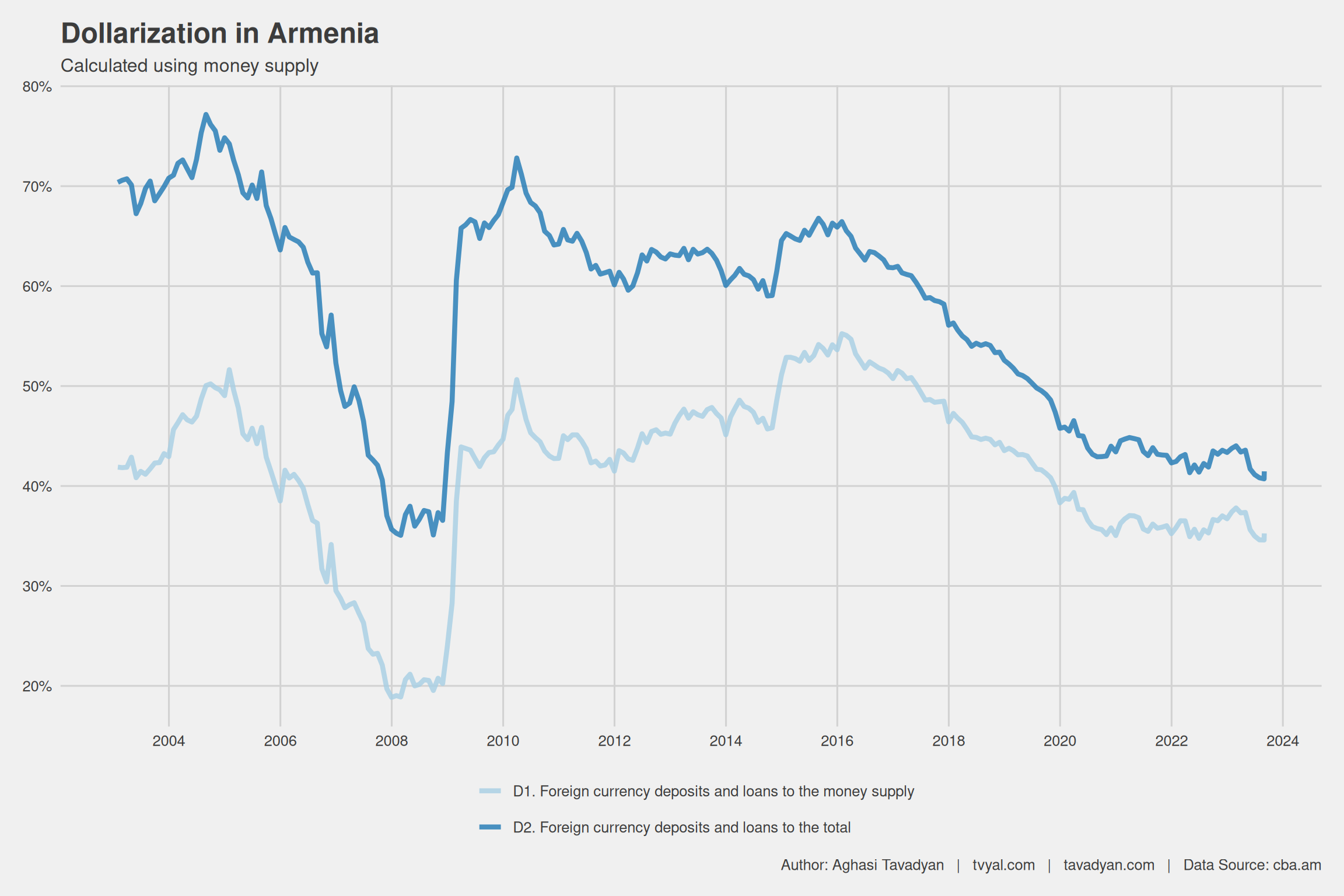
Overall, the dollarization level, estimated by various methods, attempts to assess what percentage of money in the economy is foreign currency. The higher this indicator, the lower the confidence in the economy and the banking system.
The first diagram shows the level of dollarization in Armenia. The D2 indicator in the chart is more telling, representing the ratio of residents’ foreign currency deposits and loans to residents’ total deposits and loans. The smaller this indicator, the greater the confidence in Armenia’s banking system. According to this indicator, in September 2023, the dollarization level was 41 percent. This indicator began to decline in 2016, prior to which, from 2010, it had been above 60 percent.
Chart 1. Dollarization Level in Armenia by Money Supply
The second chart presents the dollarization level according to demand deposits and foreign currency loans. What is interesting here is that the volume of foreign currency in deposits (D4) and the volume of foreign currency in loans (D5) had almost the same dynamics and moved in the same direction until March 2022. From April 2022, these indicators showed opposing trends. Foreign currency deposits sharply decreased, while the percentage of foreign currency loans increased. This was due to a rather significant inflow of foreign currency into Armenia in 2022 (for more, see Tvyal Newsletter: Analysis of International Money Transfers). The large inflow of foreign currency in 2022 strengthened the dram, which resulted in an increase in the percentage of loans taken in dram and deposits placed in foreign currency, as the amount of dollars in the system was large, and many preferred to deposit it.
Chart 2. Dollarization Level in Armenia by Foreign Currency Demand Deposits and Loans

The third chart shows the ratio of Armenian dram and foreign currency deposits to GDP. Armenian dram deposits include demand and term deposits. The data are ratioed to the 12-month cumulative GDP indicator to more clearly show the dynamics of change. From the second half of 2019, the share of dram deposits began to exceed the share of dollar deposits. Since 2018, the share of dollar deposits began to fall. As of September 2023, total dram deposits amount to about 2.4 trillion drams or 26 percent of GDP, while dollar deposits are about 1.7 trillion drams, or about 18 percent of GDP.
Chart 3. Ratio of Armenian Dram and Foreign Currency Deposits to GDP
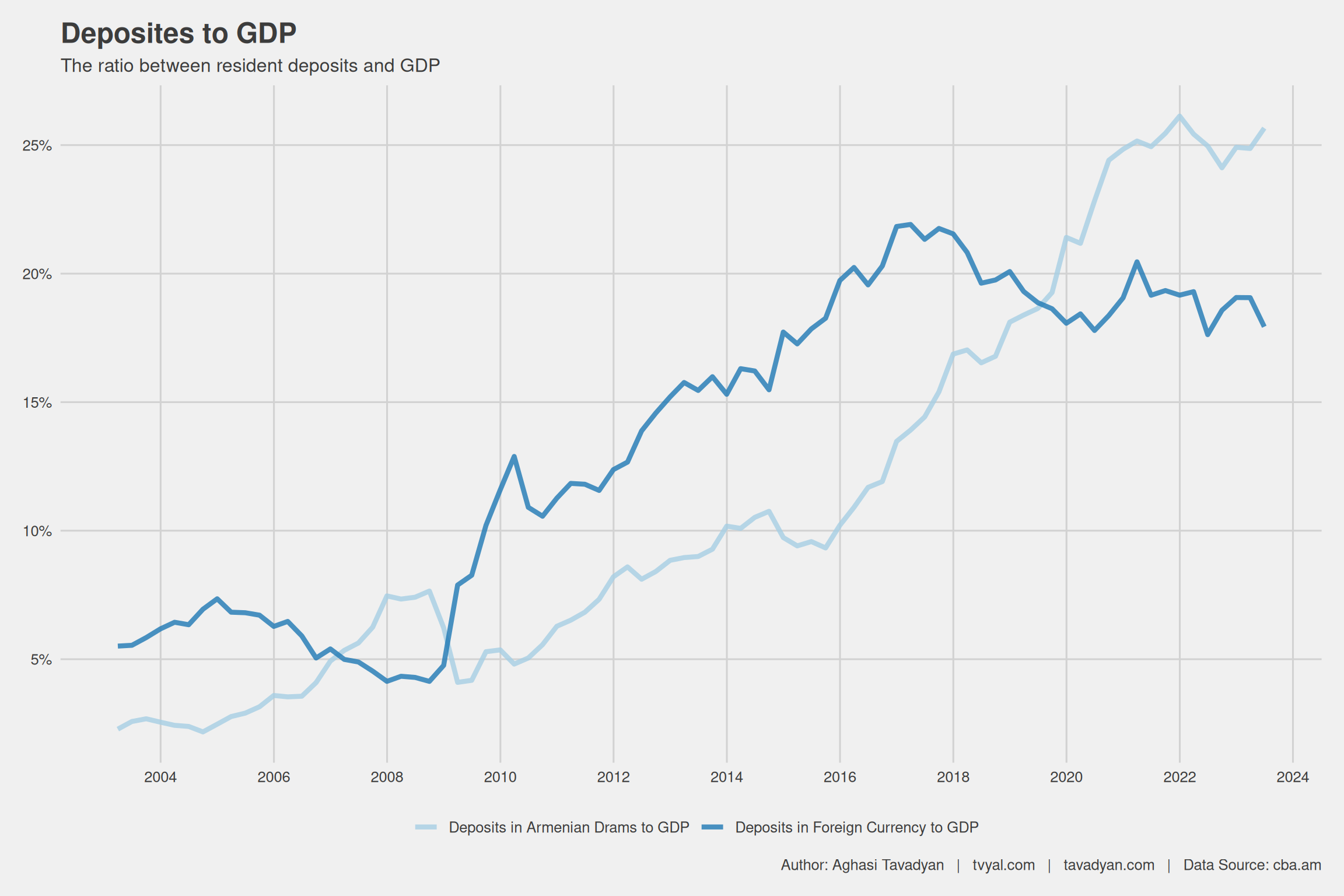
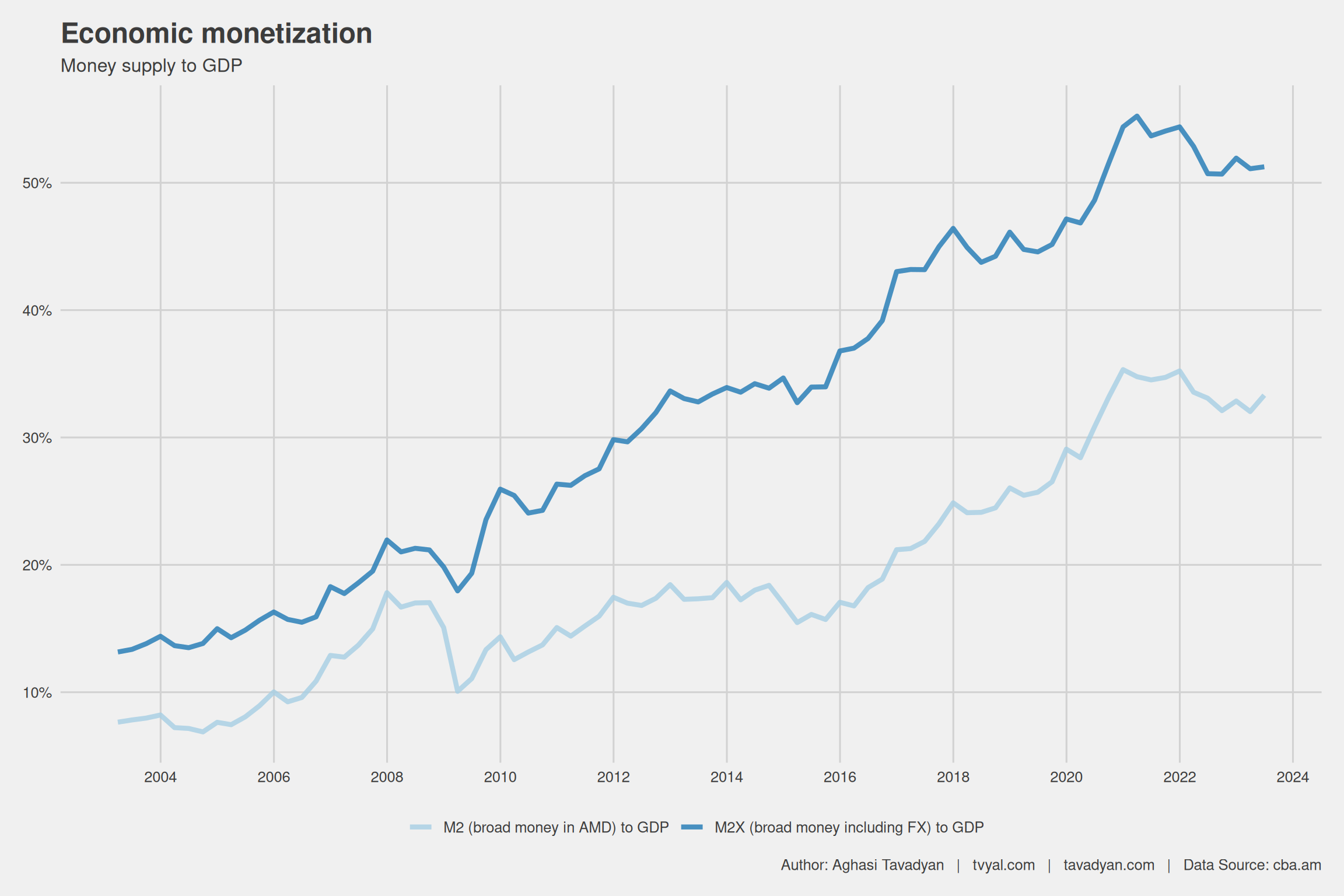
Chart 4 presents the level of dramization or monetization in Armenia, which is the ratio of money supply to GDP. The monetization of the economy is a measure of the national economy, reflecting its saturation with liquid assets. The level of monetization is determined by the development of both the national financial system and the entire economy. The monetization of the economy also determines the freedom of capital movement. Here, the main indicator is M2 monetization, which currently stands at 33 percent. Overall GDP tends to change linearly, while the money supply can change exponentially. Thanks to this, the level of monetization testifies to economic development. In all developed economies, this indicator is more than 60 percent.
Chart 4. Monetization Level in Armenia
Media Communications
This week, I gave an interview to hetq.am about the car import boom from Armenia and the fading of this trend.
The interview addresses the following questions:
excerpt from the material:
"The re-export of both cars and other goods has a short-term positive impact on Armenia's economy.
Simply put, these are resales, during which exporters generate income and profit.
Currently, Russia is a 'hungry' market and is rapidly absorbing goods re-exported from Armenia.
However, if sanctions are lifted from Russia one day, Armenian re-exporters will immediately suffer,
and the entire Armenian economy will also suffer.
Nonetheless, if we consider only cars, the impact might not be as significant."
Read more here