The Death of Armenia's 'Auto Industry'
For the first 10 months of 2023, passenger cars accounted for 7.2 percent of Armenia’s exports. Thus, the “production” of cars secured 7.2 percent of Armenia’s exports. It should be noted that during the same period, car imports constituted 10.5 percent of the total.
This significant and relatively new sector of the economy, which contributed to a portion of the economic growth in 2022 and 2023, faces major challenges and could be completely neutralized in 2024.
Table 1 Armenia’s Vehicle Exports (mln USD, for the first 10 months)
Armenia’s Exports of Vehicles (mln USD, data for the first 10 months of the given year)
| partner | 2021 | pct | 2022 | pct | 2023 | pct |
|---|---|---|---|---|---|---|
| Russian Federation | 2.4 | 34.8% | 120.5 | 91.8% | 354.0 | 84.8% |
| Other counties | 4.6 | 65.2% | 10.8 | 8.2% | 63.3 | 15.2% |
| Total | 7.0 | 100.0% | 131.3 | 100.0% | 417.4 | 100.0% |
It should be noted that in 2021, 7,362 light passenger cars (worth $77.9 million) were imported, while in 2022, this figure rose to 42,293 cars (worth $360.2 million). This represents an increase of about 6 times. In 2021, Armenia exported 319 cars, and in 2022, 10,936 cars. Thus, a quarter of the imported cars were re-exported, mainly to Russia. A significant increase in car imports from the USA, approximately 7 times, was recorded during 2022.
It should be noted that this is not simply re-export. Primarily, damaged cars are imported to Armenia from North America, after which certain repair work is carried out on these vehicles, creating added value. Subsequently, they are mainly re-exported to the Russian Federation, leaving Armenia with a service commission.
In the first 10 months of 2023, car exports increased 3.17 times compared to the same period in 2022. While this initially suggests potential and growth in the sector, the reality is different.
Table 2 Armenia’s Vehicle Imports (mln USD, for the first 10 months)
Armenia’s Imports of Vehicles (mln USD, data for the first 10 months of the given year)
| partner | 2021 | pct | 2022 | pct | 2023 | pct |
|---|---|---|---|---|---|---|
| USA | 17.9 | 22.9% | 121.3 | 33.7% | 319.4 | 32.0% |
| Japan | 13.3 | 17.0% | 77.2 | 21.4% | 221.7 | 22.2% |
| Other counties | 30.5 | 39.2% | 55.7 | 15.5% | 94.2 | 9.5% |
| Germany | 6.6 | 8.5% | 36.2 | 10.1% | 108.7 | 10.9% |
| Mexico | 2.8 | 3.7% | 24.5 | 6.8% | 102.9 | 10.3% |
| Rep. of Korea | 1.4 | 1.8% | 15.4 | 4.3% | 59.9 | 6.0% |
| Canada | 4.1 | 5.3% | 15.1 | 4.2% | 41.7 | 4.2% |
| China | 1.3 | 1.6% | 14.6 | 4.1% | 48.4 | 4.9% |
| Total | 77.9 | 100.0% | 360.2 | 100.0% | 996.9 | 100.0% |
Imports from the USA in 2022 increased by approximately 3.5 times compared to 2021, rising from $107 million to $356 million. Exports remained the same. Cars were primarily imported from the USA, accounting for about 70 percent of imports from the USA. The remainder consisted of nuclear reactors, pharmaceutical, and optical products. Until 2022, our trade turnover with the USA was about 4 percent, but in 2022, primarily due to car imports, this indicator recorded a significant increase.
It is clear that all of this is re-export, and that car exports from Armenia increased after the sanctions imposed against Russia in 2022. As a member of the EAEU, we have benefited here, as in another situation, it would not make sense to bring cars from North America to Georgia, then to Armenia, and then transport them to Russia. The EAEU free trade area has also provided certain benefits in this regard.
If we look at the list of large taxpayers, the profit tax of Armenian car importers in 2022 doubled by 7 to 15 times compared to 2021. This profit was used to acquire new cars with the hope of further re-export.
What Threatens Armenia’s “Auto Industry” in 2024
Figure 1. Armenia’s Car Imports (monthly data)
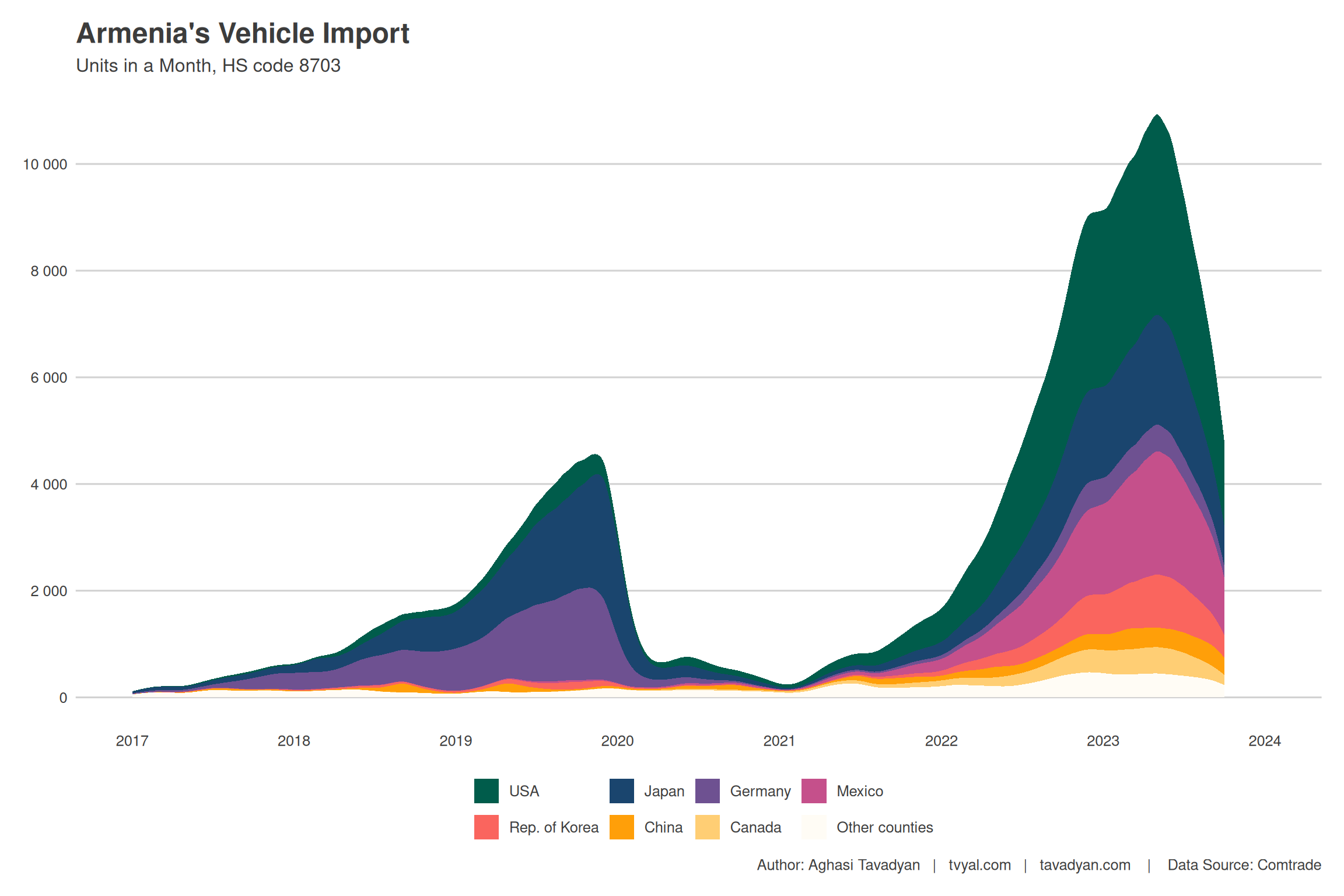
It seems everything is fine; car exports increased in 2023 compared to 2022. However, the reality, as the chart shows, is not so positive. Georgia is the main car market in this region and will not easily cede even a small part of its share to Armenia. This is also why, starting August 1, the Tbilisi authorities banned the export of American cars with engines of 1.9 liters and more, as well as hybrid and electric cars. Over 90 percent of Armenia’s car exports were of this class of vehicles. This is visible in the first chart.
It is true that the total car exports in 2023 were higher compared to 2022. However, after a sharp and unexpected increase in car exports in 2022, a peak in exports was recorded at the beginning of 2023, after which it experienced a sharp decline.
It is also interesting that a sudden increase in car imports and a year-end decline were recorded in 2019-2020. This decline primarily affected the reduction in imports of Japanese cars. The main reason for this was the introduction of new import tariffs for cars in the EAEU territory, according to which a significant tariff applied to cars manufactured more than 3 years ago, making it economically unfeasible. This neutralized this sector in 2020, and almost no car imports were recorded that year.
Figure 2. Armenia’s Car Exports and Imports (monthly data)

In 2022-23, Armenia was the second largest car market in the region after Georgia. Armenia’s large-scale exports created certain problems at the Upper Lars border. Moreover, according to business rules, an established market is unlikely to quickly exit into other markets. There is also a certain political factor at play here.
In the first 10 months of 2023, Armenia exported 18,835 cars (imported: 70,859). In all of 2022, 10,936 cars were exported (imported: 42,293). In 2023, Armenia will be the 35th largest exporter by volume among all countries, while Georgia will be around 25th. Georgia exported approximately 100,000 cars in 2023.
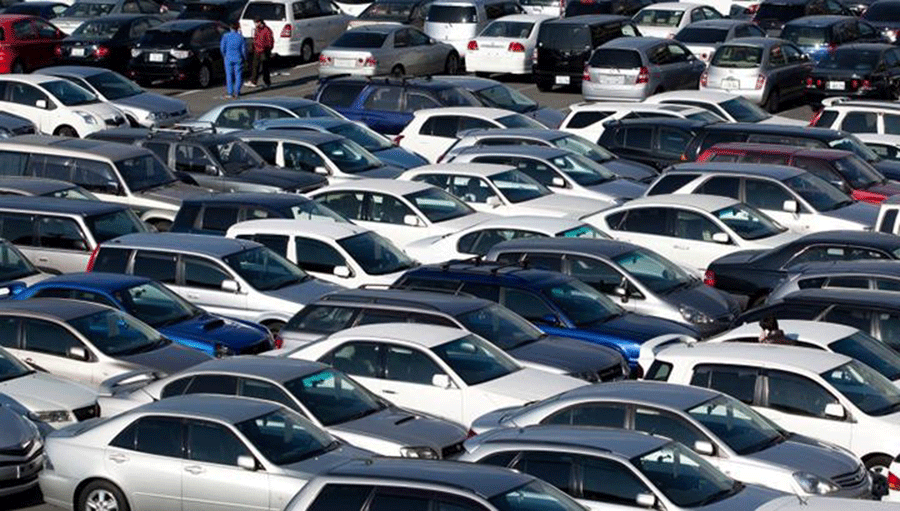
A significant number of cars have entered our market, filling customs points and importers’ parking lots. A car is a product that depreciates over time.
It can be expected that in 2024, car importers will be forced to sell a large number of cars at a loss in the domestic market, meaning car prices could drop significantly this year. This could increase the number of cars on Yerevan’s streets, as happened in 2020.
Figure 3 shows Georgia’s monthly car exports and imports by various countries. Georgia does not export a large number of cars to Russia, and exports to Russia almost ceased from August 2023, just as they did in Armenia. Primarily, cars are imported to Georgia from the USA and exported to Azerbaijan and Kazakhstan. It is also noteworthy that from mid-2023, both car exports to and imports from Georgia have stalled, which also indicates market saturation and problems in this market.
Figure 3. Georgia’s Car Exports and Imports (monthly data)

Russia No Longer Wants Re-exported Cars
In 2023, every 8th car sold in Russia was imported through “grey” imports. From January to September 2023, Russian citizens acquired over 100,000 cars that entered the Russian car market via “grey” imports. In September, their market share decreased from 13% in August to 11%.
In September, Japanese (4.4 thousand units, 34 percent), Korean (3.1 thousand units, 24 percent), and German (2.7 thousand units, 20 percent) cars were most frequently brought into the Russian Federation via “grey” imports. The share of Chinese foreign cars also showed positive dynamics, increasing from 7% in August to 12% in September.
From October 1, 2023, the rules for “grey” or parallel car imports in Russia changed. This type of import has been restricted. Now, such cars are imported by small companies and are more affordable than those in official dealerships. This is not beneficial for the Russian economy, which is trying to develop its domestic production and gives an advantage to cars manufactured in the Russian Federation.
From August 1, a preferential recycling fee also applies to “grey” car imports to Russia, which prevents an individual from importing more than one car per year into Russia and selling it within one year.
All of this will most likely lead to a significant loss in import and export volumes in 2024, which could also affect GDP growth.
Media Reports
🇦🇲🇷🇺Armenia-Russia Trade: Benefits and Risks of Falling Under Sanctions 🌐
🔗 Read my latest interview, given to jam-news. The interview is also available in English and Russian versions.
🔍 Key points:
- 📈 Sharp increase in Armenia’s export figures: Armenia exports more than half of its goods, 52 percent, to Russia.
- 🔄 Change in exports, including a significant increase in exports of radio equipment, telephones, cars, monitors, projectors, receiving equipment, televisions, and computers.
- 📊 Increase in the number of companies exporting technical equipment.
- 🇺🇸 Discussion of possible US sanctions against Armenian organizations engaged in trade with Russia.
English Summary
2024-01-19
Contents:
- The Death of Armenia’s “Auto Industry”
- Media Reports
The Death of Armenia’s “Auto Industry”
For the first 10 months of 2023, passenger cars accounted for 7.2 percent of Armenia’s exports. Thus, the “production” of cars secured 7.2 percent of Armenia’s exports. It should be noted that during the same period, car imports constituted 10.5 percent of the total.
This significant and relatively new sector of the economy, which contributed to a portion of the economic growth in 2022 and 2023, faces major challenges and could be completely neutralized in 2024.
Table 1 Armenia’s Vehicle Exports (mln USD, for the first 10 months)
Armenia’s Exports of Vehicles (mln USD, data for the first 10 months of the given year)
| partner | 2021 | pct | 2022 | pct | 2023 | pct |
|---|---|---|---|---|---|---|
| Russian Federation | 2.4 | 34.8% | 120.5 | 91.8% | 354.0 | 84.8% |
| Other counties | 4.6 | 65.2% | 10.8 | 8.2% | 63.3 | 15.2% |
| Total | 7.0 | 100.0% | 131.3 | 100.0% | 417.4 | 100.0% |
It should be noted that in 2021, 7,362 light passenger cars (worth $77.9 million) were imported, while in 2022, this figure rose to 42,293 cars (worth $360.2 million). This represents an increase of about 6 times. In 2021, Armenia exported 319 cars, and in 2022, 10,936 cars. Thus, a quarter of the imported cars were re-exported, mainly to Russia. A significant increase in car imports from the USA, approximately 7 times, was recorded during 2022.
It should be noted that this is not simply re-export. Primarily, damaged cars are imported to Armenia from North America, after which certain repair work is carried out on these vehicles, creating added value. Subsequently, they are mainly re-exported to the Russian Federation, leaving Armenia with a service commission.
In the first 10 months of 2023, car exports increased 3.17 times compared to the same period in 2022. While this initially suggests potential and growth in the sector, the reality is different.
Table 2 Armenia’s Vehicle Imports (mln USD, for the first 10 months)
Armenia’s Imports of Vehicles (mln USD, data for the first 10 months of the given year)
| partner | 2021 | pct | 2022 | pct | 2023 | pct |
|---|---|---|---|---|---|---|
| USA | 17.9 | 22.9% | 121.3 | 33.7% | 319.4 | 32.0% |
| Japan | 13.3 | 17.0% | 77.2 | 21.4% | 221.7 | 22.2% |
| Other counties | 30.5 | 39.2% | 55.7 | 15.5% | 94.2 | 9.5% |
| Germany | 6.6 | 8.5% | 36.2 | 10.1% | 108.7 | 10.9% |
| Mexico | 2.8 | 3.7% | 24.5 | 6.8% | 102.9 | 10.3% |
| Rep. of Korea | 1.4 | 1.8% | 15.4 | 4.3% | 59.9 | 6.0% |
| Canada | 4.1 | 5.3% | 15.1 | 4.2% | 41.7 | 4.2% |
| China | 1.3 | 1.6% | 14.6 | 4.1% | 48.4 | 4.9% |
| Total | 77.9 | 100.0% | 360.2 | 100.0% | 996.9 | 100.0% |
Imports from the USA in 2022 increased by approximately 3.5 times compared to 2021, rising from $107 million to $356 million. Exports remained the same. Cars were primarily imported from the USA, accounting for about 70 percent of imports from the USA. The remainder consisted of nuclear reactors, pharmaceutical, and optical products. Until 2022, our trade turnover with the USA was about 4 percent, but in 2022, primarily due to car imports, this indicator recorded a significant increase.
It is clear that all of this is re-export, and that car exports from Armenia increased after the sanctions imposed against Russia in 2022. As a member of the EAEU, we have benefited here, as in another situation, it would not make sense to bring cars from North America to Georgia, then to Armenia, and then transport them to Russia. The EAEU free trade area has also provided certain benefits in this regard.
If we look at the list of large taxpayers, the profit tax of Armenian car importers in 2022 doubled by 7 to 15 times compared to 2021. This profit was used to acquire new cars with the hope of further re-export.
What Threatens Armenia’s “Auto Industry” in 2024
Figure 1. Armenia’s Car Imports (monthly data)
It seems everything is fine; car exports increased in 2023 compared to 2022. However, the reality, as the chart shows, is not so positive. Georgia is the main car market in this region and will not easily cede even a small part of its share to Armenia. This is also why, starting August 1, the Tbilisi authorities banned the export of American cars with engines of 1.9 liters and more, as well as hybrid and electric cars. Over 90 percent of Armenia’s car exports were of this class of vehicles. This is visible in the first chart.
It is true that the total car exports in 2023 were higher compared to 2022. However, after a sharp and unexpected increase in car exports in 2022, a peak in exports was recorded at the beginning of 2023, after which it experienced a sharp decline.
It is also interesting that a sudden increase in car imports and a year-end decline were recorded in 2019-2020. This decline primarily affected the reduction in imports of Japanese cars. The main reason for this was the introduction of new import tariffs for cars in the EAEU territory, according to which a significant tariff applied to cars manufactured more than 3 years ago, making it economically unfeasible. This neutralized this sector in 2020, and almost no car imports were recorded that year.
Figure 2. Armenia’s Car Exports and Imports (monthly data)
In 2022-23, Armenia was the second largest car market in the region after Georgia. Armenia’s large-scale exports created certain problems at the Upper Lars border. Moreover, according to business rules, an established market is unlikely to quickly exit into other markets. There is also a certain political factor at play here.
In the first 10 months of 2023, Armenia exported 18,835 cars (imported: 70,859). In all of 2022, 10,936 cars were exported (imported: 42,293). In 2023, Armenia will be the 35th largest exporter by volume among all countries, while Georgia will be around 25th. Georgia exported approximately 100,000 cars in 2023.
A significant number of cars have entered our market, filling customs points and importers’ parking lots. A car is a product that depreciates over time.
It can be expected that in 2024, car importers will be forced to sell a large number of cars at a loss in the domestic market, meaning car prices could drop significantly this year. This could increase the number of cars on Yerevan’s streets, as happened in 2020.
Figure 3 shows Georgia’s monthly car exports and imports by various countries. Georgia does not export a large number of cars to Russia, and exports to Russia almost ceased from August 2023, just as they did in Armenia. Primarily, cars are imported to Georgia from the USA and exported to Azerbaijan and Kazakhstan. It is also noteworthy that from mid-2023, both car exports to and imports from Georgia have stalled, which also indicates market saturation and problems in this market.
Figure 3. Georgia’s Car Exports and Imports (monthly data)
Russia No Longer Wants Re-exported Cars
In 2023, every 8th car sold in Russia was imported through “grey” imports. From January to September 2023, Russian citizens acquired over 100,000 cars that entered the Russian car market via “grey” imports. In September, their market share decreased from 13% in August to 11%.
In September, Japanese (4.4 thousand units, 34 percent), Korean (3.1 thousand units, 24 percent), and German (2.7 thousand units, 20 percent) cars were most frequently brought into the Russian Federation via “grey” imports. The share of Chinese foreign cars also showed positive dynamics, increasing from 7% in August to 12% in September.
From October 1, 2023, the rules for “grey” or parallel car imports in Russia changed. This type of import has been restricted. Now, such cars are imported by small companies and are more affordable than those in official dealerships. This is not beneficial for the Russian economy, which is trying to develop its domestic production and gives an advantage to cars manufactured in the Russian Federation.
From August 1, a preferential recycling fee also applies to “grey” car imports to Russia, which prevents an individual from importing more than one car per year into Russia and selling it within one year.
All of this will most likely lead to a significant loss in import and export volumes in 2024, which could also affect GDP growth.
Media Reports
🇦🇲🇷🇺Armenia-Russia Trade: Benefits and Risks of Falling Under Sanctions 🌐
🔗 Read my latest interview, given to jam-news. The interview is also available in English and Russian versions.
🔍 Key points:
- 📈 Sharp increase in Armenia’s export figures: Armenia exports more than half of its goods, 52 percent, to Russia.
- 🔄 Change in exports, including a significant increase in exports of radio equipment, telephones, cars, monitors, projectors, receiving equipment, televisions, and computers.
- 📊 Increase in the number of companies exporting technical equipment.
- 🇺🇸 Discussion of possible US sanctions against Armenian organizations engaged in trade with Russia.