💹💳 76 Percent of Private Jobs are in Yerevan
Analysis of Inflation-Adjusted Wages
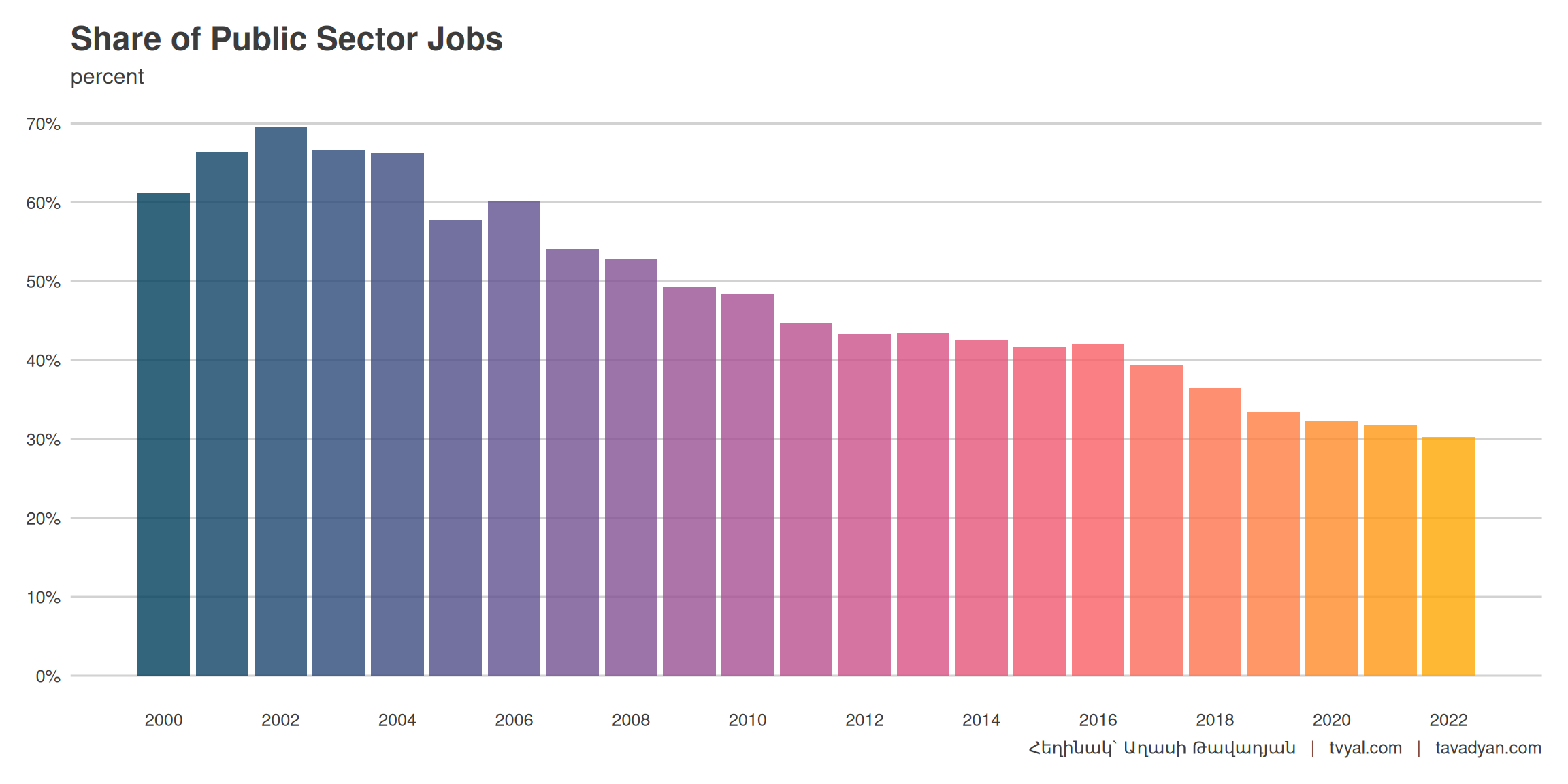
It should be noted that the proportion of jobs in the public sector has continuously decreased since 2002, when approximately 70 percent of registered jobs were in the public sector. In 2022, public sector jobs accounted for 30.3 percent of the total. The reduction is not due to a decrease in the number of public sector jobs, but rather an increase in registered non-public sector jobs. The number of public sector employees grew by 3.2 percent during 2020-22, while non-public sector jobs increased by 12.8 percent. In 2022, 684,783 employees were registered, which is 5.4 percent more than the previous year.
Figure 1. Share of Public Sector Employees in Armenia
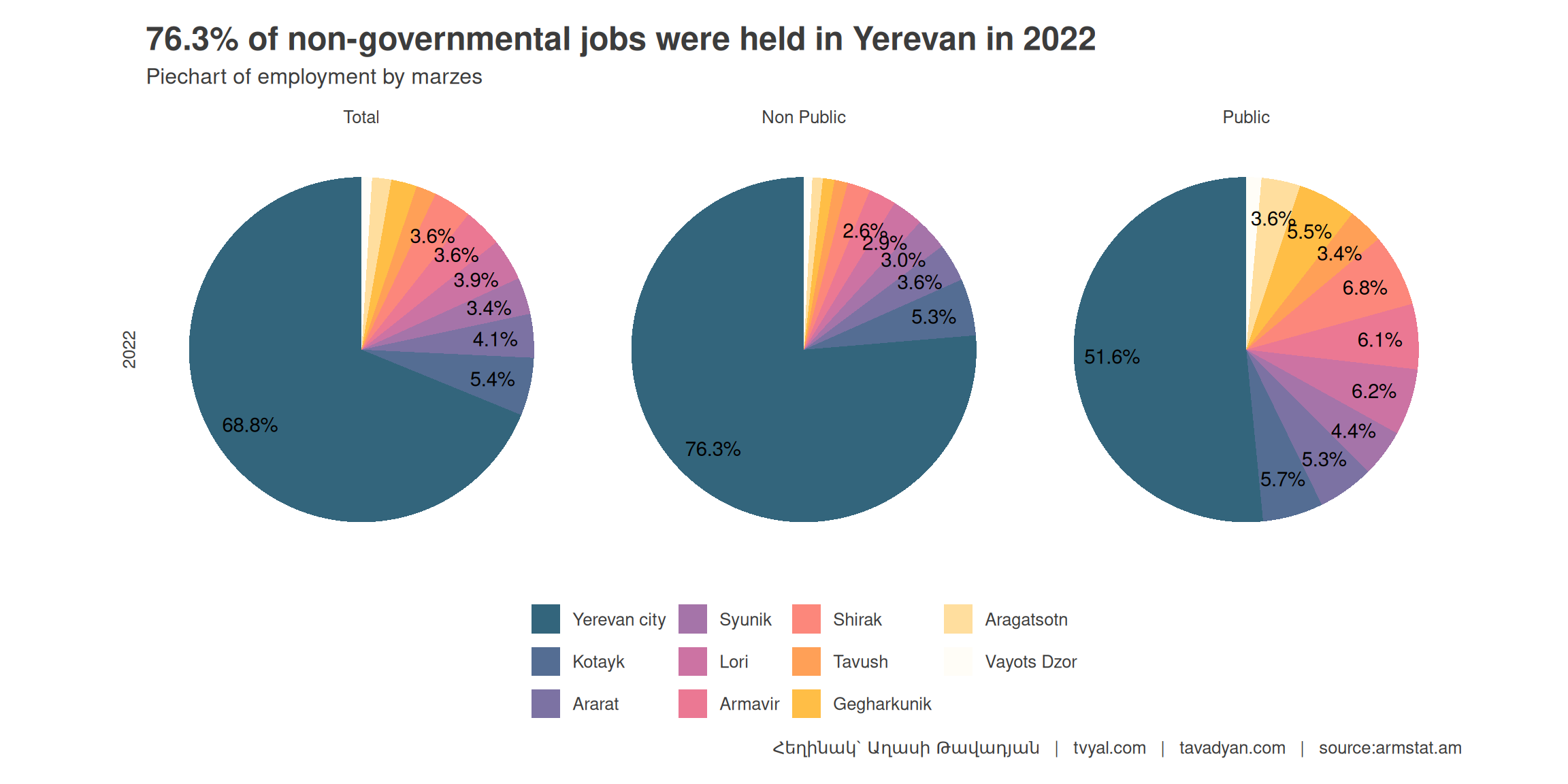
In 2022, 76.3 percent of non-public sector jobs were registered in Yerevan, a noticeable increase compared to 2019, when 73.5 percent of jobs were in Yerevan. Thus, private sector jobs have primarily grown in Yerevan. According to our calculations, 78 percent of private sector jobs will be registered in Yerevan by December 2023. This is a concerning trend, the regions are developing disproportionately compared to Yerevan. In the regions, incomes are primarily provided by public sector jobs. Considering Yerevan’s administrative status, 51.6 percent of non-public sector jobs were concentrated in Yerevan in 2022.
Figure 2. Employment by Region
In the last three years (2022 compared to 2019), jobs in the regions grew by only 4.7 percent, while in Yerevan, they grew by 19.5 percent. Private sector jobs in the regions increased by 7.2 percent, while in Yerevan, the growth was more significant, at 24.5 percent. The lowest job growth was recorded in Lori, with only a 2.5 percent increase. During this period, public sector jobs in Ararat province grew by 6.4 percent, reaching 10,975 employees, and in Yerevan, they increased from 101,744 employees to 107,039 employees, a 5.2 percent growth.
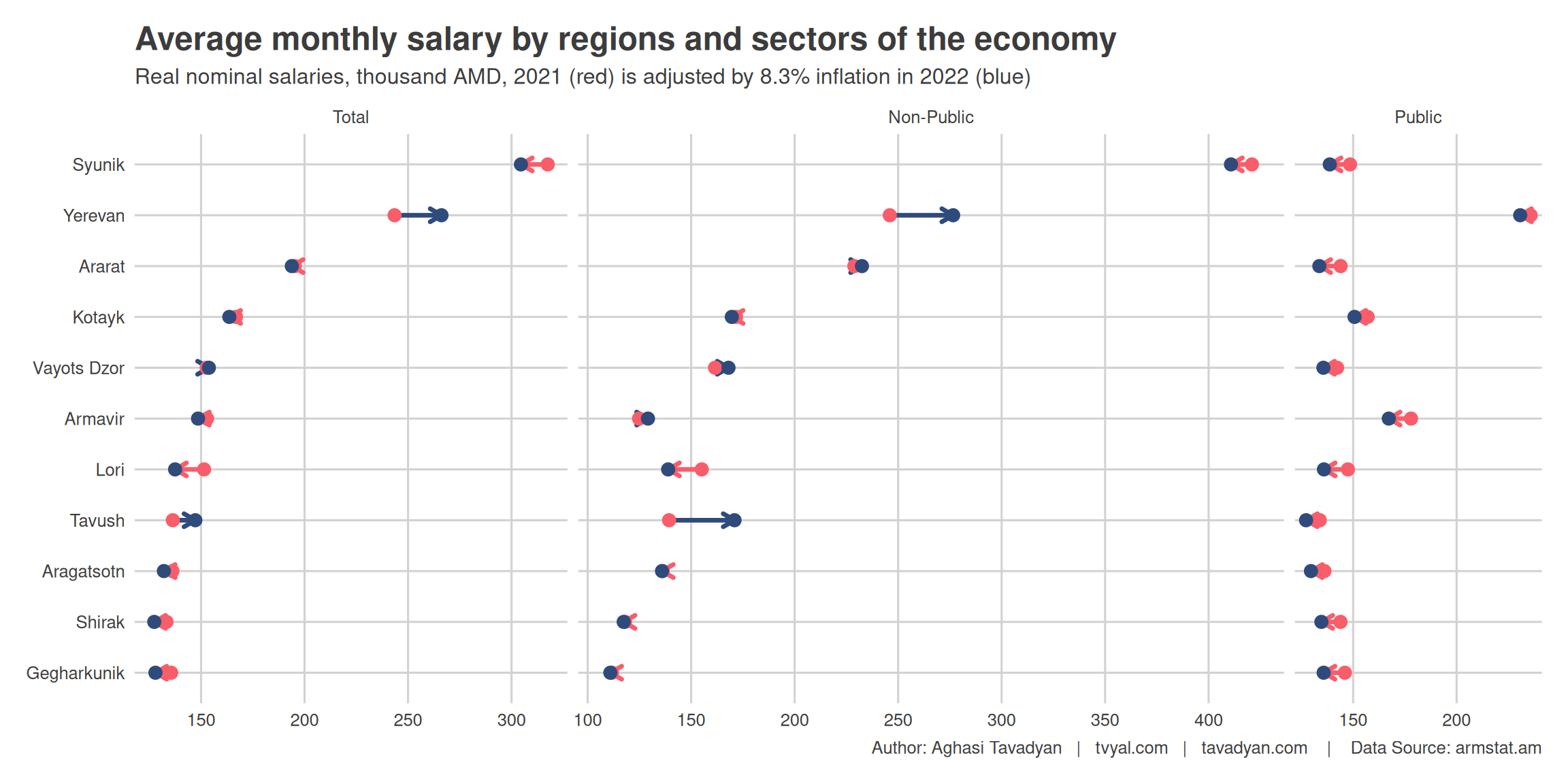
Let’s examine the average monthly nominal wage by region and economic sector. We have considered real wages, which have been weighted by 2022 purchasing power.
As seen in the figure, real average wages in the public sector decreased in all regions in 2022. This decline was influenced by the 8.3 percent inflation recorded in 2022. The average wage in the public sector in 2022 was 186,940 drams, with a nominal increase of 4.3 percent. However, real growth decreased by -4 percent.
In 2023, a deflation of 0.6 percent was recorded, which did not reduce the growth of real wages. If we consider that public sector wages also ensured a 4 percent growth in 2023 and no inflation was recorded, then public sector wages should be compared with 2021 purchasing power. It should be noted that in 2022, 207,591 people, or 30.3 percent of the total registered workforce, were employed in the public sector.
It is important to note that the 0.6 percent deflation does not align with Article 4 of the Law on the State Budget of the Republic of Armenia, which requires “being guided by a target indicator within the permissible range of 12-month inflation fluctuations of 4±1.5 percentage points.”
Table 3. Average Monthly Nominal Wage by Region and Economic Sector
We note that this analysis is the 3rd part of the household analysis.
Read previous analyses here:
- 🏠💰📉 Households have become poorer
- 👨👩👧👦✨ Strong family, rich family
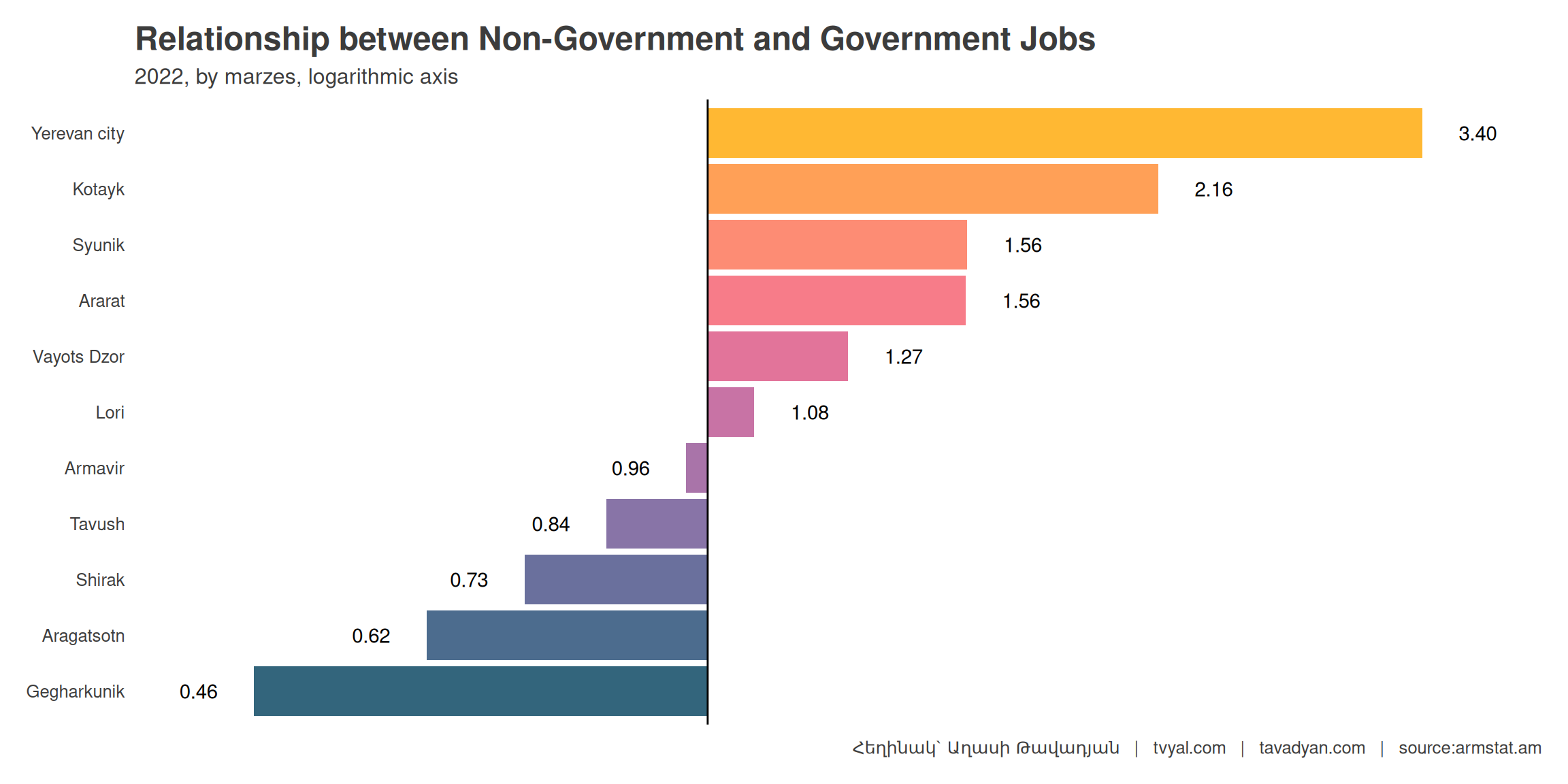
As seen in Figure 4, the lowest non-public sector wages were recorded in Gegharkunik, Shirak, and Aragatsotn regions, where, considering inflation, real wages in 2022 were lower compared to 2021. In these regions, the share of public sector employees is larger than the number of non-public sector employees. In Gegharkunik, more than twice as many employees are registered in the public sector than in the non-public sector. This further emphasizes that public sector jobs primarily contribute to income generation in the regions.
Figure 4. Ratio of Non-Public to Public Sector Jobs:
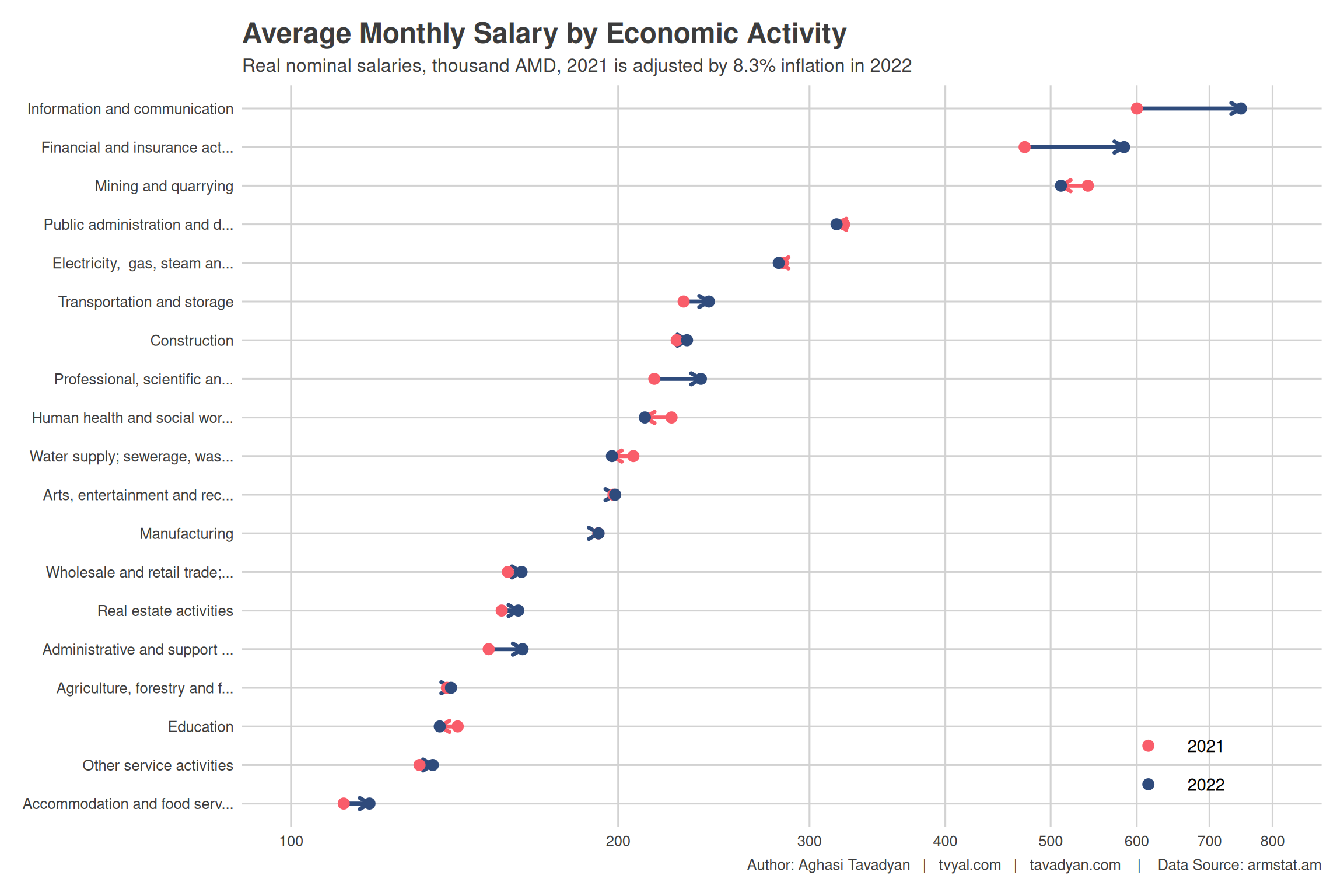
Let’s examine the average wage by economic activity. In 2022, the information and communication, as well as financial services sectors, recorded the highest and fastest growth, with nominal wage increases in these sectors being 35% and 33.7% respectively.
In 2022, 21,449 people were employed in the finance and insurance sector, and 40,301 people in the information and communication sector. Information and communication accounted for 5.9% of total registered employees. This sector has the highest average wage, 748,235 drams. Notably, IT accounted for 71.1 percent of this sector (28,668 employees). The average wage in the IT sector in 2022 was 917,192 drams. In 2023, the average IT wage already exceeded 1 million drams. If we exclude the IT sector from the Information and Communication scope, the average wage in the communication sector alone was 331,863 drams.
Figure 5. Average Monthly Wage by Economic Activity
Until 2021, the education sector was the largest employer, with 116,445 employees, accounting for 17% of the workforce. In 2022, the “Wholesale and retail trade, repair of motor vehicles and motorcycles” sector became the largest employer, employing 121,953 people, or 17.8% of the 2022 workforce.
The education sector is of paramount importance for educating future generations, and over 17 percent of the workforce is employed in this sector. The average monthly nominal wage (including taxes) in this sector in 2022 was only 132,756 AMD. Considering inflation compared to the previous year, the real wage in the public sector for this sector decreased by 5 percent.
Conclusions
Wages and jobs have primarily grown in Yerevan, in the private sector. The most significant wage growth is observed in the IT and financial sectors.
It is not accurate to rely solely on the increase in the arithmetic mean wage. The growth in wages of relatively high-income earners has a significant impact on this indicator. In recent years, an increase in average wages has been observed, mainly due to the influence of high-earners. It is also important to consider the median wage, as it reflects the income of the average statistical person. Our second study showed that the middle class has the most children, emphasizing the importance of a strong family as the foundation of a strong state.
The average annual inflation in Armenia is 4 percent. It is important to ensure that the annual wage growth for the average worker exceeds 4 percent, especially in the education sector.
A problem also arises from the significant labor imbalance between Yerevan and other regions. The promotion of IT organizations and the Law on Income Tax Refund primarily contribute to the creation and increase of private wages in the IT, construction, and consequently, services and financial sectors, which are mainly concentrated in Yerevan. This trend deepens the development disparity between Yerevan and the regions, as new jobs are primarily created in the capital. It is necessary to provide certain incentives to organizations that wish to operate in regions where the number of public sector employees exceeds the number of private sector jobs.
Most importantly, it is necessary to prioritize the middle class and the formation of their incomes, as this class is the cornerstone of society.
* All data for this analysis are taken from official sources, specifically the 2019, 2020, 2021, 2022 reports of the Statistical Committee of the Republic of Armenia on wages, number of employees, and organizations, and Armenia’s monthly consumer price index. Wages have been adjusted by monthly cumulative inflation, meaning each indicator represents purchasing power at the end of 2022. Official data on 2023 wages are not yet available. The calculations are fully available on GitHub; they can be verified by visiting our GitHub page, where the data, calculation, and plot codes are provided.