
Capital Outflow
Analysis of International Money Transfers
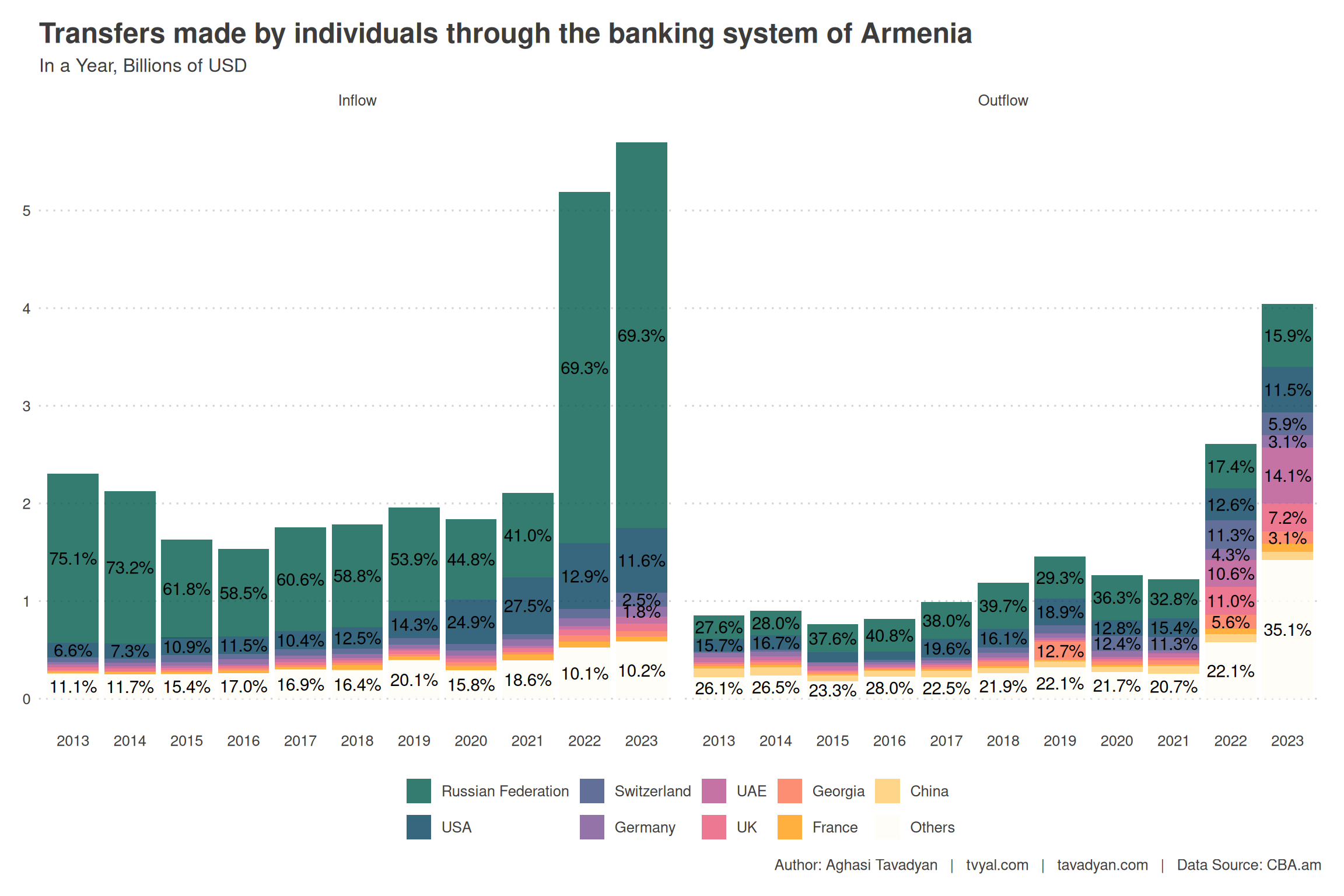
2022 was an unprecedented year in terms of the growth of transfers from individuals to Armenian banks, which grew by 2.5 times, reaching 5.2 billion dollars from 2.1 billion dollars. In 2022 the inflow of foreign currency to the banking system grew by 2.5 times, and the outflow by 2.1 times, while net inflow in 2022 grew by almost 3 times, from 0.9 billion dollars to 2.9 billion dollars. This growth was mainly driven by bank transfers received from Russia, which quadrupled, reaching 3.6 billion dollars from 865 million dollars. As a result, a significant amount of money was transferred to Armenia, mostly in dollars, which led to an increase in dollar supply, and also contributed to the strengthening of the dram recorded in April-June 2022, when the dollar went from 480 drams to 405 drams.
Chart 1. Money transfers made through the RA banking system (annually, billion dollars)
As a result of such a large capital inflow, Armenia’s commercial banks recorded a net profit of 255.6 billion drams in 2022, which is about 3 times more than the previous year. The largest profit was recorded by Ardshinbank at 62.2 billion drams. This means the banking system recorded a profit of 0.58 billion dollars in 2022. Because the income tax return law operates in Armenia, the funds that entered the banking system were mainly invested in construction.
You can read about the future risks of the real estate market in the following material: 🏠🔄🤔 13.5% Growth in Real Estate Prices, 40.9% Decline in Transactions.
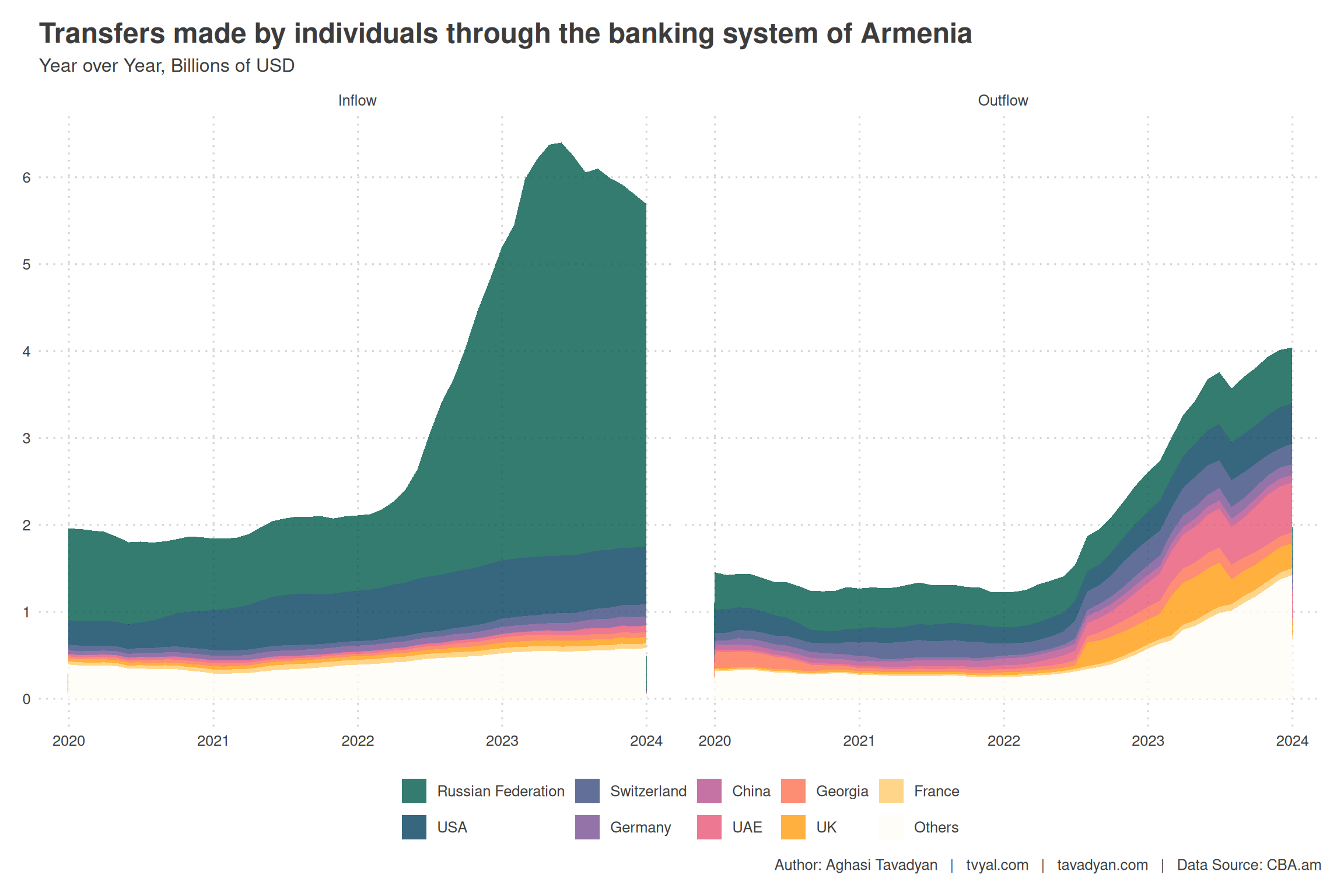
Looking at 2023, bank transfers recorded a 9.7 percent growth in 2023 compared to the significant 2.5 times growth in 2022. An annual growth of 9.7 percent indicates growth at first glance, but if we look at the monthly breakdown (Chart 2), it is clearly visible that the peak point for 12-month money transfers was recorded in May 2023 at 6.4 billion, which is 11 percent less than the year-end financial inflow indicator of 5.7 billion dollars. The money that exited the banking system grew by 55 percent, reaching 4 billion dollars. The net inflow contracted by 36 percent, from 2.6 billion to 1.6 billion dollars. We also note that 5 months ago we forecasted a contraction in funds entering the banking system.
Chart 2. Money transfers made through the RA banking system (on a 12-month basis, billion US dollars)
In fact, a capital outflow was recorded in 2023 and the same trend, all other conditions being equal, will continue in 2024. In 2023, the net profit of the banking system contracted by 9 percent, becoming around 230 billion drams.
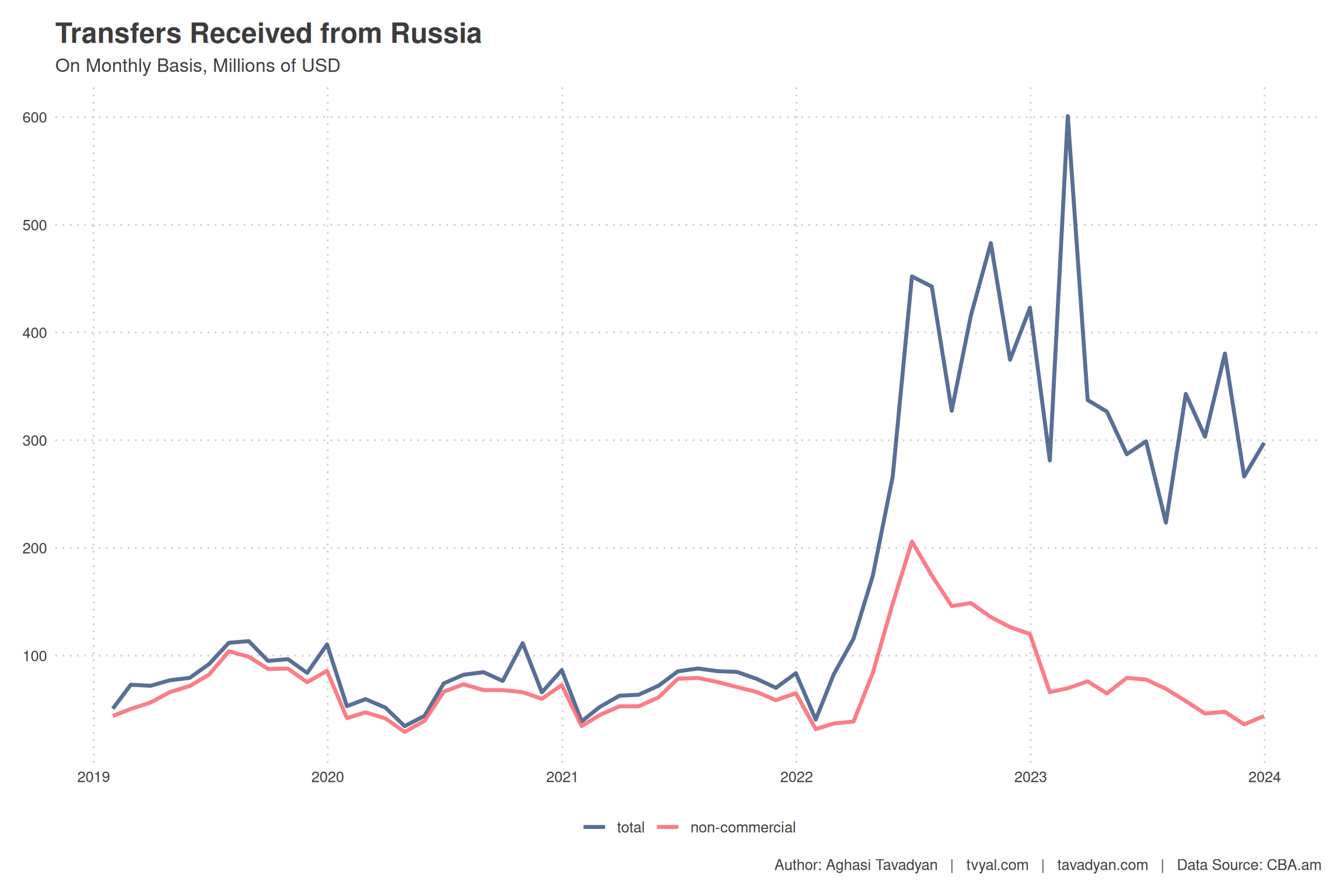
69.3 percent of money transfers made by individuals through Armenia’s banking system (3,946 million dollars) were received from the Russian Federation, and 11.6 percent from the USA (663 million dollars). In 2023, 81.4 percent of money transfers received from Russia were for non-commercial purposes. Let us also examine the bank transfers made separately from the RF (Chart 3). As can be seen from the chart, up until 2022 the overwhelming majority of transfers were non-commercial transfers, and starting from 2022 the overwhelming majority of transfers have a commercial nature. Let me also note that the non-commercial transfers / GDP ratio has experienced a decline and in 2023 is at a record low level of 6 percent.
Chart 3. Non-commercial and total bank transfers received from Russia (on a monthly basis, million US dollars)
Since bank transfers have a significant impact on the net profit of the banking system and, as a consequence, on its health status, let us also examine the forecasts for bank transfers for the next 2 years. Two time series forecasting models were examined: exponential smoothing (ets) and seasonal-trend decomposition (stlm), which were applied to monthly indicators and consolidated on a 12-month basis.
Chart 4. Forecast of money flows made through the RA banking system (on a 12-month basis, billion US dollars)
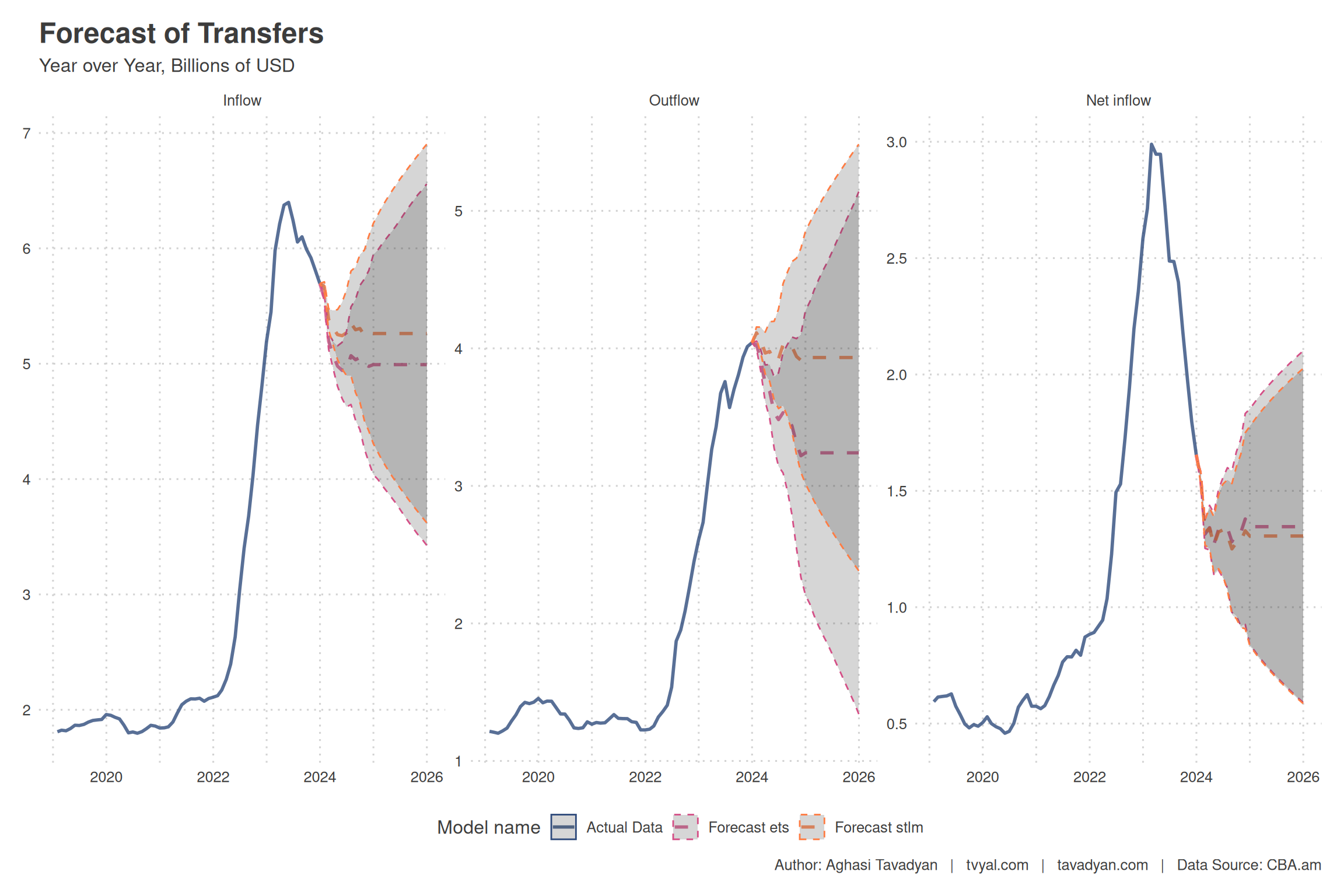
As can be seen from the forecasts, bank transfers will contract by about 7 percent in 2024, likely reaching about 5.3 billion dollars from 5.7. The outflow from the banking system will stabilize and will be at almost the same level as in 2023. The net inflow to the banking system could contract by an additional 21 percent in 2024.
Table 1. Money transfers made through the RA banking system and forecast
| Transfers Made Through the Banking System of Armenia | ||||||
| Year | Inflow | Outflow | Net Inflow | |||
| Billion USD | growth % | Billion USD | growth % | Billion USD | growth % | |
| 2018 | 1.78 | 1.6% | 1.19 | 20.0% | 0.60 | -22.2% |
| 2019 | 1.96 | 9.7% | 1.45 | 22.4% | 0.50 | -15.5% |
| 2020 | 1.84 | -6.0% | 1.27 | -12.9% | 0.57 | 14.0% |
| 2021 | 2.11 | 14.5% | 1.23 | -3.3% | 0.88 | 53.8% |
| 2022 | 5.19 | 2.46 times | 2.61 | 2.13 times | 2.58 | 2.92 times |
| 2023 | 5.70 | 9.7% | 4.04 | 55.0% | 1.65 | -36.0% |
| 2024 ets forecast | 5.26 (from 4.31 to 6.22) | -7.6% (from -24.4% to 9.2%) | 3.93 (from 3.02 to 4.85) | -2.7% (from -25.4% to 20.1%) | 1.31 (from 0.83 to 1.78) | -21.1% (from -49.6% to 7.4%) |
In many of the datasets we studied, there are signs of a possible economic decline. One of these indicators is money transfers through the banking system received from other states, made by individuals. The continuation of the capital outflow that began in mid-2023 represents a clear risk from the perspective of securing the net profit and health of the banking system. Since transfers through the banking system and the net profit of the banking system are interconnected, one can assume that a contraction in banking system profit will also be recorded in 2024. This is a clear challenge for our economy in 2024, and the significant economic growth primarily secured by the influx of Russian capital in the previous 2 years should not be allowed to obscure the real picture. In the span of the coming 1 year, the banking system and the economy could be threatened by a shock. Especially when the majority of the capital within Armenia has been invested in construction, and the World Bank predicts a global economic anti-record for 2024, according to which global economic growth in the first half of this decade could be the weakest in the last 30 years. It is necessary to realistically assess our economic capabilities.
* Let us note that there is a certain terminological misunderstanding between the terms remittances and bank transfers. Bank transfers include all types of transfers, including for commercial purposes. Remittances are only non-commercial transfers made by individuals, the English term calls this “remittances”. It causes confusion that the English term “transfers” refers to all kinds of commercial and non-commercial transfers. In the charts, the English term “transfers” represents all kinds of commercial and non-commercial money transfers. All data in this analysis are taken from official sources, specifically from Central Bank data. The calculations and forecasting code are fully available on github, they can be checked by visiting our github page, where the data, calculation, and chart codes are provided.