10 Years of Agriculture Collapse
The Transition from Agriculture to a Consumer Economy
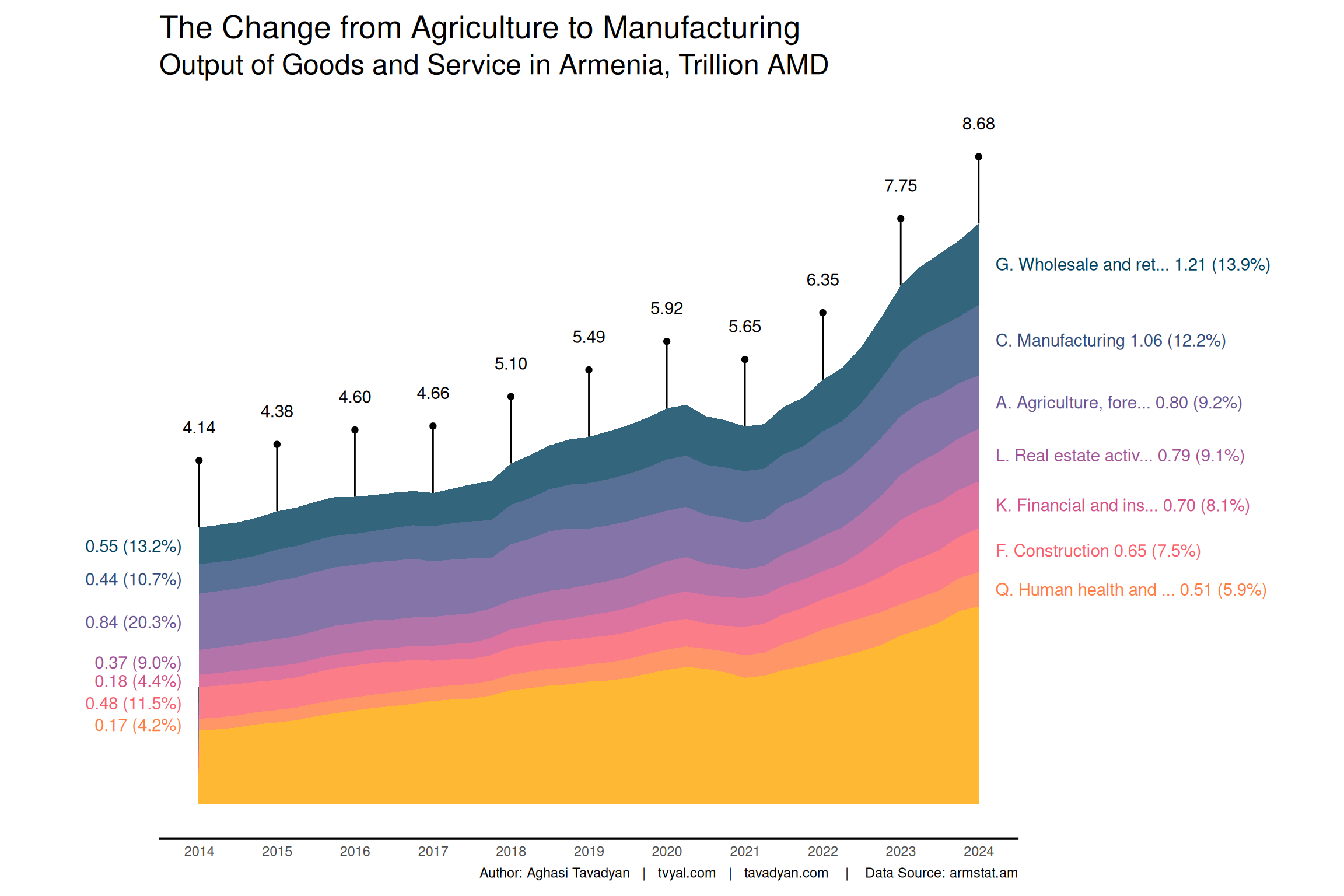
Overall, in these 10 years, GDP has more than doubled, amounting to 4.14 trillion drams in 2013 and already 8.68 trillion drams in 2023. We note that if we consider the cumulative inflation of these 10 years, the real economic growth during this period was 55 percent. 10 years ago in 2013, 20.3 percent of Armenia’s GDP was provided by agriculture, which amounted to 840 billion drams, trade was in second place making up 13.2 percent of GDP or 550 billion drams.
In 2023 the picture is reversed: “Wholesale and retail trade; repair of motor vehicles and motorcycles” is already in first place, providing 13.9 percent of GDP (1,210 billion drams), while agriculture has fallen from a 20.3 percent share to 9.2 percent (800 billion drams) in these 10 years.
It is remarkable that in these 10 years GDP has grown by more than 2 times, while agriculture has registered almost no growth, growing by a negligible 5 percent. Industry has grown by 2.5 times in these 10 years. Agriculture is already in 3rd place after industry and wholesale and retail trade. In fact, the volume of agriculture has contracted by 5 percent, and if we also consider inflation, the real contraction of agriculture over 10 years was 30 percent.
Let us also examine the construction sector. Construction amounted to 480 billion drams or 11.5% of GDP in 2013, and 650 billion drams in 2023, but its specific weight dropped to 7.5 percent. If we consider inflation, then real growth in this sector is almost zero. The real growth of real estate related activities (L) was 55 percent.
Chart 1. Change in output of goods and services in GDP
Agriculture has had negative growth over the last 4 years and negatively contributes to economic growth.
Let us examine which branches of output of goods and services had the most significant growth during these 10 years.
As can be seen, the only branch that contracted during these 10 years is agriculture. If we also consider inflation, the growth trend was negative. In fact, almost all branches registered a growth of 2 times or more, except for agriculture.
Chart 2. Comparison of GDP structure growth from 2013 to 2023
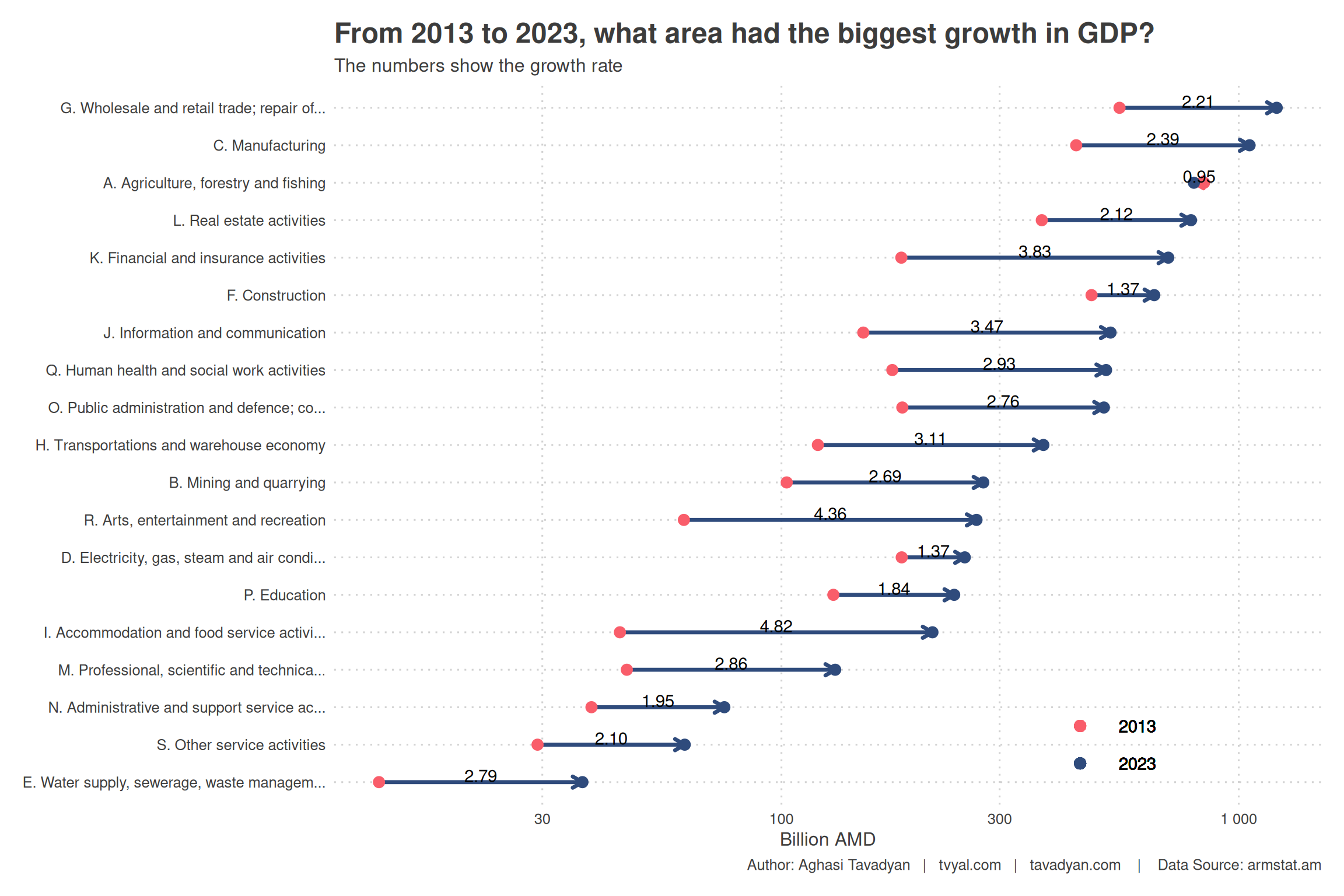
The largest growth was registered by the (I) Accommodation and food service activities and (R) Arts, entertainment and recreation sectors, which have grown by more than 4.8 and 4.3 times respectively over these 10 years. This primarily speaks to the development of tourism in Armenia.
Financial and insurance activities grew by more than 3.8 times.
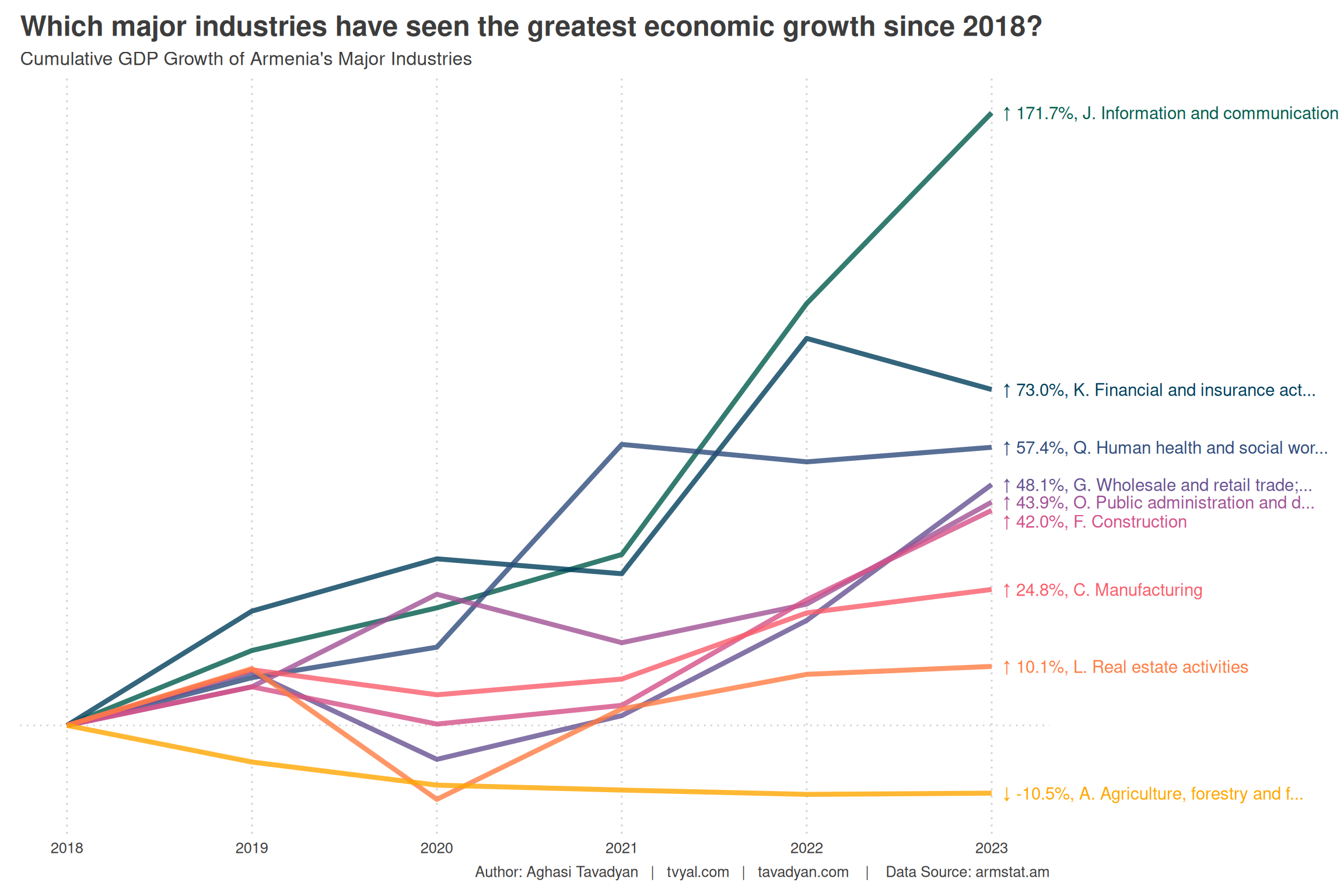
Chart 3. Which main branches secured the largest economic growth since 2018
Read about which branches contribute to economic growth:
🇦🇲📊🏗️ The Main Reasons for Armenia’s 8.7% Economic Growth in 2023.
The Dangers of 7 Percent Economic Growth
Stable and long-term high economic growth requires qualitative changes in the economy, specifically the expansion of production capacities, which is secured by the stable addition of value added. The high economic growth of 2022 and 2023 was primarily secured by trade, that is, consumption and construction, which do not ensure the creation of long-term value added.
Let us recall that in the period from 2002 to 2007, double-digit economic growth was also primarily driven by the growth of construction and consumption. There is a probability that the phenomenon of the 2002-2008 period will be repeated. During that time, the US Federal Reserve lowered its interest rate and a quite large amount of financial funds appeared in the global market, which impacted developing states with multiplicative effects, including Armenia. During that period there was an economic growth of more than 10 percent, primarily driven by external factors. A small portion of the growth in those years was driven by domestic productivity. The cessation of financial inflows and the financial crisis of 2008 led to a collapse in construction and a quite large amount of empty apartments on Northern Avenue.
Armenia’s average economic growth over the last 10 years was 4.5 percent. In any system, if structural and qualitative changes are not present, the system tends to return to the long-term average indicator.
We note that in the 2024 budget plan the government forecasts 7 percent economic growth. Any deviation from this target, say providing a more realistic 4 percent economic growth instead of the expected 7 percent economic growth, could result in about 80 billion drams or 3 percent lower budget revenues than planned in the budget. Of course, a reserve fund of around 155.9 billion drams can mitigate the negative impact, although this is also dangerous with the growth of state debt. This could also create certain problems from the perspective of the government’s creditworthiness.
The economic growth of 2022-2023 is also primarily driven by external factors. The situation of 2002-2008 could be repeated because this growth was formed by an inflow of financial funds and, as a consequence, by consumption growth; the inflow of financial funds primarily stimulated construction. We note that during 2023 a contraction in financial inflows and a 55 percent growth in the outflow of financial funds is already being observed.
Read the analysis of capital outflow from Armenia in 2023:
Media Announcements
The following topics were touched upon in the interview:
- Yerevan was more expensive than Moscow in the summer of 2023
- Relocants are leaving Armenia
- Construction boom in Armenia: the government is repeating Kocharyan’s mistakes
- What advantages will the European path give to Armenia’s economy