The Dram's Drama: Why the Dram Depreciates and Appreciates
The appreciation of the dram over the last month has caused some anxiety in the market. This analysis will examine the history of the dram’s exchange rate changes and will explain what is driving the dram’s appreciation.
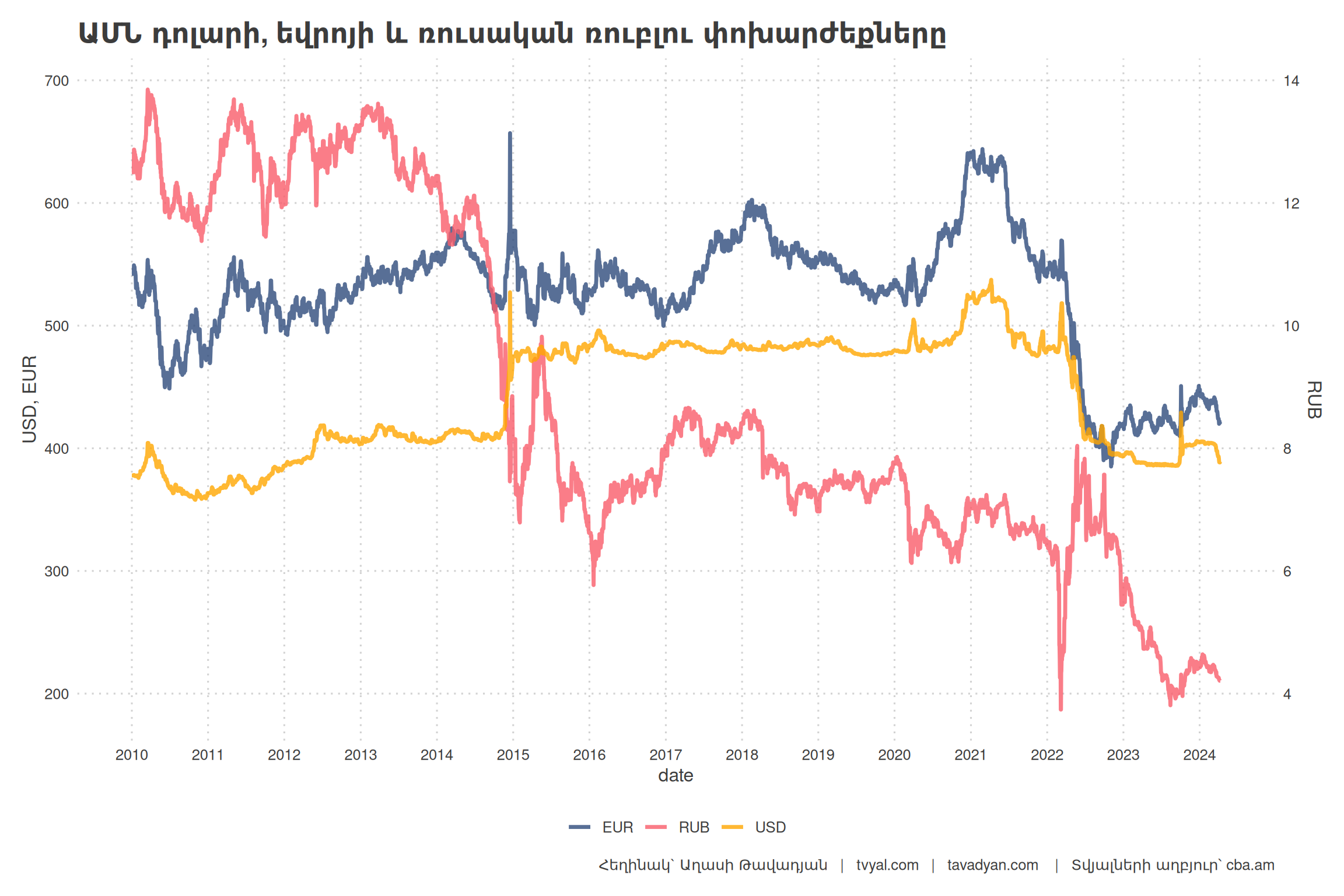
First let us look at the exchange rates of the US dollar, euro, and Russian ruble, which are presented in the first chart.
Chart 1.
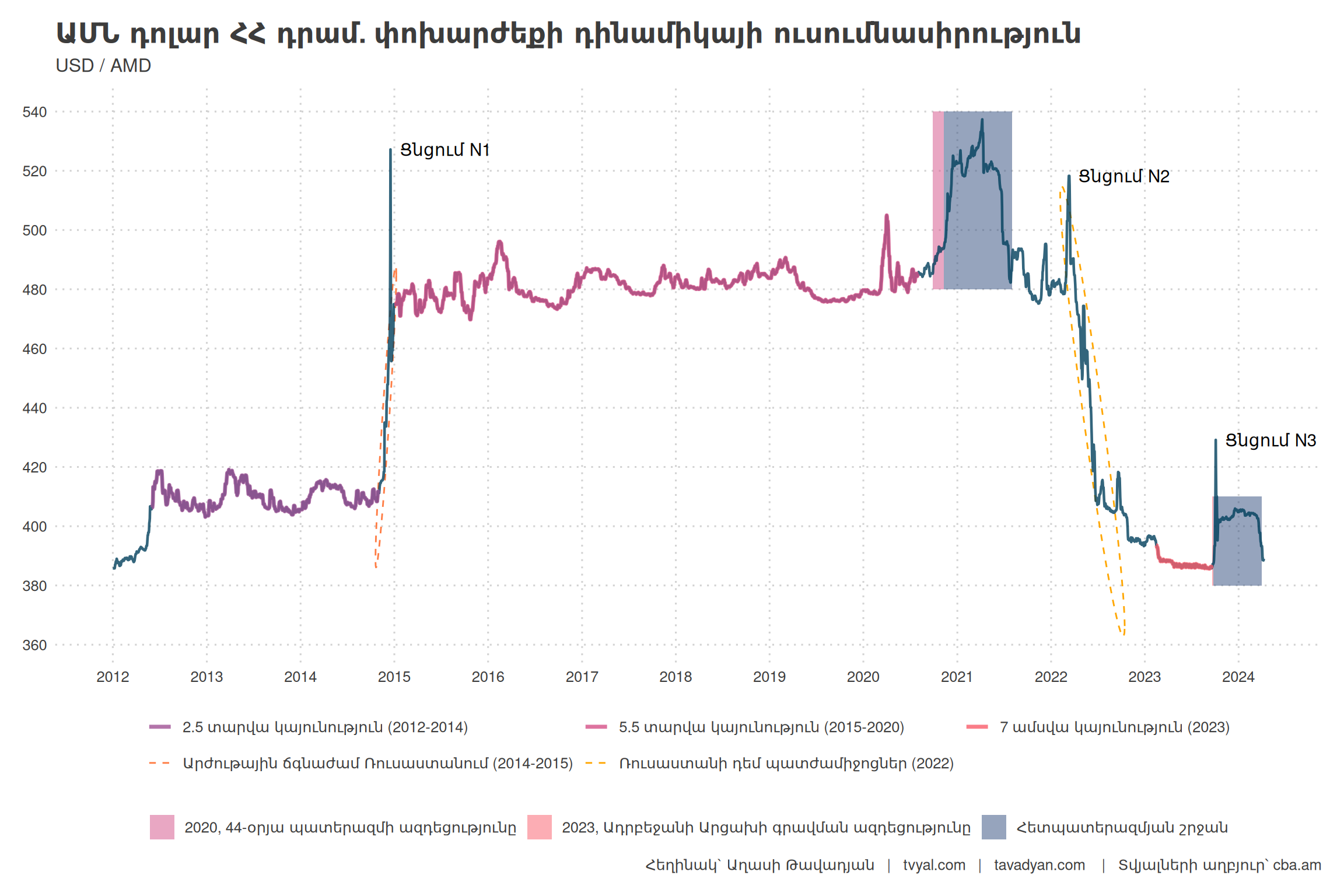
The second chart depicts the history of the US dollar’s value against the AMD starting from 2012. The chart shows 3 periods of stability, 3 shocks, 2 Russian Federation exchange rate crises, and the impact of the loss of Artsakh.
From 2012 until the end of 2014 the US dollar exchange rate was relatively stable around 410 drams. In the second half of 2014 a financial crisis began in Russia, which was driven by a drop in global oil prices and sanctions against Russia that were applied following the annexation of the Crimean Peninsula to Russia. Overall these events depreciated all regional currencies including the euro. Notably, during the 2014-2015 period the euro depreciated more against the US dollar than the dram did. However, unlike the euro whose depreciation was gradual, the dram’s depreciation was short-term, unexpected, and destabilizing.
In the chart the sudden shift of the value of one US dollar from 410 to 480 drams is marked as “Shock N1”. This shock was due to the Central Bank no longer being able to maintain the US dollar exchange rate around 410 drams through market interventions, and the dram depreciated in panic reaching up to 580 drams. This caused panic in the market for a few days, after which the situation stabilized with one US dollar around 480 drams. This stability lasted for 5.5 years until the fall of 2020.
Chart 2.
During this period the 44-day war of 2020 took place. It should be noted that a banknote is similar to faith. A banknote carries no intrinsic real value; rather, society has a collective faith in the value of the banknote. When faith in the economy and consequently in the currency is high, the latter appreciates, and in the case of a loss of faith it depreciates.
After the 44-day war of 2020 as well as after the loss of Artsakh in 2023, a portion of society lost faith in the economy and consequently in the dram. This led to the selling of the dram and the purchase of foreign currency, resulting in the dram starting to depreciate in October 2020. Let us note that members of society cannot hold purchased foreign currency for long, because in Armenia no currency other than the dram can serve as a means of payment. Therefore, after some time the accumulated foreign currency is sold back and drams are purchased, which re-appreciates the dram back to the post-war level.
Shock N2 depicted in the chart occurred on March 11, 2022, which was a reaction to the Russian-Ukrainian conflict and sanctions against Russia. This led to a sharp depreciation of the Russian ruble during that time. Similar to the events of December 2014, the Armenian market also expected the dram to depreciate like the Russian ruble, which caused some panic in the domestic market. Nevertheless, this time the sanctions against Russia resulted in a quite large outflow of foreign currency from Russia.
During 2022 transfers to the Armenian banking system grew by 2.5 times mostly from Russia, the inflow of which increased by 4.5 times during that year. As a result of all this, the net profit of the Armenian banking system grew 3 times in 2022. The dollar can be viewed as a commodity. During 2022 this commodity flooded the Armenian market and as a result the dollar began to depreciate against the dram, while the dram strengthened. Thus in February 2022, as a result of the start of the Russian-Ukrainian conflict, the market expected the dram to start depreciating just like the events at the end of 2014, however due to a significant outflow of foreign currency from Russia the dram appreciated in the opposite direction of the initial expectation. Following these events from the beginning of 2023 was the 3rd period of stability for the dollar-dram exchange rate, which lasted a relatively short time due to the capture of Artsakh by Azerbaijan.
You may also be interested in the following analysis:
The capture of Artsakh (like the 44-day war in 2020) resulted in a loss of faith in the dram and the economy by a mass of society. A segment of society began to sell drams and buy foreign currency, which led to the depreciation of the dram. Shock N3 was recorded at this time. During this period speculative players in the economy, mostly exchange offices, sensing a repeat of the October 2020 scenario, started buying dollars and on October 4, 2023 the price of the dollar was speculatively raised reaching up to 450 drams per dollar. Of course, initially the depreciation of the dram was natural, but it began to take on a speculative nature, as a result of which it was mainly the exchange offices that suffered.
Chart 3.
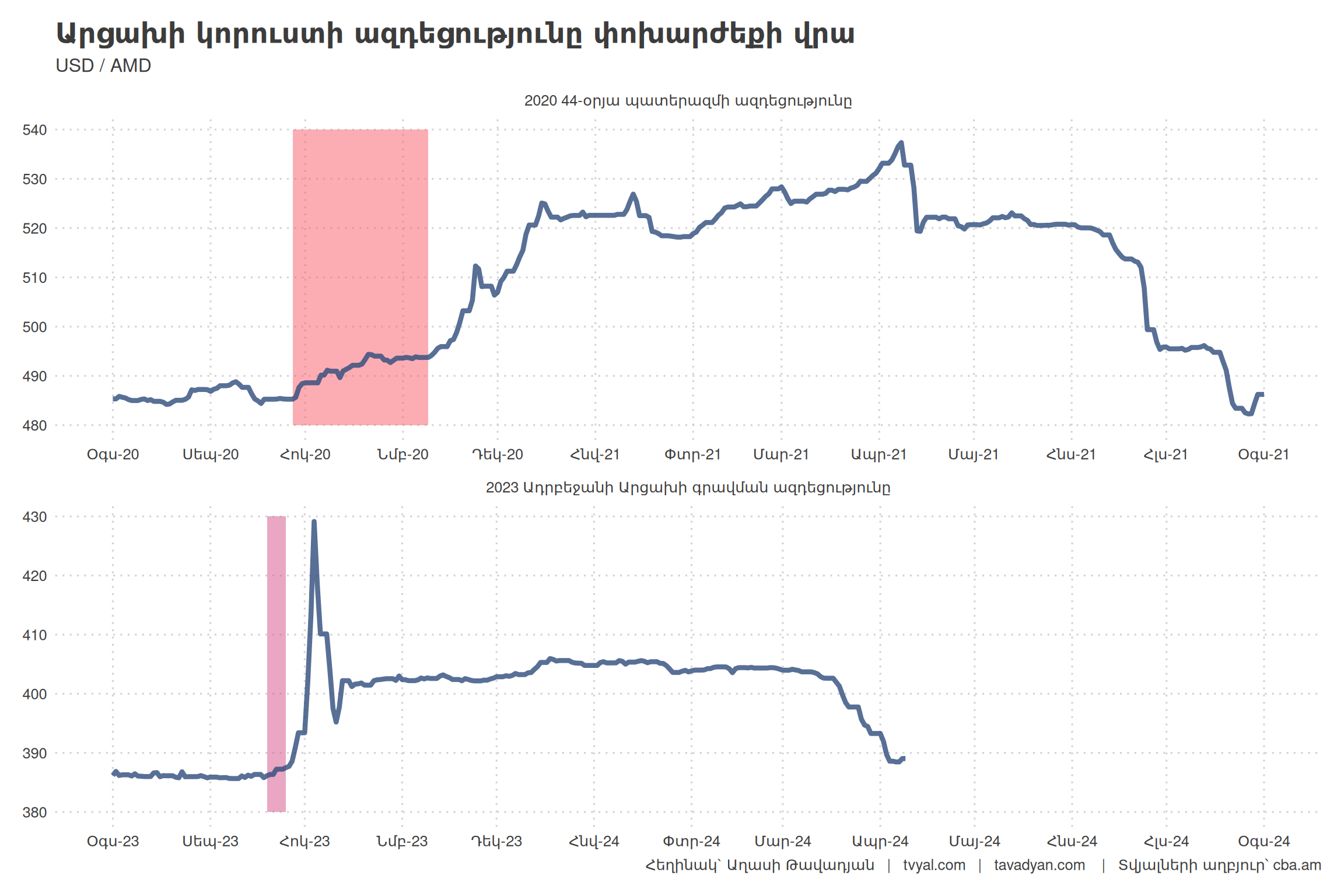
Over the past few days (since mid-March 2024) an appreciation of the dram has been observed in the market, which as in 2020-21 is due to the fact that foreign currency is not an official means of payment in Armenia. People who kept foreign currency after the loss of Artsakh in October 2022 are forced to sell it back, which depreciates the dram. The dollar exchange rate will revert back to the September 2022 level.
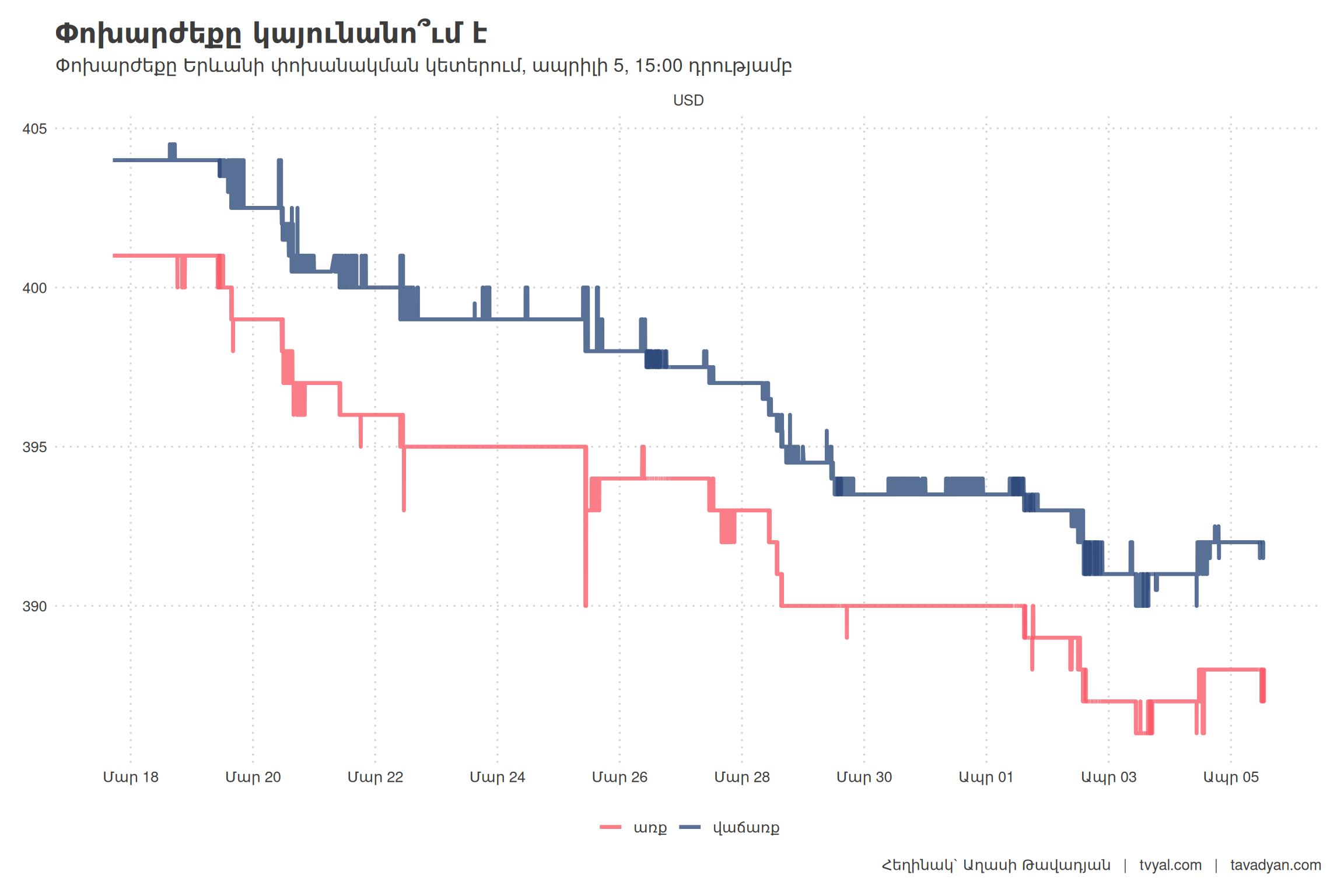
The fourth chart depicts the buying and selling exchange rates of Yerevan exchange offices over the past month. Overall it can be seen from the chart that the exchange market has already calmed down and found new equilibrium points.
During times of calm the Central Bank of Armenia to some extent pegs the exchange rate to the dollar. Let us note that during the stability period presented in the 2nd chart the dollar exchange rate fluctuated less against the dram than many exchange rates loosely pegged to the dollar. If there are no major shocks in the market, the exchange rate will remain at this new equilibrium point.
The capture of Artsakh like the 44-day war in 2020 resulted in a loss of faith in the dram and the economy by a mass of society. A segment of society began to sell drams and buy foreign currency, which depreciated the dram. Shock N3 was recorded at this time. During this period speculative players in the economy, mostly exchange offices, sensing a repeat of the October 2020 scenario started buying dollars and on October 4, 2023 the price of the dollar was speculatively raised reaching up to 450 drams per dollar. Of course initially the depreciation of the dram was natural, but it began to take on a speculative nature, as a result of which exchange offices mainly suffered.
Chart 4.
Consequences of Dram Appreciation
The appreciation of the dram will have a negative impact on the export of goods and services, as well as on bank transfers.
In 2023 the 55 percent export growth was mainly secured through the re-export of gold and diamonds, whose specific weight accounted for 28 percent of exports. However, many traditional export directions recorded a decline in 2022. The appreciation of the dram will make the export of Armenia’s real output to foreign markets more expensive. In addition, the appreciation of the dram will lead to higher prices for services in the tourism and information technology sectors.
You may also be interested in the following analysis:
📈📉❓ Export Growth of 55.3 Percent or Decline of -12.2 Percent.
Bank transfers for commercial purposes played a crucial role in the 2022 economic growth. Now an outflow of bank capital and a slowdown of inflows are being recorded. Inflows for commercial purposes will depreciate as a consequence of the dram’s appreciation.
A depreciation of the dram will also lead to an increase in the volume of the state debt in dollars due to the lowered cost of servicing dollar liabilities. This contains certain risks. At the same time, a depreciation of the dram in the short term could also bring about a reduction in the price of gasoline by around 20 drams. However, this effect may last for a short period as increases in global oil and gasoline prices are currently being recorded.
PODCAST !!
Let’s Talk Numbers #2
High Economic Activity in Armenia: At What Cost?
- 🔘 The economic activity index in February
- 🔘 What is hidden behind the high indicator
- 🔘 Which sectors are recording growth
- 🔘 What economic growth in Armenia will be like
On How2B we “talk in numbers” with economist Aghasi Tavadyan.
An analysis on the topic is presented on the tvyal.com website: 🌿🤨💎 Precious Effect: Reasons for the 2024 Economic Growth