2 Million Armenians in Armenia by 2100
Analysis of RA Demographics
According to population movement forecasts, Armenia has a most serious demographic problem: In 2100 only 2 million Armenians will live in Armenia, according to the World Population Prospects database (see the first chart). It is expected that Armenia’s population will either remain mono-ethnic and shrink over the years, or a portion of the population will be replaced by other nationalities.
By 2100, all other conditions being equal, 2 million Armenians will live in Armenia.
Chart 1.
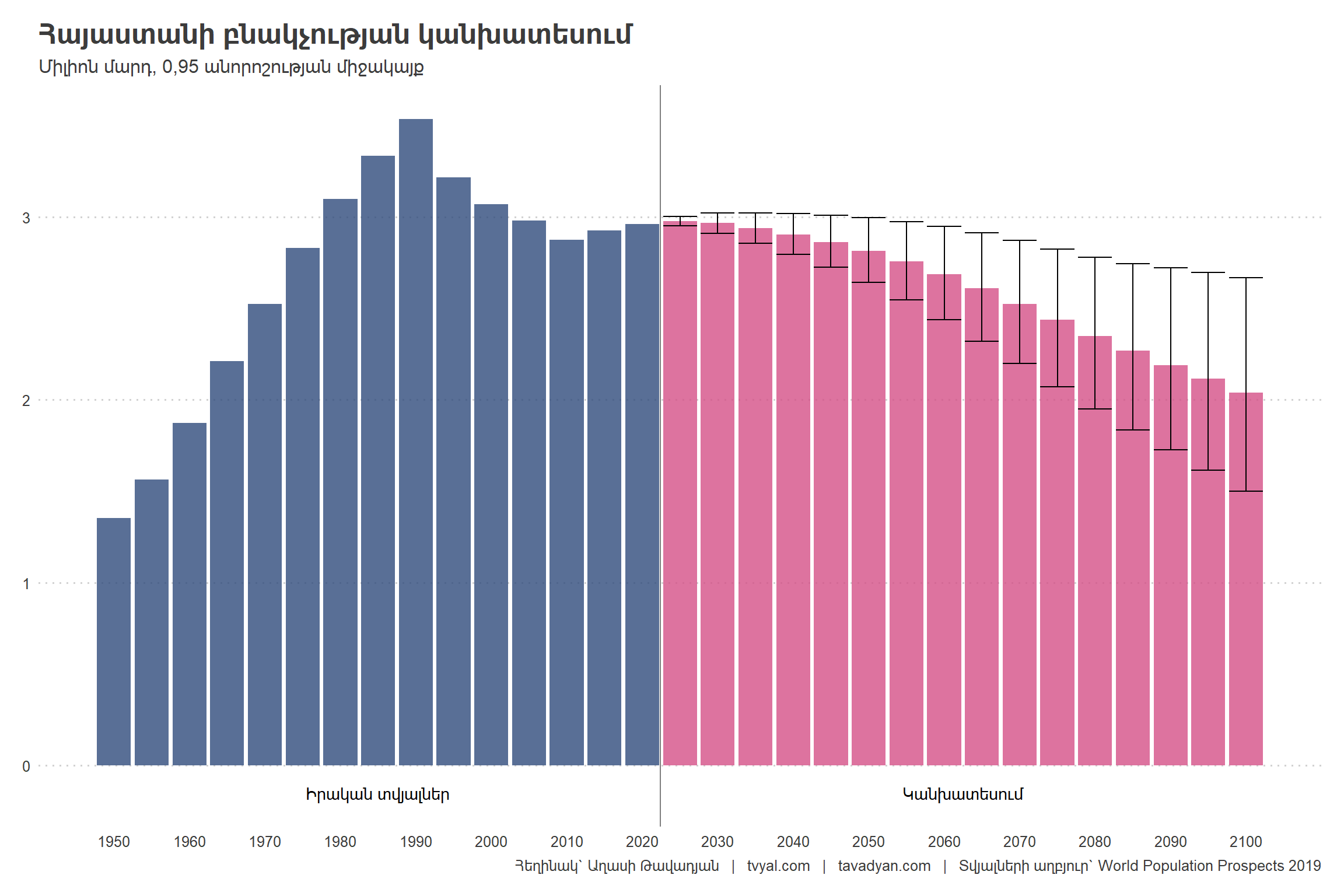
The forecasted trend is based on data recorded up until 2019. The forecast does not take into account the 44-day Artsakh war of 2020, the loss of Artsakh in 2023 and the subsequent emigration of Artsakh Armenians, as well as the circumstances of approximately 100-140 thousand relocants moving to Armenia from the Russian Federation due to the Russian-Ukrainian conflict, and the immigration of Indian citizens to Armenia in relatively large numbers over the last two years. The immigration of 100-140 thousand citizens of the RF makes up 3-4 percent of Armenia’s population. A significant part of the RF relocants are Armenian. We note that according to the Ministry of Economy data, about one third of the relocants have recently already left Armenia. These significant changes are not yet factored into this forecast. This could mitigate the demographic problem to some extent.
Let us also highlight that large numbers of Indian citizens have already settled in Armenia. Mainly male representatives have come from India, without their families. It is necessary to conduct a study to determine for what period of time the men who came from India plan to stay in Armenia and to develop appropriate steps for their full integration in Armenia.
Chart 2.
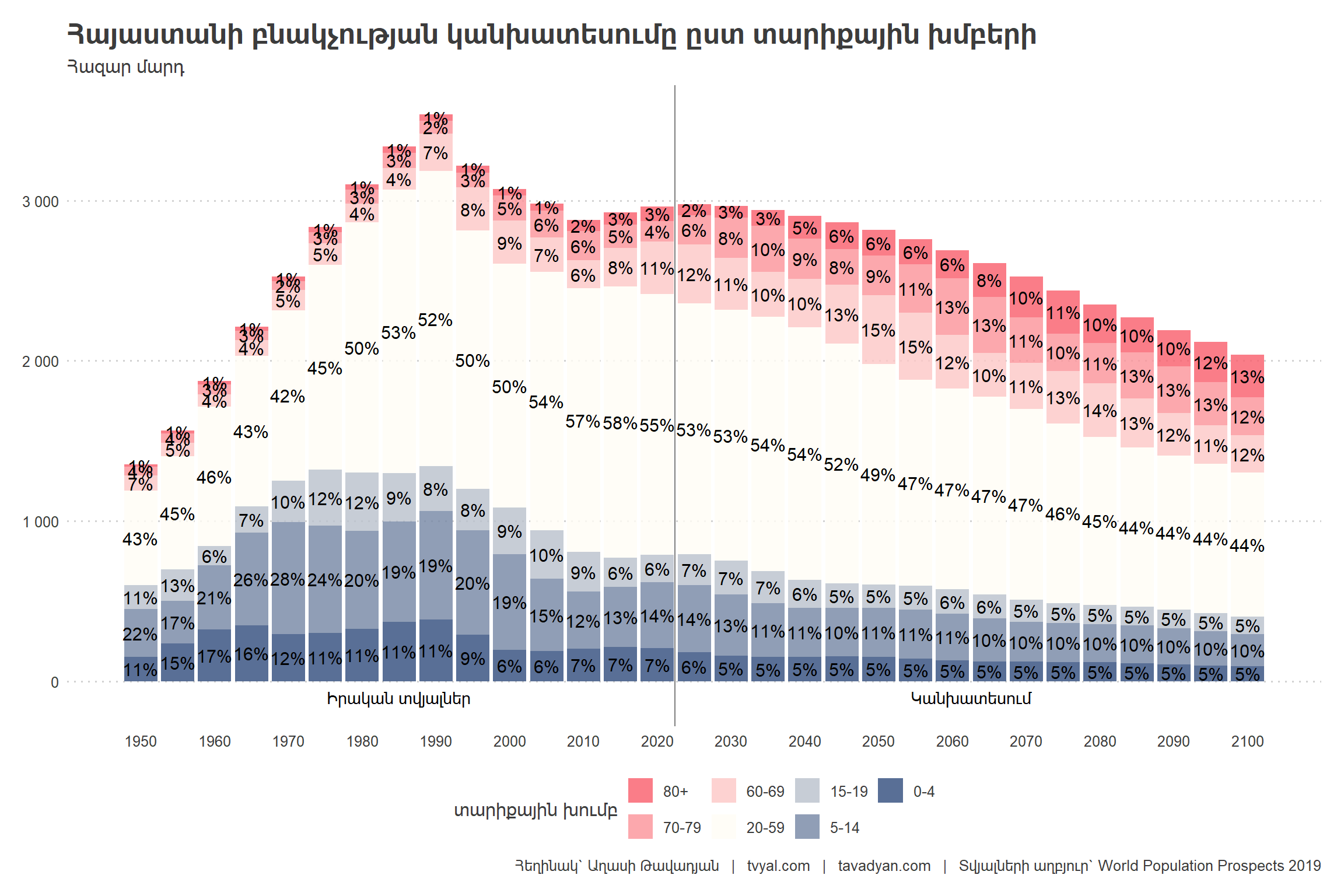
Chart 2 presents the forecasted age structure of Armenia’s population. 1990 is distinct in the chart, when Armenia’s population was relatively young with 38 percent made up of individuals under 20. Until that period a significant rate of population growth had been recorded, which later experienced a sharp regression. The reasons for the regression were several: the Spitak earthquake, the collapse of the USSR and economic decline (the highest hyperinflation was recorded in Armenia in those years), as well as the Artsakh war. Overall, in the 1990-1995 period the population shrank by 9 percent.
We note that in Georgia, where the earthquake and war situation were absent, an 8 percent population decline was recorded in the same period. Since there was no large-scale war and earthquake in Georgia during the mentioned period, one can assume that the main cause of population emigration was the collapse of the USSR and its consequences.
It is worth noting that after the collapse of the USSR the opposite trend was recorded in Azerbaijan; the population grew by 7.3 percent. This is explained by the fact that the living standard of the population in Azerbaijan was lower than in neighboring Transcaucasian countries, hence against the background of war and economic changes no major fluctuation in living standards was registered. Let us highlight that in 1990 Azerbaijan’s population was 7.2 million, and in 2020 it was already 10.2 million.
You may also be interested in the following analysis:
If we continue Armenia’s 1990 growth trend without taking geopolitical changes into account, then Armenia’s population should have crossed 4 million in 2020. Let us also note that a repeat of the economic shocks recorded in the 1990s or the “dark and cold” years could again cut Armenia’s future native population by about one quarter.
Let us present the forecasted gender-age structure of the RA native population (Chart 3).
Chart 3.
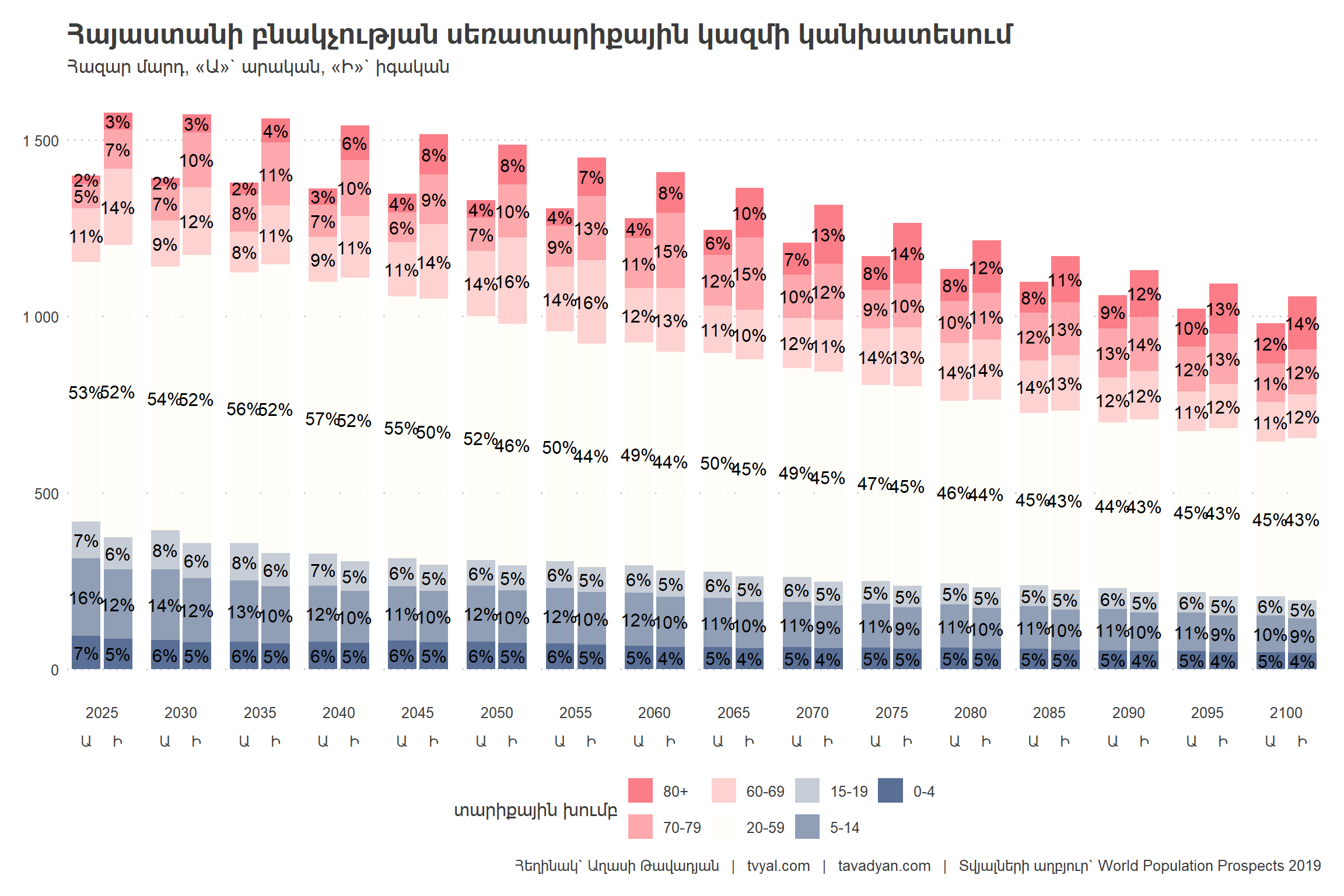
The chart shows a clear imbalance between the number of men and women. The total number of female representatives currently exceeds the male sex by about 12 percent, and this imbalance will continue for many years. The problem of selective abortions exists in Armenia. The number of boys under 20 in 2020 exceeds the number of girls by 13.5 percent.
According to the forecast, there is also a significant problem of workforce reduction. At this moment 53% of the population, that is about 1.5 million people, are in the 20-59 age group. In 2050 it is forecast that 48 percent, or 1.3 million people will be in that group, and in 2100, 44% percent, or 0.5 million people will be of working age.
In fact, in 2020 the number of women over 60 in Armenia was 20 percent higher than the number of men. Our previous research has shown that the older the head of the household is and the higher the probability that the head of the household is a widowed woman, the greater the probability of the family falling into the disadvantaged class. Disadvantaged households mainly consist of elderly widowed women who do not have relatives, about 40 percent of whom have a basic education.
You can read the study of Armenian families according to gender-age structure and income level here:
The Fundamental Problem of Selective Abortions in Armenia
We note that in 2000 there were 117 newborn boys for every 100 newborn girls in Armenia, which is a major deviation and causes gender imbalance. That year this negative ratio compared to other states in the world was the largest in Armenia. This circumstance is mainly explained by selective abortions, when the parents or a parent decide to terminate the development of a female fetus.
The chart presents the 4 states with the largest deviation in the gender ratio of newborn children (China, Azerbaijan, Armenia, Vietnam), as well as the levels of Georgia and the world.
Chart 4.
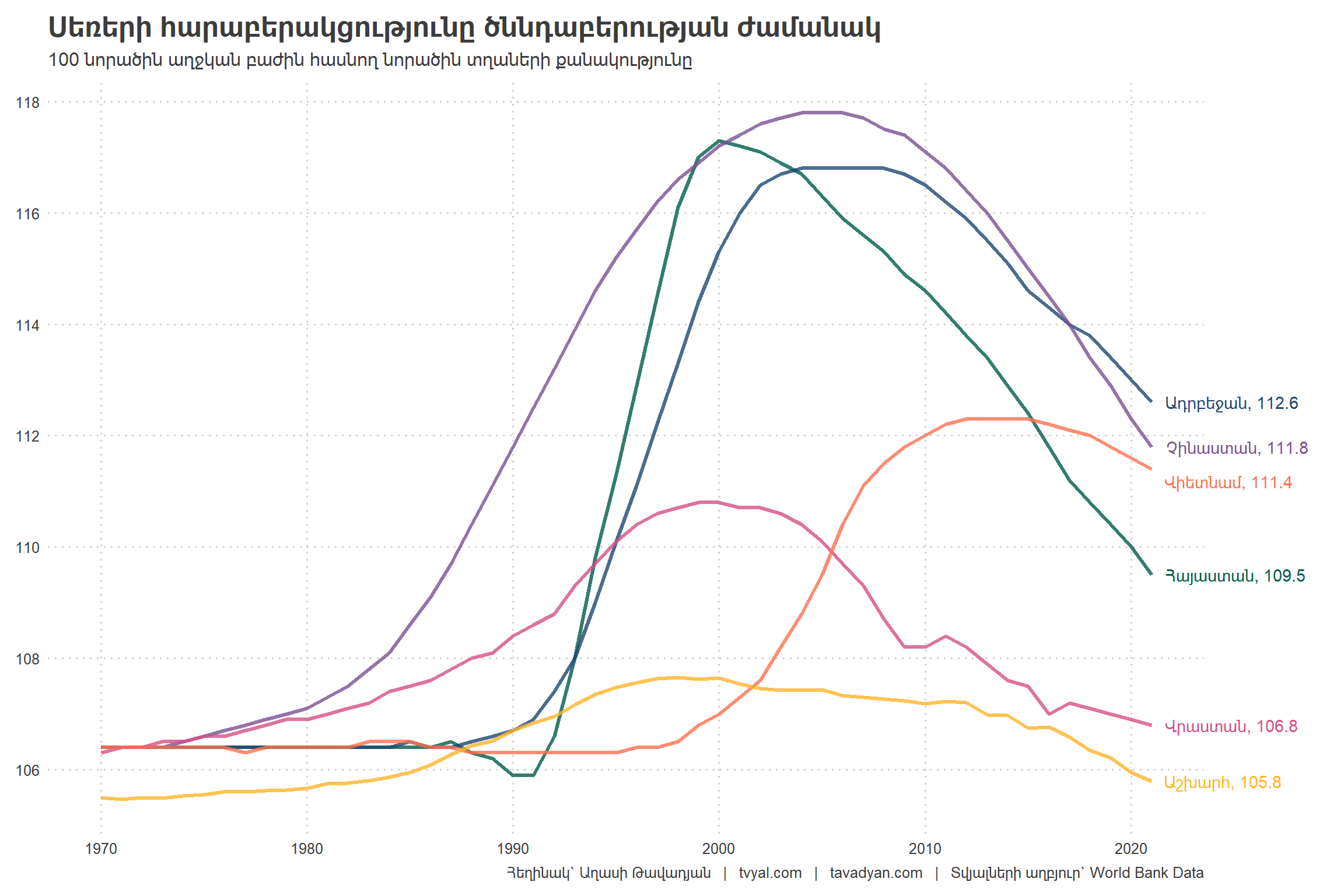
We note that at the level of natural births there are 105 to 106 boys for every 100 newborn girls. This means that without selective intervention there is already a certain inequality at the moment of birth. The reason for this is that compared to girls, boys are more likely to be born with inclusive or other diseases, and during maturation are more likely to die. Natural gender equality comes after puberty when the numbers of boys and girls equalize.
We note that up until 1990 Armenia was at a natural level of 106 boys per 100 girls. After the first Artsakh war this natural ratio was sharply disrupted in both Armenia and Azerbaijan in favor of the birth of boys, which can be explained by the fact that a significant number of men died during the war, as a result of which women were about 10 percent more than men.
In 2021 there were already 109.5 boys for every 100 newborn girls, meaning the situation is improving. It is expected that in 2028 Armenia will return to the natural level of 106 boys per 100 newborn girls.
World Population Forecast Dashboard
I would be grateful if you write suggestions to me to perfect this dashboard, as we strive to improve its functionality and ease of use.
PODCAST !!
Let’s Talk Numbers #4
Gold Fever: What is Really Hidden Behind Armenia’s High Export Indicator?
- 🔘 What export growth does Armenia have and what is it driven by?
- 🔘 Why and how is Armenia being used for the re-export of gold?
- 🔘 What are the volumes of re-exports in Armenia, and what remains for us from it?
- 🔘 What is the export picture like without that “external effect”?
On How2B we “talk in numbers” with economist Aghasi Tavadyan.
- 00:00 The incredible growth of Armenia’s exports in the last 2 years
- 02:04 We are dealing with re-exports: What and how?
- 04:50 Re-exports according to official statistics, and why is it flawed?
- 08:05 How to find out how much of the export is actually re-export?
- 11:17 The true volumes of re-exports
- 14:26 Gold fever: Gold and precious metals are being re-exported
- 17:39 What indicators would we have if there were no re-exports?
- 19:47 What consequences does the re-export of gold through Armenia have?
- 21:27 The export picture without re-exports
An analysis on the topic is presented on the tvyal.com website:
🚀♻🟨 Gold Fever: Half of Armenia’s Exports are Re-exports