Electric Armenia: Reduction in Electricity Production and Export
In 2023 solar power plants accounted for 8.7 percent of electricity production.
The first chart depicts monthly electricity production in Armenia by types of plants for 2023 and the first quarter of 2024. The chart shows the seasonality of the different sources of electricity production.
Chart 1.
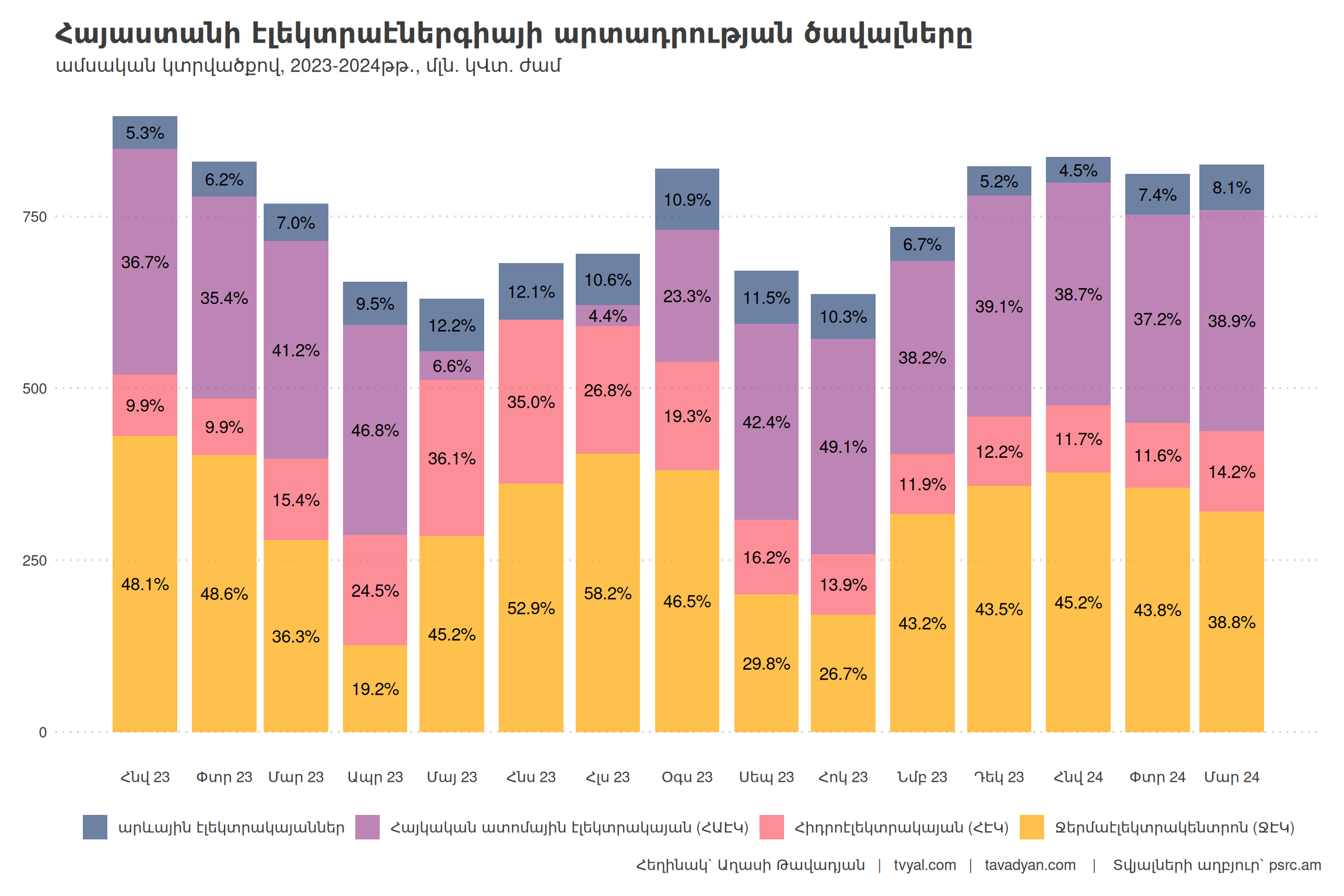
For a landlocked country that is heavily dependent on imported fossil fuels, solar energy becomes important for several reasons: first, solar energy provides a decentralized source of energy, reducing dependence on external suppliers and improving energy security. We note that in 2023, 42 percent or 3,715.6 million kWh was produced by TPPs (Thermal Power Plants), which use gas imported from Russia for electricity production and is the most expensive source of electricity in the domestic market. By utilizing solar energy, Armenia can significantly reduce its vulnerability to geopolitical tensions, price fluctuations, and supply disruptions associated with imported gas.
In 2023 electricity production and export contracted, which causes some concern. In 2023, 8,845 million kWh of electricity was produced, and in 2022 it was 9,165 million kWh. In fact electricity production contracted by 3.5%. Aside from solar electricity production, the electricity production of all other main types contracted. TPP production contracted by 4.2%, ANPP (Armenian Nuclear Power Plant) production by 4.8%, and HPP (Hydro Power Plant) production by 15.2%. Growth was secured only by electricity produced by solar power plants, with about 55% growth.* In 2023 this source provided 8.7% of total produced electricity or 772 million kWh.
Of course, the growth of solar electricity is positive from the perspective of ensuring energy security, but the overall decline in electricity production is concerning and may indicate a decline in the real economy, because electricity is a commodity that must be consumed immediately after production, and the fact that 3.5 percent less electricity was produced in 2023 than the previous year indicates that production demand for electricity has fallen.
Chart 2.
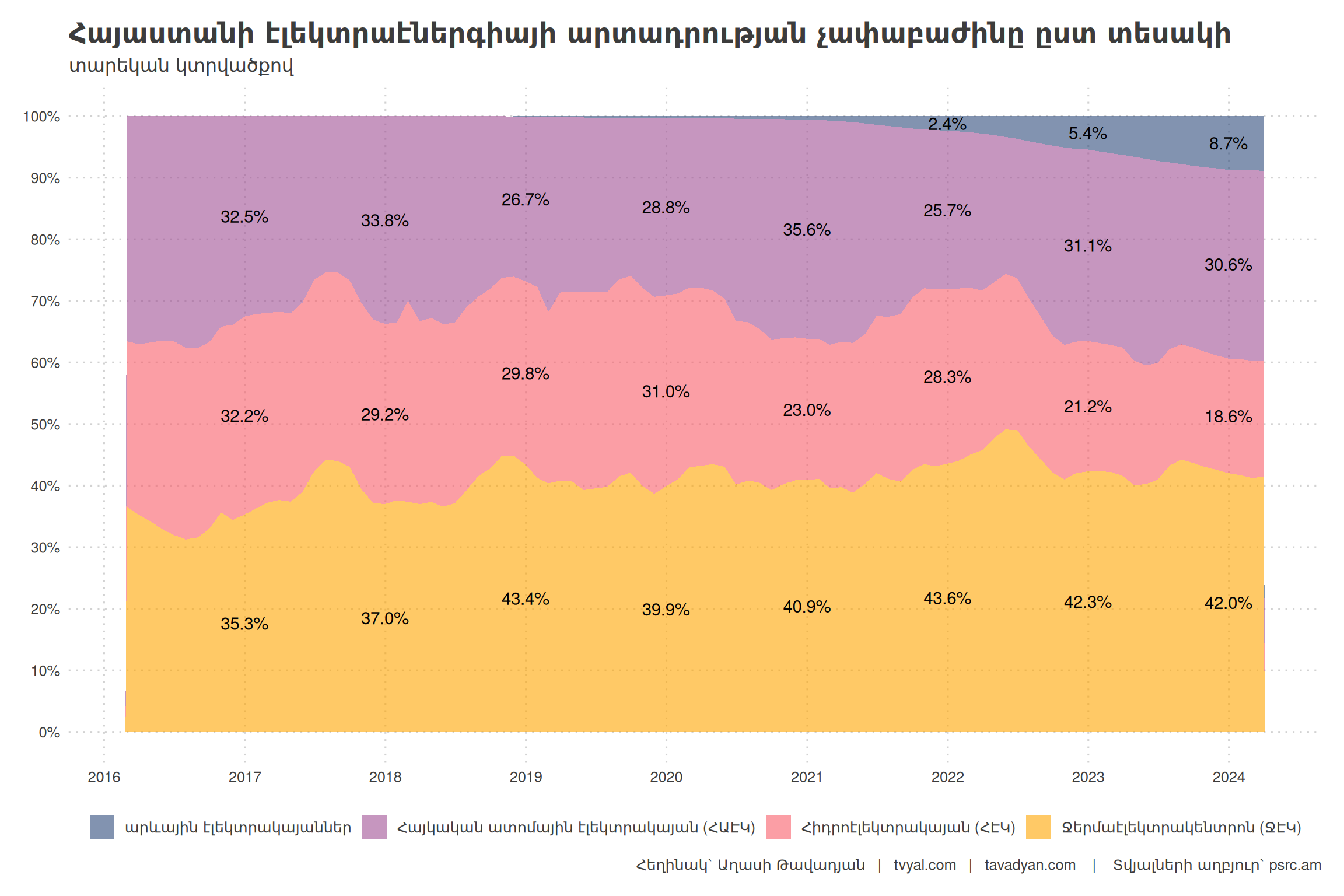
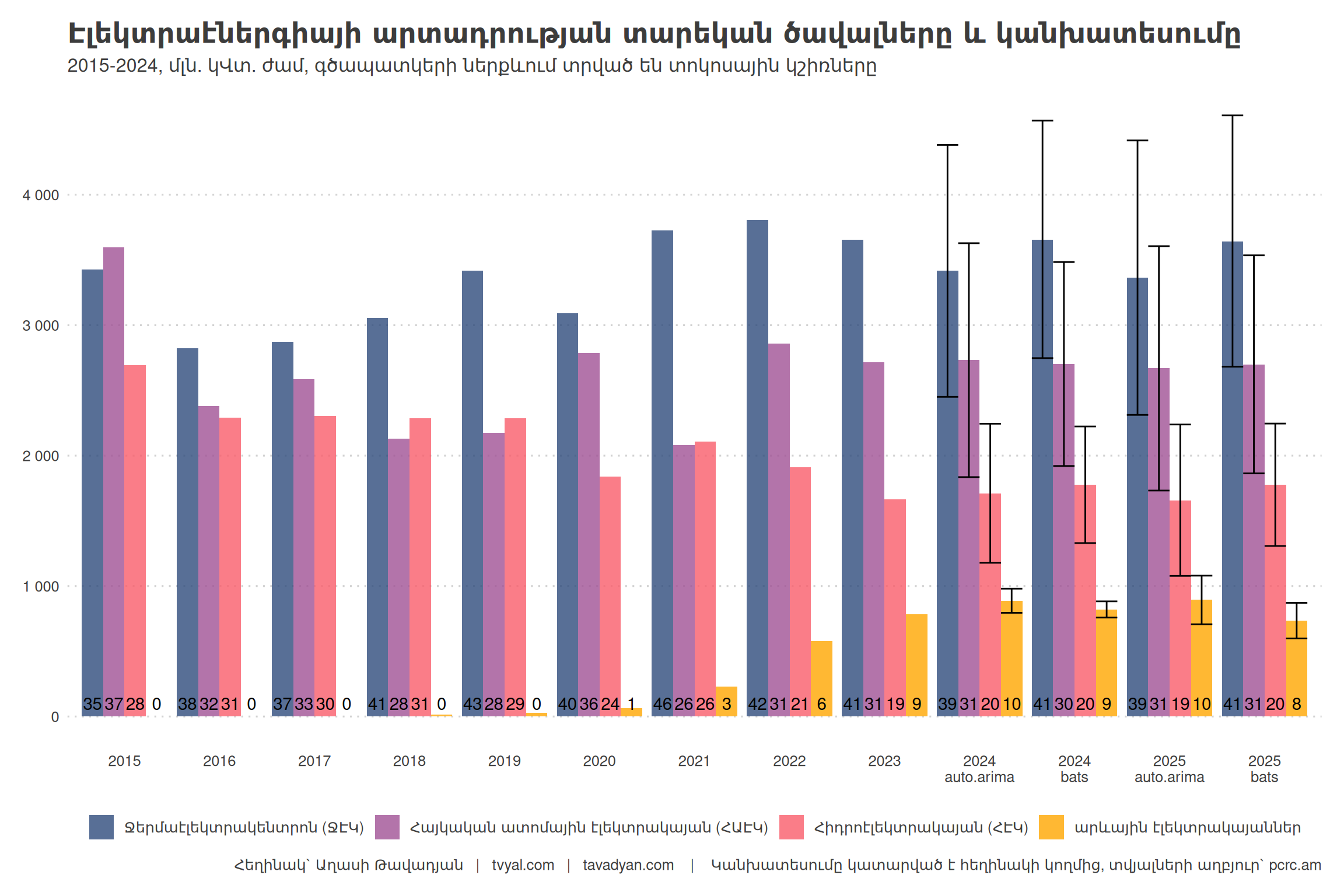
The third chart reflects annual electricity production by types of power plants. At the bottom of the chart the percentage weights of each year’s production are given. Thus in 2015, 35 percent of electricity production was provided by TPPs, 32 by ANPP, and 28 by HPPs. In 2023 it is respectively 41, 31, 19, and solar power plants already at 8.7 percent.
The chart also reflects the 2024 and 2025 forecasts using 2 models (AUTO.ARIMA and BATS), while also giving the uncertainty interval. Forecasts by both methods are nearly equivalent for 2024 and 2025, predicting that solar electricity will make up 9-10 percent of total production this year. Thus the forecasts in all likelihood do not expect growth in electricity production, and all other conditions being equal, over the next 2 years 2023 may be the peak year for electricity production.
Chart 3.
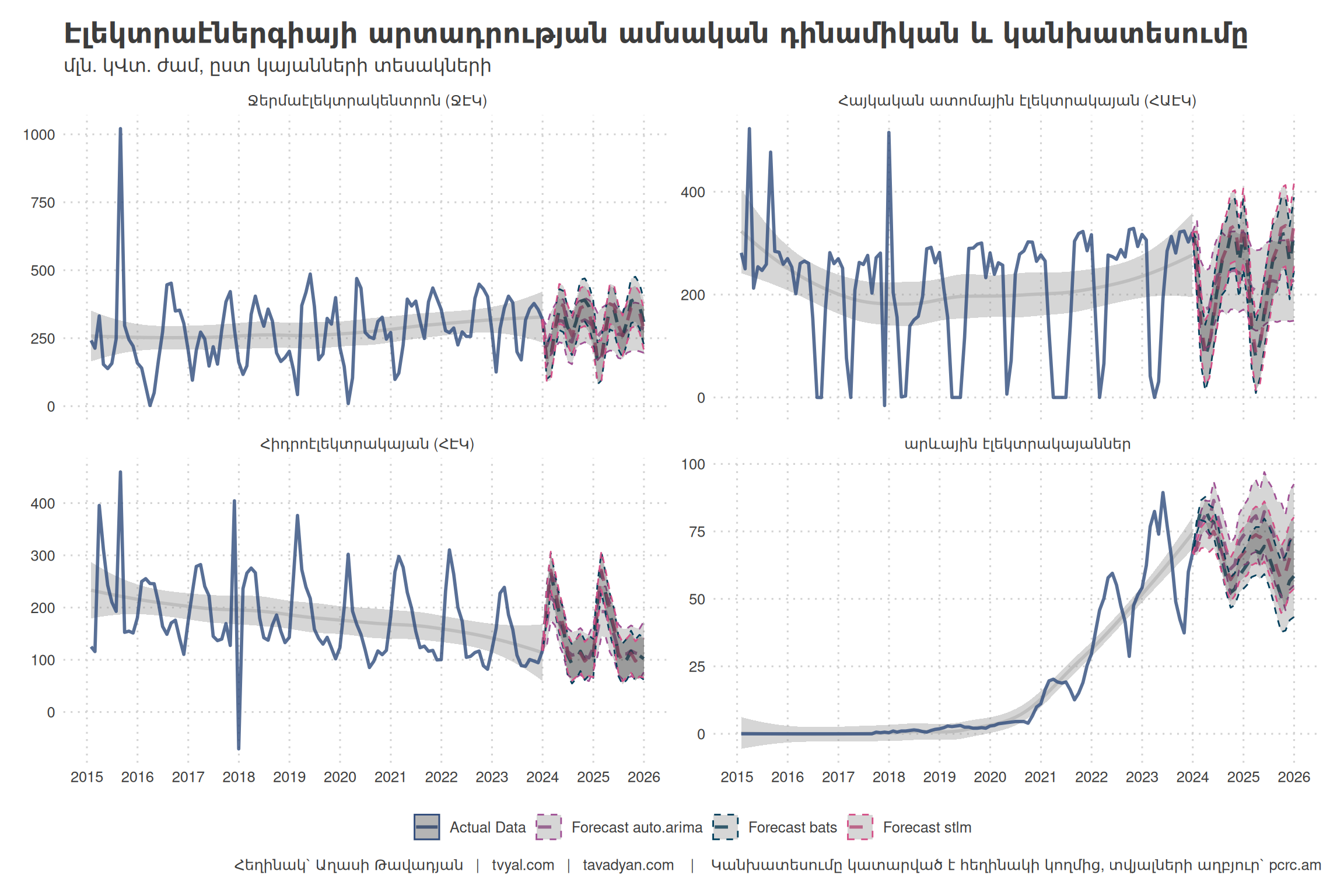
The 4th chart displays the monthly volumes of electricity produced in Armenia by types of power plants. The chart also provides a 2-year forecast up to 2026.
The Hrazdan TPP, which currently produces the most electricity, has an unchanged trend. Overall no changes in electricity production are expected in this sector.
The chart shows the planned seasonal shutdowns of the Armenian nuclear power plant, which have been planned shutdowns aimed at the restarting and lifetime extension of the nuclear plant since 2016.
Hydro power plant production has a declining trend. If in 2017 an average of about 200 million kWh of electricity was produced monthly, in 2023 it was already about 150 million kWh per month. This raises some concern from the perspective of securing renewable electricity growth. The trend here depends on the seasonality of water intake, which is also reflected in the forecasts.
In recent years Armenia was on an exponential growth curve for solar electricity, which has reached a production peak according to forecasts conducted by us. The growth and seasonality of solar electricity are clearly visible in the chart.
Chart 4.
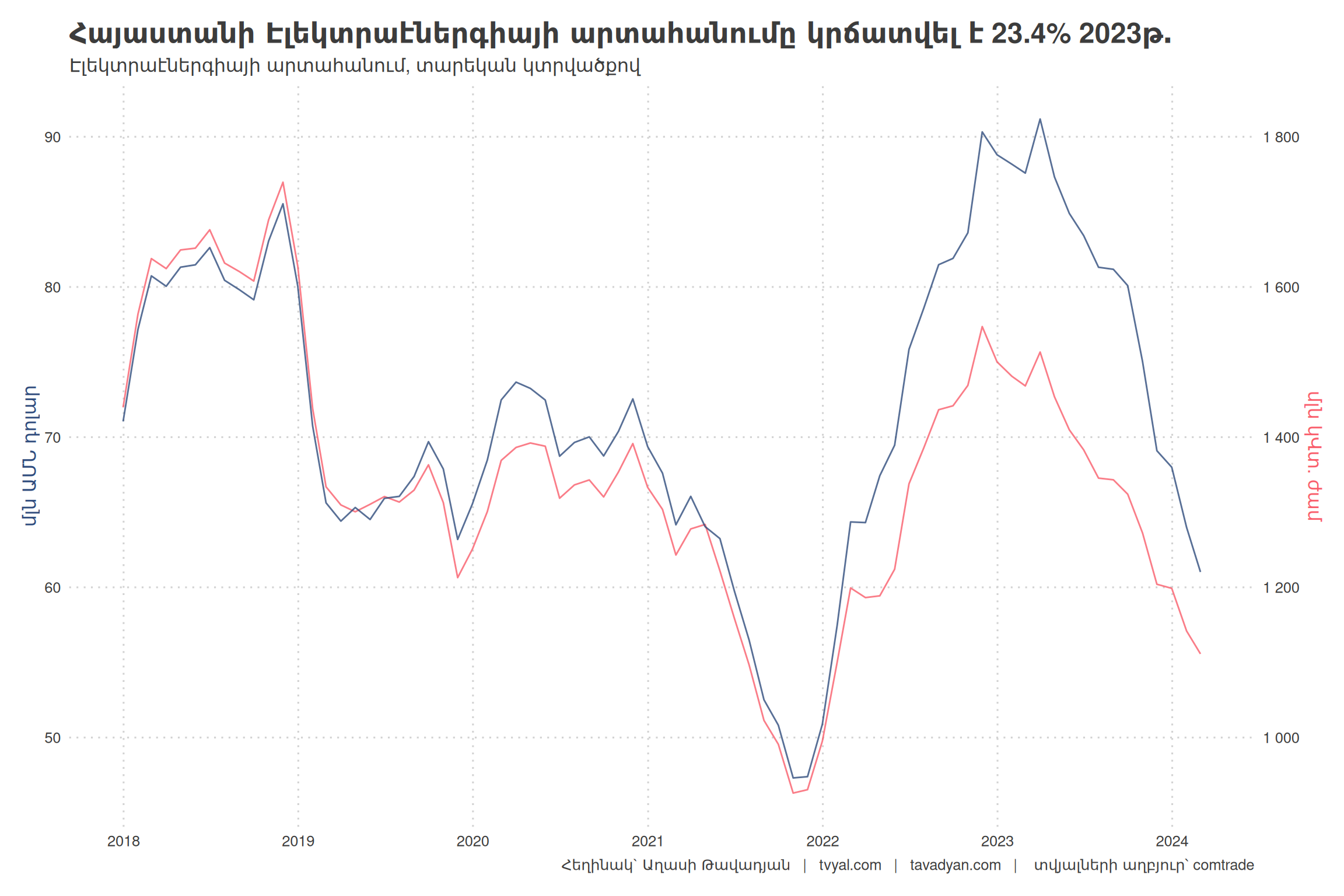
Let us also examine the export of electricity, where the contractions are more substantial. As can be seen in the chart, in 2022 electricity exports registered a record growth of 74.5% (from 50.9 million dollars to 88.8 million dollars). This was mainly driven by post-pandemic recovery growth and a large amount of capital inflow from Russia. At this moment a capital outflow is being recorded.
In 2023 there is a decline in electricity exports of 23.4% to 68.0 million dollars, and on an annual basis there is still a sharp decline in exports. Electricity is mainly exported to Iran in exchange for gas. Since electricity must be consumed during production, exports are organized during surplus hours.
You may also be interested in the following analyses:
Chart 5.
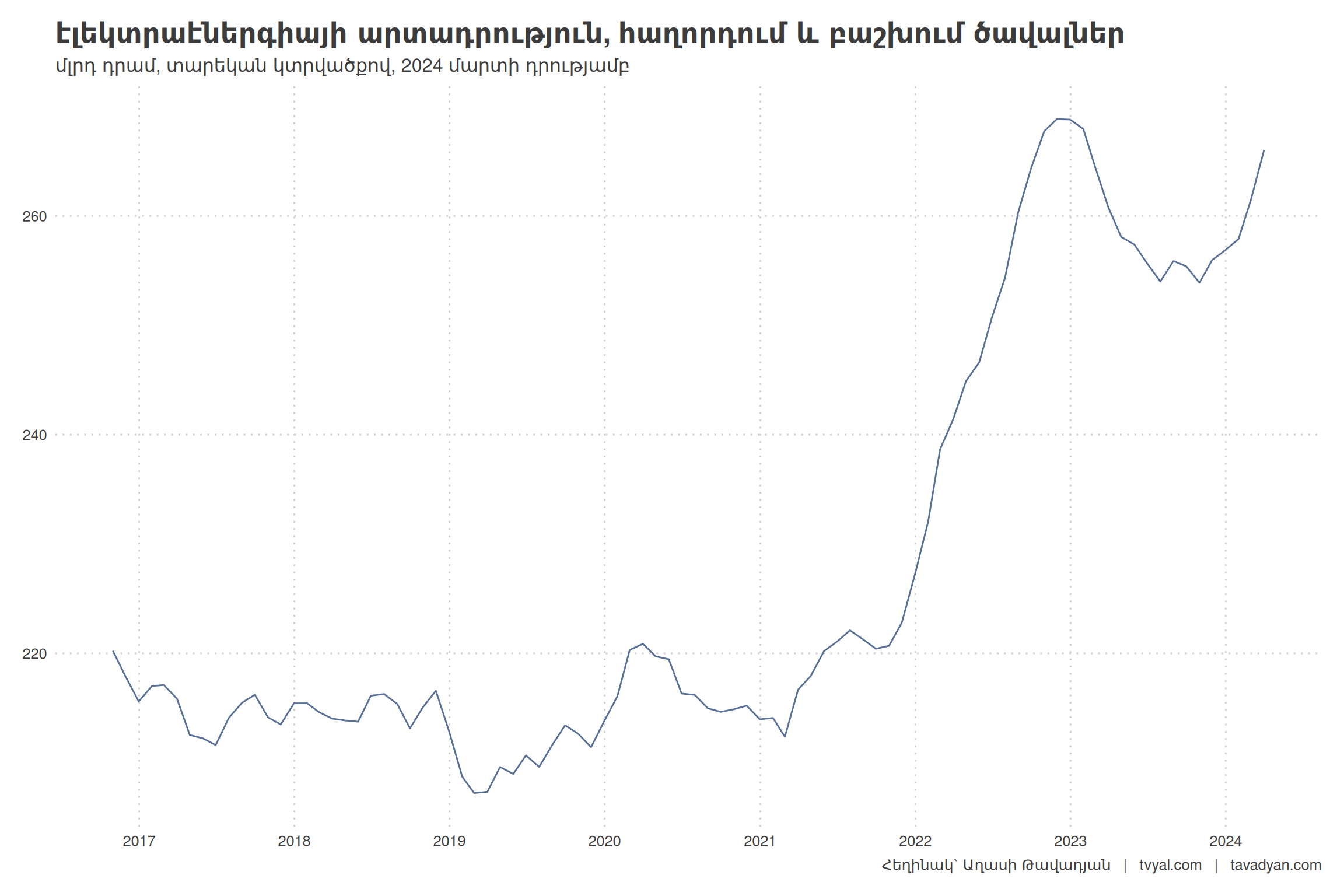
The final chart reflects electricity production within the volumes of industrial product output at current prices. The table is given on an annual basis. The rapid growth of electricity production in 2022 is also visible here. Total electricity production volume in drams grew by 18.3% in 2022 (from 227.2 billion drams up to 268.8 billion drams). In 2023 a 4.4% decline was already recorded, down to 256.9 billion drams; however, according to official statistics, within the volumes of industrial product output there is already a growth in electricity production.
Chart 6.
We note that there is a global trend of transitioning to electric cars and renewable heating sources. In the future a significant portion of apartment heating and car charging will likely be done with electricity. The latter will increase demand for electricity, and in this scenario the growth in household consumption will increase electricity production. However, this could subject Armenia’s energy system to stress, because if the majority of households transition to electric cars and electric heating, this will increase electricity demand by about 2 times, infrastructural capabilities for which Armenia currently lacks. A possible doubling of demand and supply could put strain on electrical infrastructures, which need to be urgently updated. To avoid these risks it is necessary to increase production capacities and the amount of electrification infrastructures. Thus, a certain plan must be implemented so that in a few years Armenia’s electrical infrastructures will be ready to provide 18,000 million kWh of power annually.
* From 2023 there is a change in the calculation of solar electricity production. The volumes of solar electricity production also include the quantities of electricity produced by autonomous producers regarding electricity mutual flows. To account for this, solar electricity production indicators up to 2023 have been adjusted.<>