Golden Illusion: The Real Picture of Armenia's Exports
A strange situation has developed in Armenia’s economy. Official statistics show an unprecedented growth in exports, but the reality is quite different.
At first glance, Armenia’s export figures are astonishing. In the first half of 2024, the country’s exports reached 7.9 billion dollars, more than doubling the 3.4 billion dollars reported in the same period of 2023. Normally, such a sharp increase would mean that the economy is moving forward at full steam. However, a closer examination reveals a reality that is not entirely positive.
Chart 1.
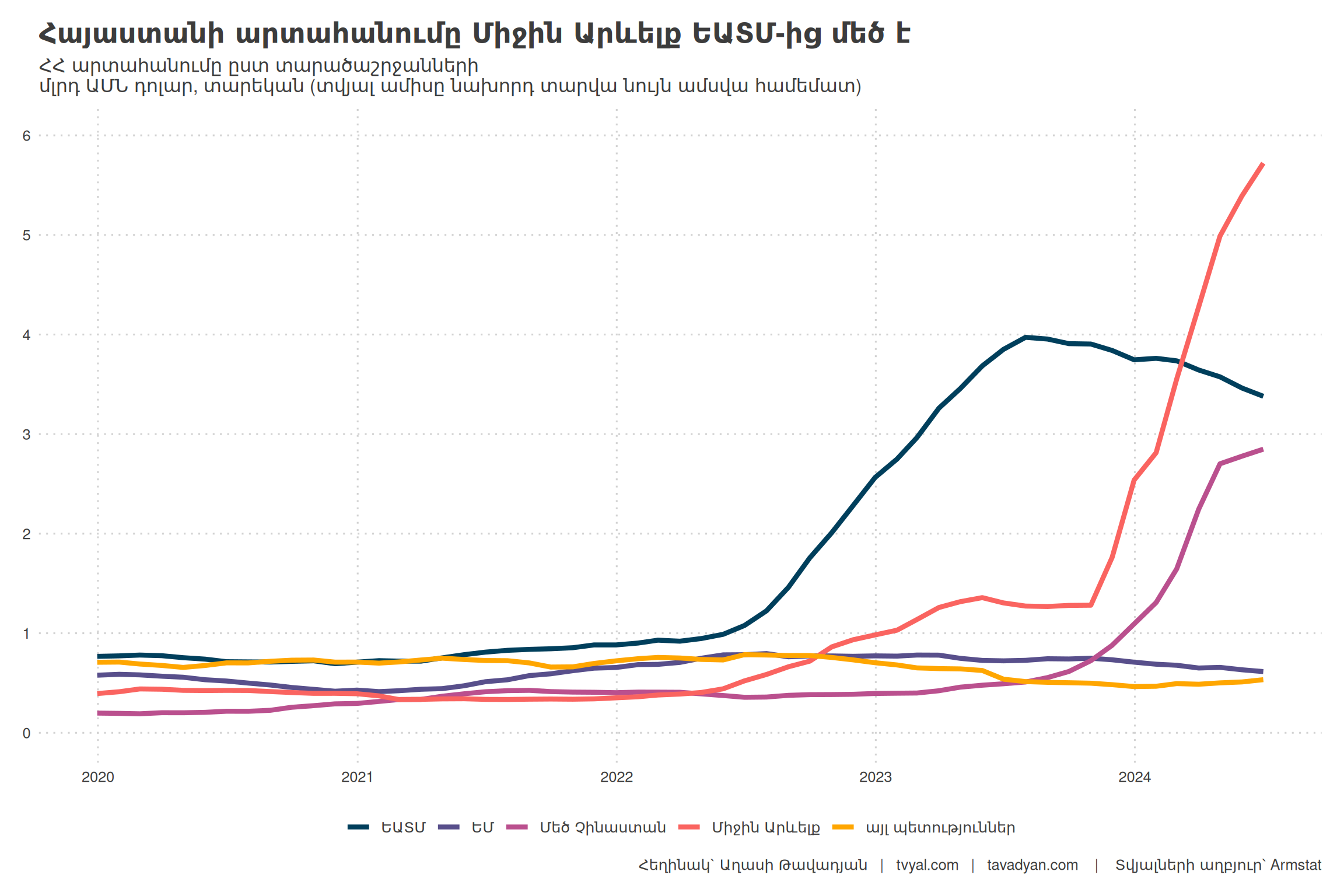
The first chart illustrates a dramatic shift in exports. The chart shows that Armenia’s exports to the Middle East have skyrocketed, surpassing even exports to the Eurasian Economic Union (EAEU). At first glance, this might seem like a success in economic diversification, but the reality is different.
Over the first half of the year, the lion’s share of Armenia’s exports, a staggering 71%, accounted for a single commodity category: precious metals and stones, dominated by gold. However, Armenia is not experiencing a modern gold rush. Instead, it has become a crucial hub for the Russian gold trade. In the first quarter of 2024, 88% of Russia’s gold exports passed through Armenia. Read more: 🇷🇺💰🇦🇲 Armenia: A Haven for Russian Gold.
This phenomenon is a typical case of re-exporting, and it has radically altered Armenia’s trade picture. The Middle East, specifically the United Arab Emirates, has suddenly become the primary destination for Armenia’s exports, accounting for almost half (48.2%) of total exports in the first half of 2024. This is a massive shift compared to just a few years ago when the EAEU and the European Union were the main trading partners.
Table 1.
| Table 1. Armenia’s Exports by Region | ||||||||
| Data is provided for the first half of the year | ||||||||
| 2021 | 2022 | 2023 | 2024 | |||||
| mln. $ | mln. $ | mln. $ | % growth | % total | mln. $ | % growth | % total | |
| EAEU | 381.0 | 576.5 | 1,863.7 | 223.3% | 55.1% | 1,497.1 | −19.7% | 18.9% |
| EU | 297.6 | 426.1 | 376.3 | −11.7% | 11.1% | 281.8 | −25.1% | 3.6% |
| Greater China | 230.8 | 184.4 | 282.0 | 52.9% | 8.3% | 2,037.0 | 622.2% | 25.7% |
| Middle East | 148.9 | 319.5 | 640.7 | 100.5% | 18.9% | 3,823.5 | 496.8% | 48.2% |
| Other states | 321.8 | 384.1 | 218.8 | −43.0% | 6.5% | 288.2 | 31.7% | 3.6% |
| Total | 1,380.1 | 1,890.6 | 3,381.5 | 78.9% | 100.0% | 7,927.6 | 134.4% | 100.0% |
| — | — | — | — | — | — | — | — | — |
| Author: Aghasi Tavadyan | tvyal.com | tavadyan.com | Data source: Armstat |
The table presented shows abrupt changes in trade flows. The EU’s export share decreased from 21% in 2021 to a mere 3.6%. In the first half of 2024, exports to the EU dropped by 25.1% compared to the same period in 2023. This is not just a change in proportions, but a conceptual shift with far-reaching consequences.
So what is happening to Armenia’s traditional exports? It should be noted that we evaluated the actual volumes of Armenia’s re-exports using a new methodology, detailed in the article 🚀♻🟨 Gold Rush: Half of Armenia’s Exports are Re-exports. This analysis shows that Armenia’s “real” exports have actually decreased. According to our estimation, about 75% of exports in 2024 are already re-exports, compared to 2021 when this figure was 6%. In fact, without re-exports, real exports in the first half of 2024 amounted to about 3.2 billion dollars, barely exceeding the 2.8 billion dollars recorded in 2021. The export figures also include re-exports. Thus, the export figure has already been inflated from the 3 billion index of 2021 to 13 billion dollars. That is, a 4.3 times seemingly impressive inflated growth, currently driven by gold re-exports.
Chart 2.
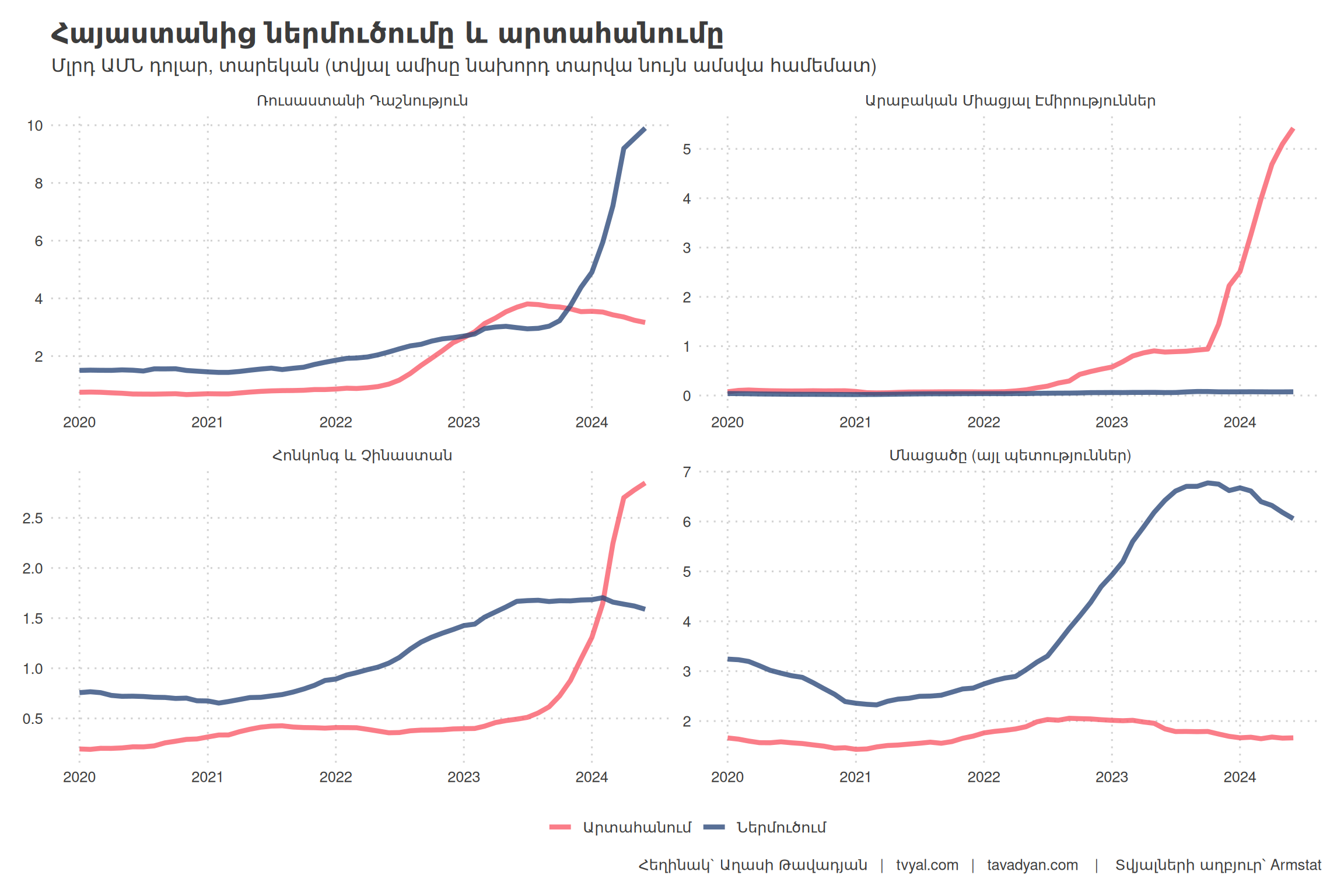
The second chart shows a sobering picture. While exports to the UAE and Hong Kong (mostly gold) are rising sharply, exports to other countries, including Russia, are declining. This 🤒🟨♻️ “gold rush” masks the decline of Armenia’s real economy, trade turnover, and GDP. It has inflated GDP figures, creating the illusion of economic growth where growth is actually small. In the first quarter of 2024, the Armenian government boasted an impressive 9.2% GDP growth. Our estimates showed that a staggering 4% of this growth was driven solely by the gold re-export “industry” (read more: 🌿🤨💎 The Precious Effect: Reasons for Economic Growth in 2024). Following this publication, on October 20, this figure was revised down to 6.6%. The main revision was lowering the share of gold re-export “production” in GDP from 4 percentage points to 1.2 percentage points. This is not just a revision, but a conceptual change. From a seeming upward trend, Armenia is now on a trajectory of stagnation.
Chart 3.
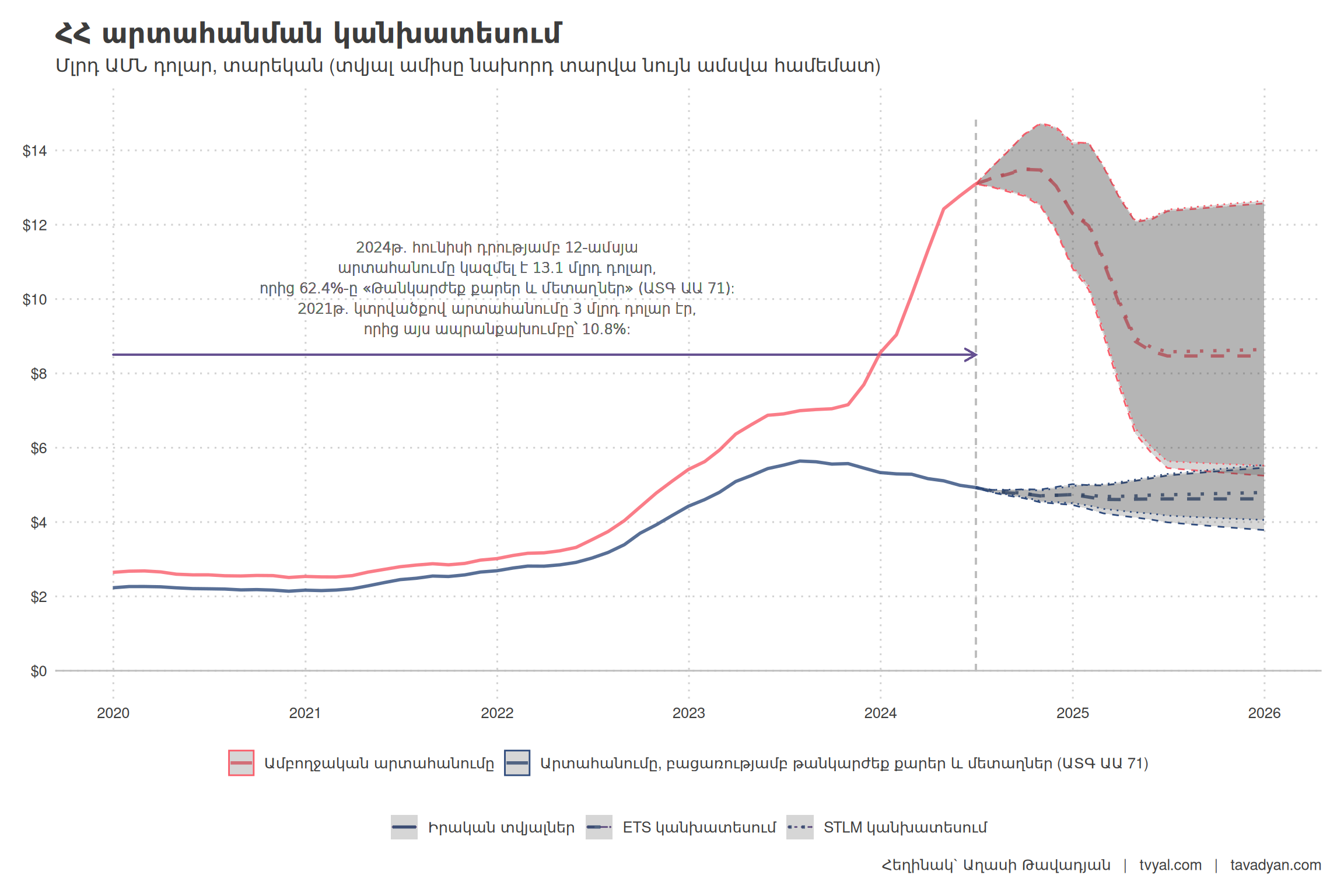
The third chart illustrates a less-than-positive outlook. While total exports seem to skyrocket due to the re-export of precious metals and stones (HS Code 71), there is a decline across the export of all other goods. This discrepancy is the reality behind Armenia’s current economic illusion. The area between the red and blue lines on the chart reflects the share of precious stones and metals in total exports.
The sustainability of this golden profit is highly questionable at best. The surge in gold re-exports through Armenia is largely driven by geopolitical circumstances, specifically Western sanctions against Russia. This is a temporary phenomenon dictated by global economic realities that are already shifting.
Chart 4.
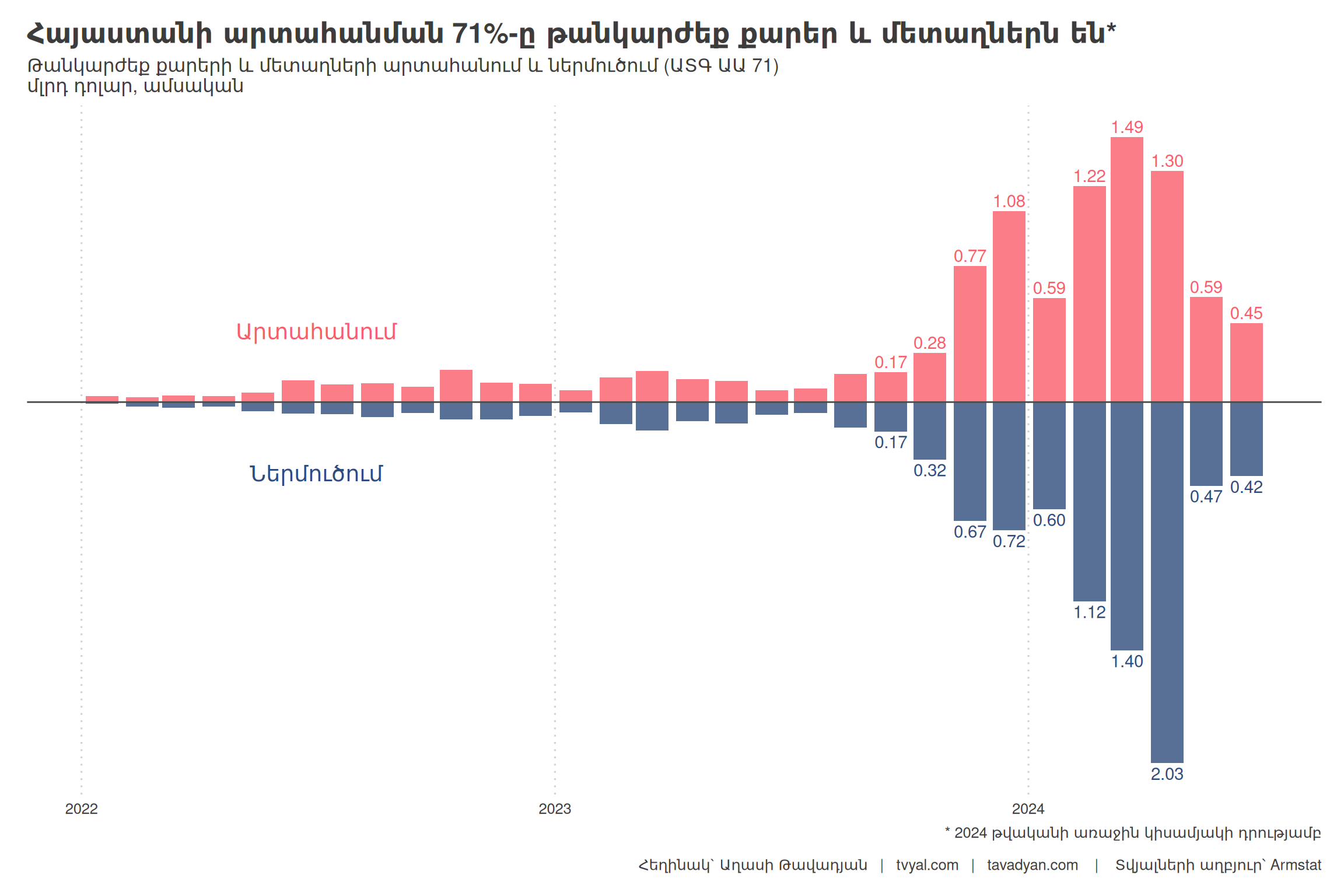
This chart shows the sharp spike in exports and imports of precious metals from November 2023 to April 2024. Pay attention to the last two months, which may signal the end of Armenia’s “golden age”.
The chart indicates that in April 2024 alone, 2 billion dollars’ worth of gold was imported from Russia to Armenia, after which it experienced a sharp drop. In May, 471 million dollars’ worth of gold was imported. From April to May, imports of precious stones and metals fell by 4.3 times.
As a result of recent legislative changes in Russia, the export duty on gold was abolished. Following its introduction, 88% of Russia’s gold exports passed through Armenia. The transit flow of gold is already decreasing. In recent months, Armenia’s export and GDP growth have been based on this external, temporary, and artificial phenomenon, putting the economy in a highly precarious state. It masks the decline in the real economy and diverts attention from the true economic situation and the necessity for economic changes.
While Armenia has ridden this golden wave, the development of sustainable, high-value-added sectors capable of ensuring long-term economic stability is being neglected. The decline in exports to traditional EAEU and EU markets is particularly worrying as it may indicate a loss of competitiveness in sectors that previously served as the pillars of Armenia’s economy.
The coming months will be crucial. As the rapid growth of gold re-exports is already fading, Armenia may find itself facing a harsh economic reality. The actual state of the economy, hitherto hidden behind the glitter of gold, will become much clearer.
It is essential to look beyond this “golden era” and start building an economy with a real industrial foundation that generates long-term and sustainable value-added output, rather than relying on temporary and unsustainable external stimuli, which have primarily driven Armenia’s temporary double-digit economic growth. It is necessary to build a resilient economy, involving investments in education, fostering innovation, creating an environment conducive to the growth of high-value sectors, as well as 🧮⏳🎲 establishing an effective tax framework.
This analysis shows that Armenia stands at a critical crossroads. Armenia’s “golden illusion” serves as a cautionary tale for developing economies. It underscores the danger of relying on temporary windfalls and the importance of establishing a solid, diversified economic foundation. As the country recovers from the gold rush, Armenia’s real economic strength will be put to the test. The question remains: when the gold dust settles, what will continue to shine in Armenia’s economy?