
Household Incomes Grew in 2023
In 2023, the real incomes of Armenian families recorded growth. After the previous year’s decline, when high inflation (8.3%) significantly reduced real incomes, price stability in 2023 (-0.6% official inflation) and the 2022 economic growth led to an improvement in living standards with a certain lag.
The adjusted income of an average family grew by 15.3%, reaching 331 thousand drams from 287 thousand drams. Most notably, the upper threshold of the poorest 10% of the population grew by 23.2%, reaching 117 thousand drams from 95 thousand drams. At the same time, the lower threshold of the richest 10% grew by 14.5%, reaching 767 thousand drams from 670 thousand drams.
Regional Inequality
However, this growth was not evenly distributed across regions. In Yerevan, average income grew by 15%, which corresponds to the national average. It should be noted that if we compare the growth of real household incomes with 2020, the picture here is different. From 2020 inclusive to 2023, the real incomes of households in Yerevan grew by 16.6%. Growth was also recorded in the Aragatsotn and Gegharkunik regions. In all other regions, since 2020, the main incomes of households have either experienced a decline or remained unchanged.
In the first chart, the rows represent the regions, and the columns represent social classes (disadvantaged class, middle class, and the wealthy). If the line is red, it means incomes have decreased compared to the previous year, and if blue, they have increased.
Chart 1.
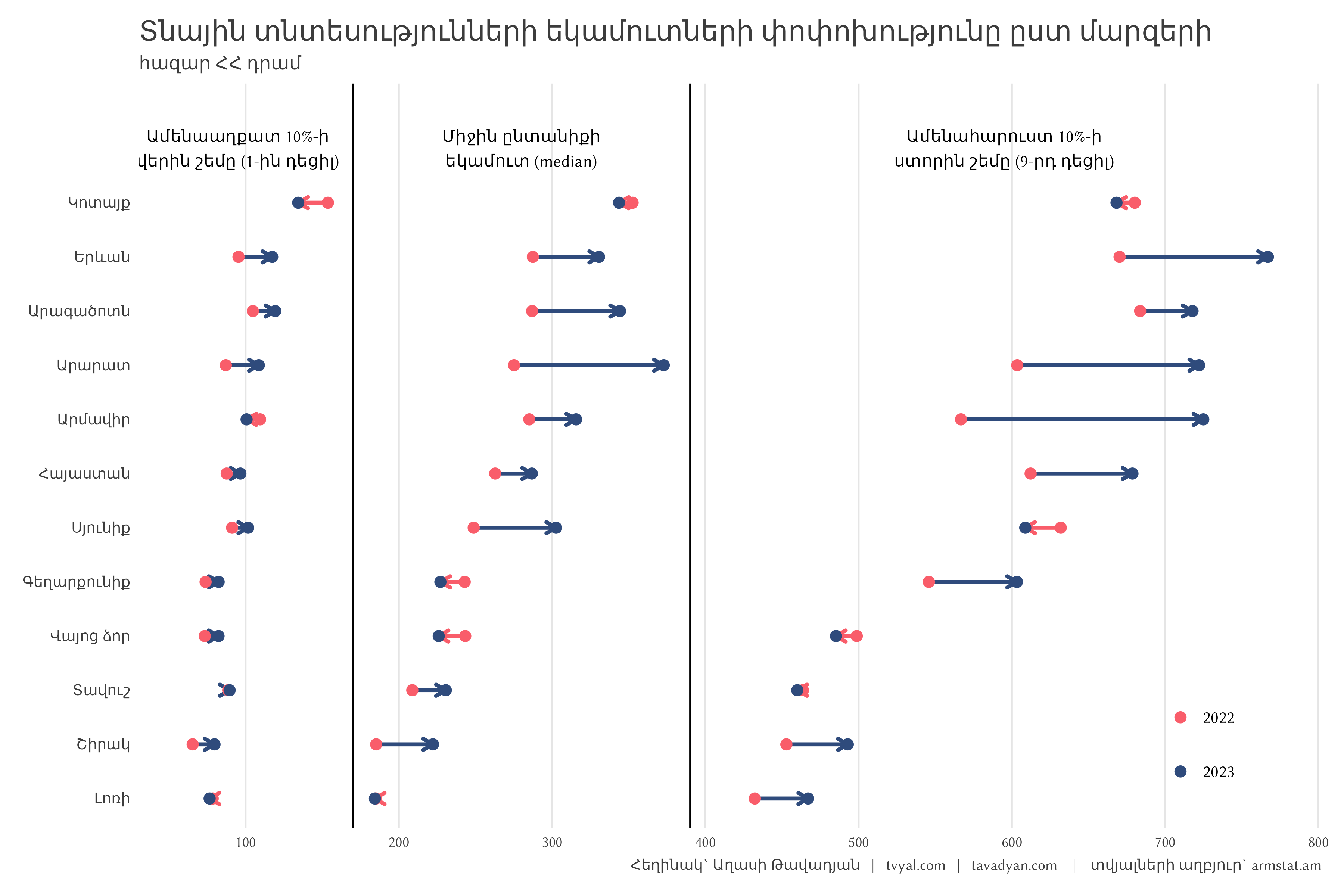
It is noteworthy that income inequality between regions has deepened. While in 2022 the difference between the regions with the highest and lowest average incomes was 172 thousand drams, in 2023 it reached 171 thousand drams. The Kotayk region, which led in average income in 2022 (404 thousand drams), recorded a 4.2% decline in 2023.
Rearrangement of Income Groups
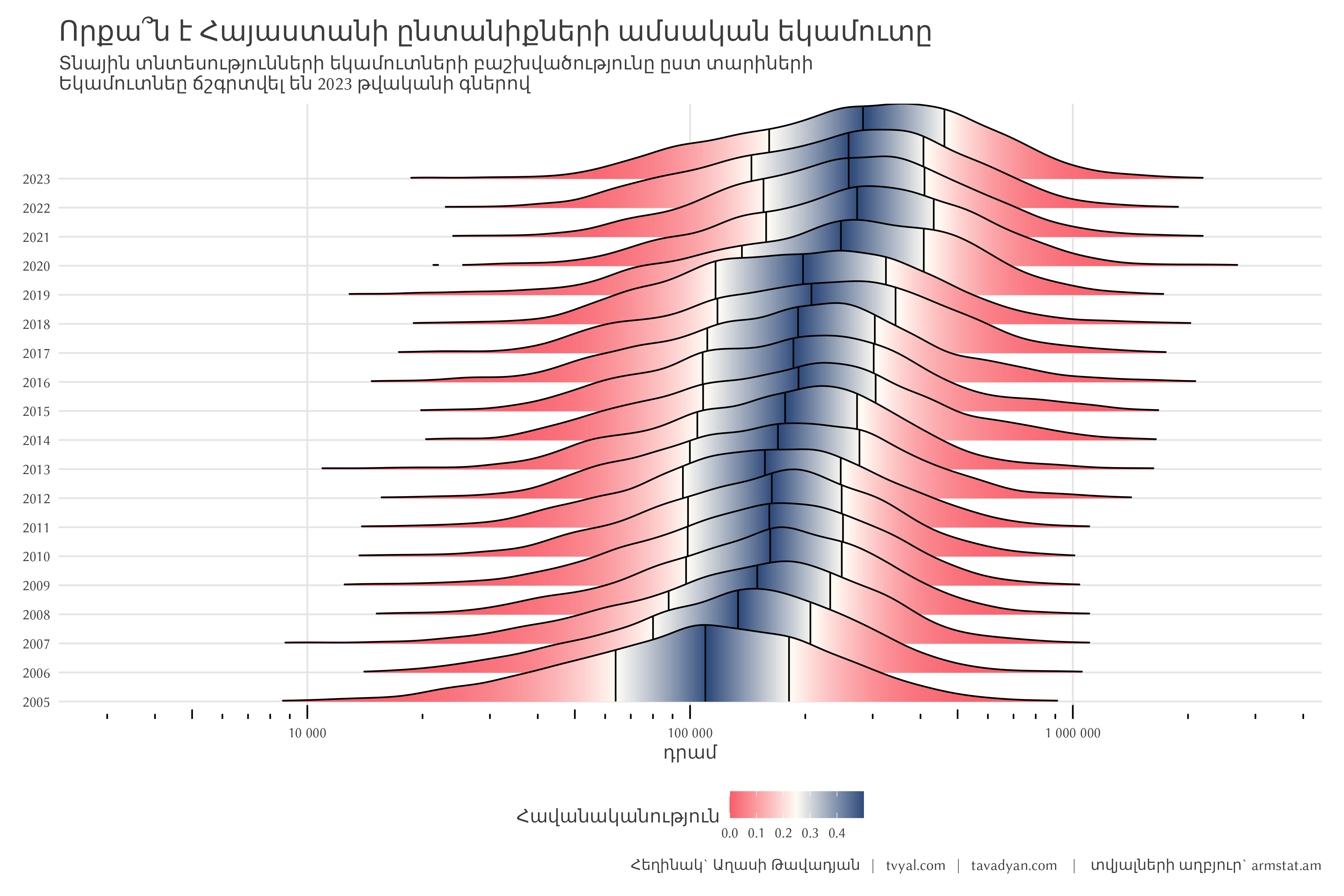
The 2023 data show an interesting rearrangement of income groups. 35.1% of families are in the upper-middle income group (256-512 thousand drams), indicating a strengthening of the middle class. The lower-middle income group (128-256 thousand drams) makes up 27.1%.
Chart 2.

It is noteworthy that only 2.6% of families receive a monthly income above 1 million drams, while 2.7% still live on an extremely low income (less than 64 thousand drams). This indicates that despite the generally positive trends, there are still serious challenges in overcoming poverty.
Historical Trends
Chart 3.
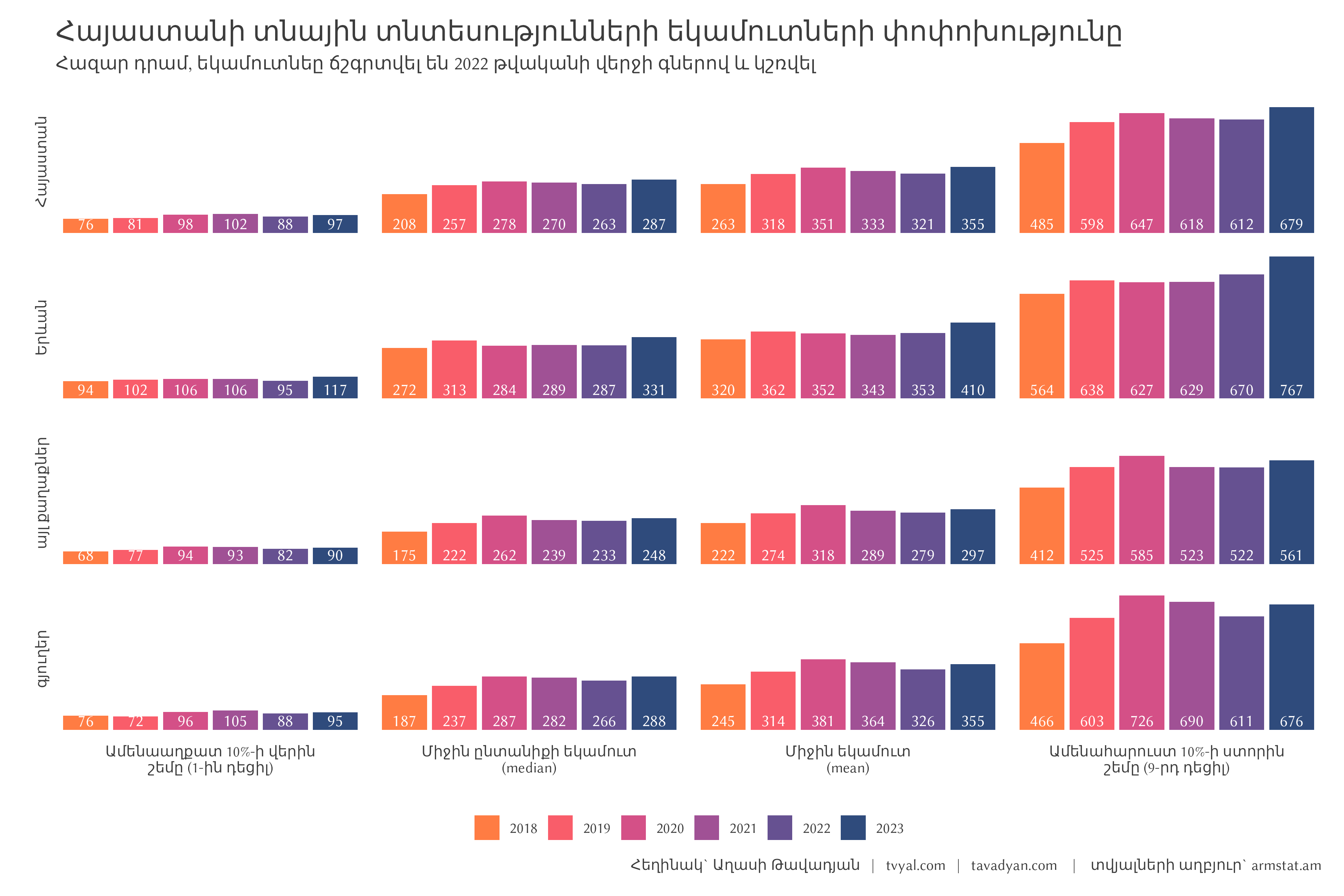
Income inequality has slightly decreased. In 2022, the income of the richest 10% exceeded the income of the poorest 10% by 7.05 times; in 2023, this ratio decreased to 6.56. This is a positive trend, although inequality still remains high by international standards.
Data is available from 2005. The chart also shows that since 2005, inflation-adjusted household incomes have recorded steady growth. According to the data, real household incomes recorded the greatest growth in 2006 and 2007, as well as in 2019.
Correlation between Inflation and Real Incomes
The growth of real incomes in 2023 was largely due to price stability. The containment of inflation allowed the growth of nominal wages to directly reflect in the growth of real incomes. According to official data, inflation in 2023 was -0.6%, compared to 2022, when the 12.6% economic growth was not reflected in household incomes due to high inflation (8.3%).
In 2022, a 12.6 percent economic growth was recorded, and GDP per capita grew from 4,972 dollars to 7,018 dollars, that is, by 41 percent, but the real incomes of the people fell. In 2021, the median adjusted income of households was 333 thousand drams, and in 2022 it was 320 thousand drams. The threshold for the poorest 10% of the population received up to 101 thousand drams in 2021, and in 2022, it was already 88 thousand drams.
Growth in nominal incomes was also recorded in 2021 and 2022, but in those years, 7.2 and 8.6 percent inflation was recorded, respectively, which significantly lowered real incomes. This means that at the end of 2022, salaries had not yet caught up with the inflation rate, and the 12.6 percent economic growth recorded in 2022 had not yet affected the growth of household incomes or salaries. It should be noted that almost zero inflation was recorded at the end of 2023. The perspective of zero inflation is presented in the video.
The idea presented in the second chart is also alternatively reflected in the next chart.
Chart 4.
Let us also present the changes in household incomes over the years in the form of a table.
Table 1.
Changes in household incomes in Armenia in thousand drams, incomes adjusted to end-2023 prices and weighted
| Year | Upper threshold of the poorest 10% (1st decile) | Median family income (median) | Average income (mean) | Lower threshold of the richest 10% (9th decile) |
|---|---|---|---|---|
| 2005 | 43 | 129 | 156 | 290 |
| 2006 | 46 | 148 | 180 | 325 |
| 2007 | 50 | 174 | 208 | 386 |
| 2008 | 61 | 178 | 226 | 423 |
| 2009 | 68 | 202 | 235 | 444 |
| 2010 | 70 | 201 | 239 | 468 |
| 2011 | 74 | 201 | 240 | 448 |
| 2012 | 74 | 222 | 261 | 482 |
| 2013 | 71 | 210 | 248 | 469 |
| 2014 | 70 | 225 | 283 | 552 |
| 2015 | 72 | 224 | 282 | 545 |
| 2016 | 75 | 225 | 328 | 692 |
| 2017 | 78 | 249 | 310 | 582 |
| 2018 | 94 | 272 | 320 | 564 |
| 2019 | 102 | 313 | 362 | 638 |
| 2020 | 106 | 284 | 352 | 627 |
| 2021 | 106 | 289 | 343 | 629 |
| 2022 | 95 | 287 | 353 | 670 |
| 2023 | 117 | 331 | 410 | 767 |
Conclusion
The growth of household incomes in Armenia in 2023 indicates the recovery of the economy. However, regional inequality and significant income stratification remain serious challenges. Price stability has played a crucial role in the growth of real incomes, which highlights the importance of macroeconomic stability for raising living standards.
The data are taken from official sources, specifically the anonymized microdata base of the integrated living conditions survey of households and the monthly consumer price index of Armenia. The indicators of household living standards were adjusted for monthly cumulative inflation and
➡️ Export volumes to the EU decreased, falling from 28.7% in 2018 to 4.5% in 2024.
➡️ The volume of bank transfers from Russia to Armenia increased 3.5 times, from $1 billion in 2018 to $3.5 billion in 2024.