Transport Fare Increase: Yerevan's Public Transport Reforms and the Limits of Affordability
Yerevan’s public transport reforms and the limits of affordability
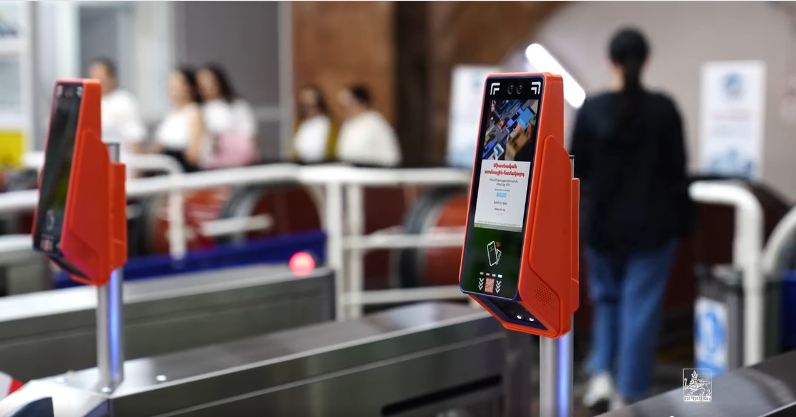
For over two decades, Yerevan residents paid 100 AMD ($0.25) to use public transport, a price that remained unchanged through economic cycles, currency fluctuations, and three different presidential administrations. This price is set to change starting February 1, 2025, when the fare will triple, reaching 300 AMD ($0.75) per ride. The price hike coincides with the city’s transition from outdated minibuses to modern Chinese-made buses, which is the most significant transformation of Yerevan’s public transport system in recent years. Starting February 1, 2025, the cost of transport tickets will be:
- 90-minute ride - 300 AMD
- One-day pass - 900 AMD
- 10-ride ticket - 2,200 AMD
- 7-day pass - 5,000 AMD
- Monthly pass - 9,000 AMD
- 90-day subscription - 24,000 AMD
- Annual pass – 90,000 AMD
If we assume that a passenger travels 2 times every day, then the average cost of the trip will be:
- With an annual card: 123 AMD per ride
- With a monthly card: 150 AMD
- With a 10-ride card: 220 AMD
- With a 7-day card: 357 AMD
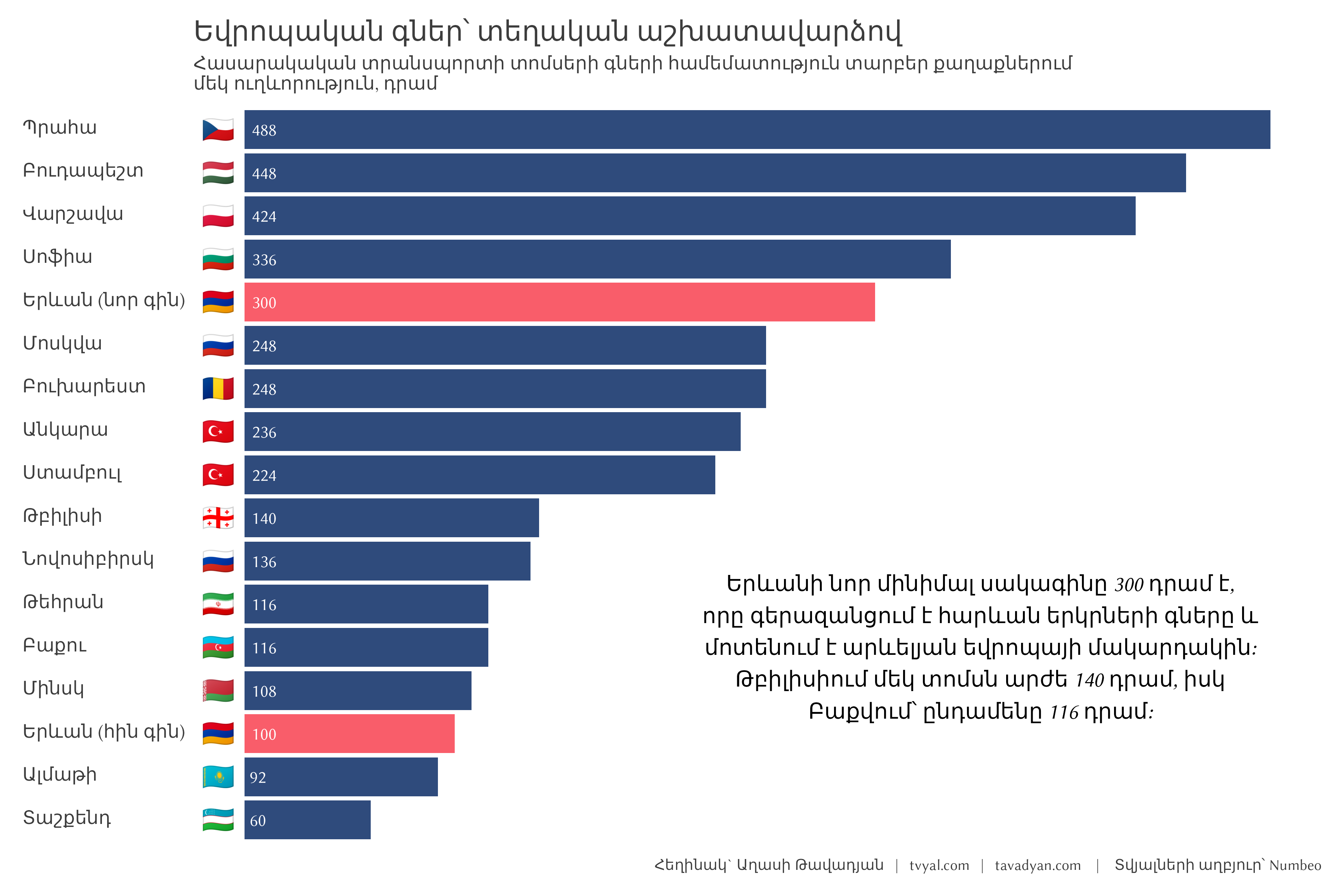
The new tariffs match the prices in Eastern European capitals but do not match the prices of Armenia’s immediate neighbors. In Warsaw, a single ticket costs 3.40 PLN (326 AMD), while in Sofia the cost of a digital ticket is 1.6 BGN (338 AMD). For comparison, the price in Tbilisi is 140 AMD, and in Baku it is 118 AMD. Table 1. Comparison of public transport fares in different cities
Prices are displayed in local currency and Armenian drams (AMD)
| City | Country | Ticket Type (link) | Local Price | Price in AMD |
|---|---|---|---|---|
| Budapest | Hungary | Single ticket | 600.00 HUF | 601 |
| Prague | Czech Republic | 30-minute ticket | 30.00 CZK | 486 |
| Sofia | Bulgaria | Single ride | 1.60 BGN | 338 |
| Warsaw | Poland | 20-minute ticket | 3.40 PLN | 326 |
| Istanbul | Turkey | Metro single ride | 27.00 TRY | 304 |
| Yerevan | Armenia | Standard ride | 300.00 AMD | 300 |
| Bucharest | Romania | Single ride | 3.00 RON | 249 |
| Moscow | Russia | Metro single ride | 57.00 RUB | 221 |
| Tbilisi | Georgia | Metro single ride | 1.00 GEL | 140 |
| Baku | Azerbaijan | Metro single ride | 0.50 AZN | 118 |
| Minsk | Belarus | Metro single token | 0.90 BYN | 103 |
| Tehran | Iran | Metro single ride | 10,000.00 IRR | 95 |
| Kyiv | Ukraine | Standard ride | 8.00 UAH | 76 |
| Almaty | Kazakhstan | Single ride | 90.00 KZT | 68 |
| Tashkent | Uzbekistan | Cash/bank card | 2,000.00 UZS | 61 |
The true impact of transport costs becomes more evident in the context of local salaries. While a Yerevan worker’s monthly transport costs have increased from 5,000 to 9,000 AMD, this amount constitutes a significantly larger portion of local incomes compared to other capitals in the region. In Warsaw, where the average monthly salary exceeds 716,000 AMD, transport costs make up about 1.5% of a worker’s income. In Yerevan, where the average monthly salary is around 216,000 AMD, the new transport costs will amount to almost 4.2% of incomes.
Chart 1.
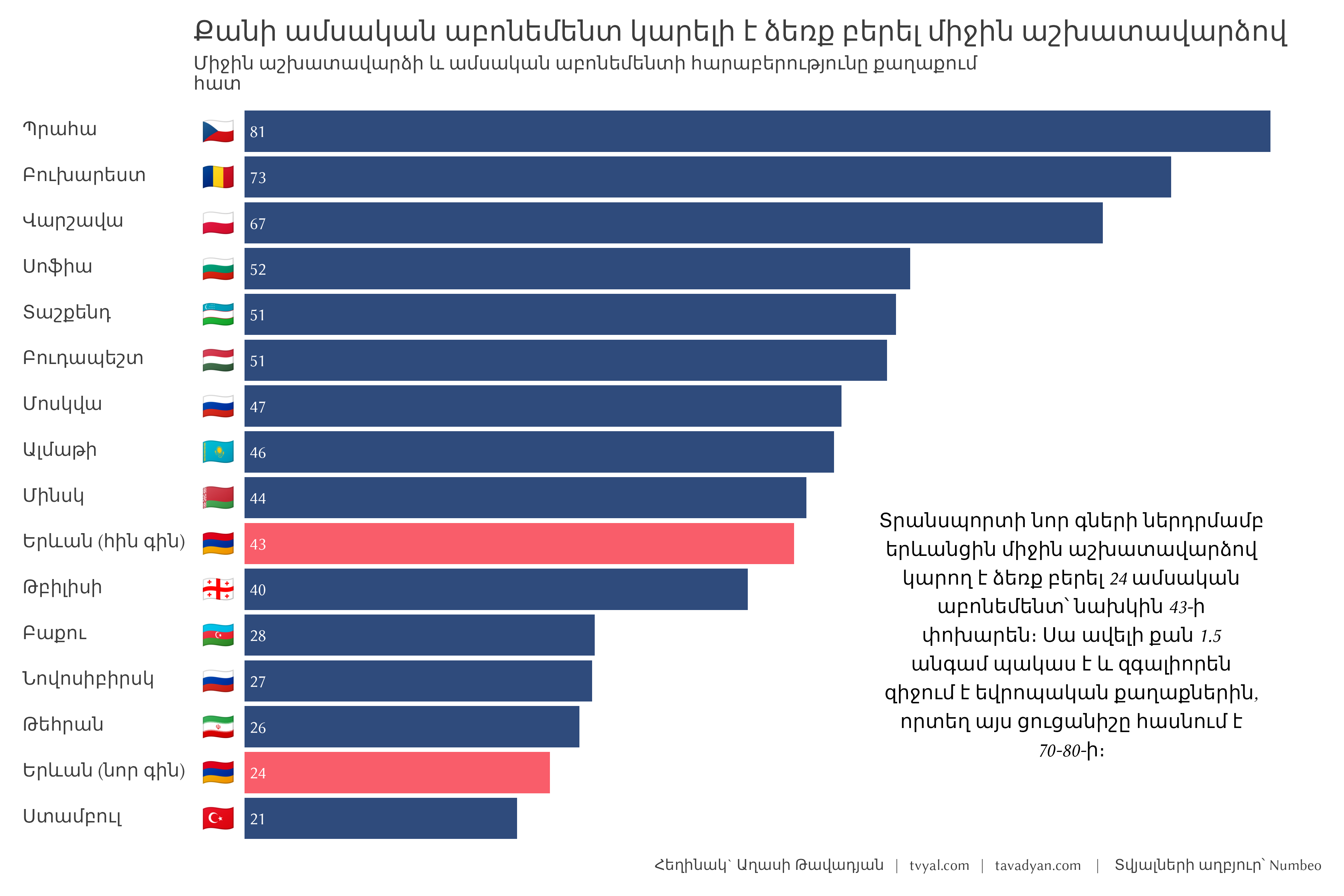
This disparity becomes even more pronounced when we examine how many monthly subscriptions a citizen earning an average salary can buy in each city. The average worker in Warsaw can buy 61 monthly subscriptions with their salary. Meanwhile, in the old system, a Yerevan worker could buy on average 43 subscriptions, and in the new system only 24, which is one of the lowest indicators compared to the cities in the region. This metric vividly shows the true burden of the new tariffs on local residents.
Chart 2.

City authorities have tried to mitigate the impact through a multi-tiered system of discounts. Students receive a 15% discount, pensioners 30%, and a number of citizen groups, including people with disabilities and families with four or more children, can use transport for free. The new system also introduces technological improvements, making it possible to pay via the municipality’s website, mobile apps, and bank cards.
However, the pricing structure can lead to unpredictable consequences. The minimum 90-minute ticket costs 300 AMD, whereas an average taxi ride in Yerevan starts from 600 AMD. When two or three people travel together, a taxi suddenly becomes an economically competitive option, which is exactly the opposite of the usual goals of public transport reforms.
Chart 3.
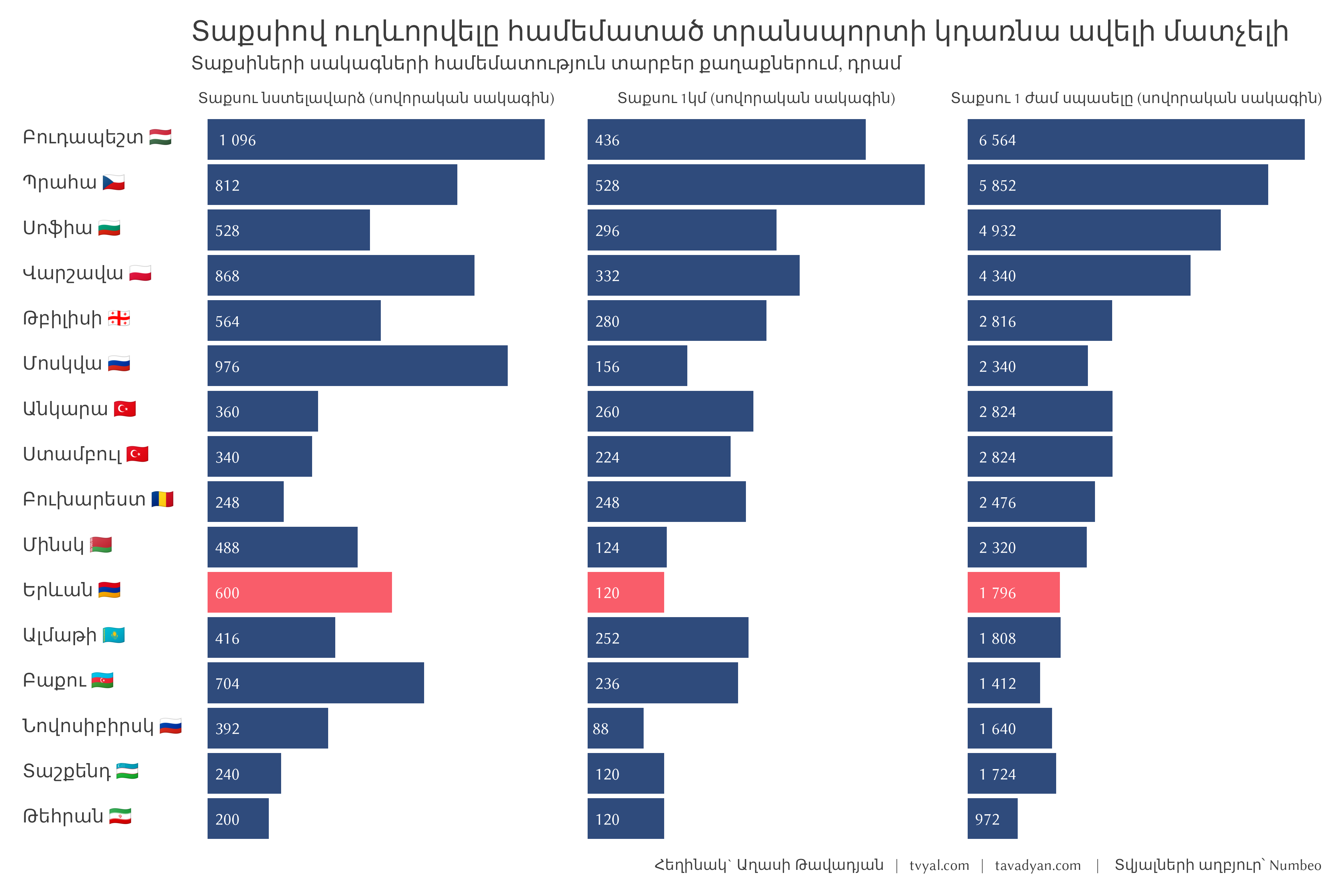
Because of this price change, taxis will become more attractive to Yerevan residents. A family of three will pay 900 AMD for public transport, more than for a short taxi ride. This economic calculation threatens to increase the number of vehicles on Yerevan’s already congested streets, potentially undermining one of the main goals of public transport: reducing urban traffic.
Chart 4.
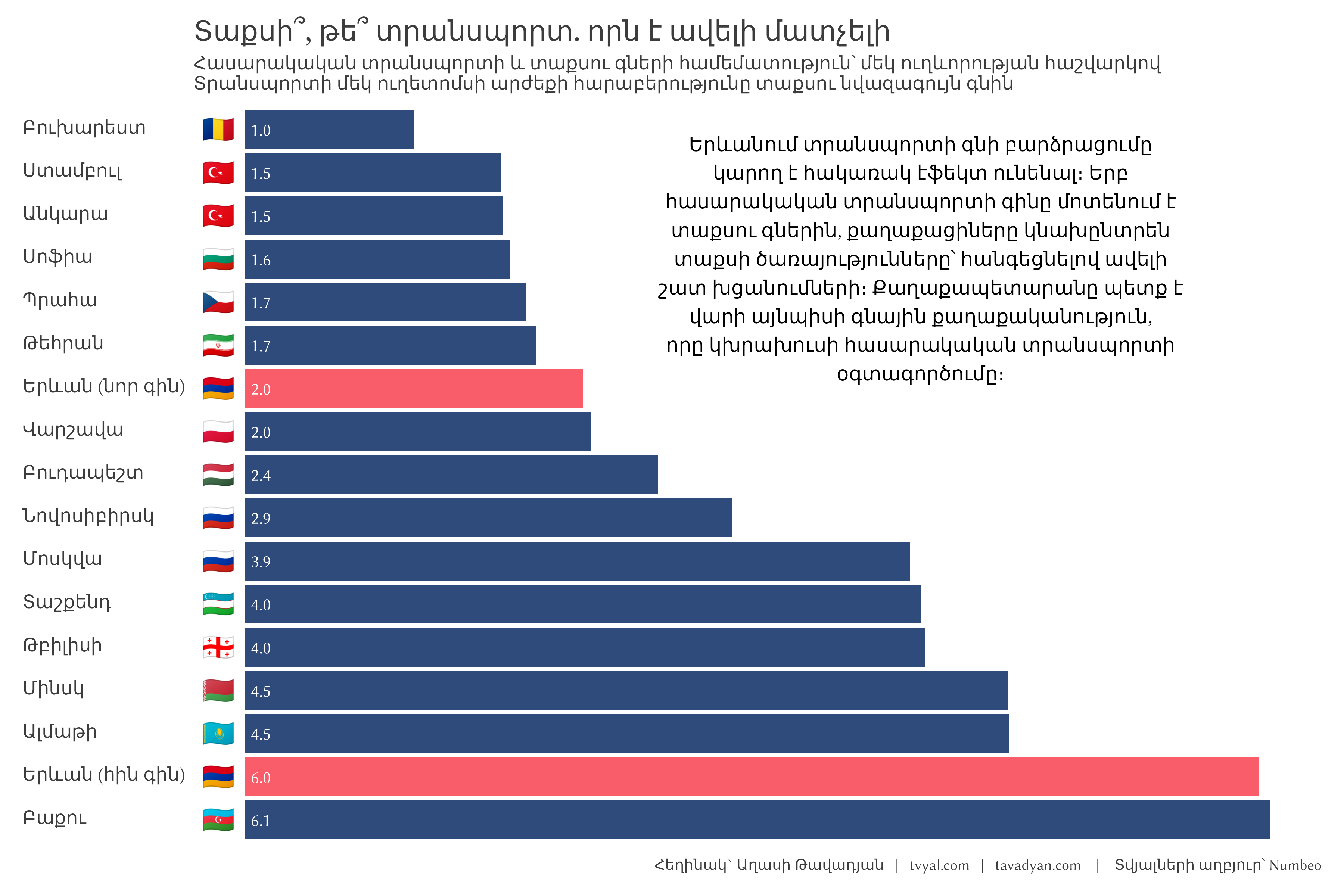
This challenge is not unique to Yerevan. Across the post-Soviet region, cities struggle to balance modernization costs with social affordability. The Georgian capital Tbilisi maintains lower tariffs at 1 GEL (140 AMD), but operates an older rolling stock. Baku recently increased the metro fare to 0.50 AZN (118 AMD), though it is still significantly lower than Yerevan’s new prices. At the same time, Moscow, despite higher salaries, maintains relatively affordable public transport prices thanks to significant municipal subsidies.
Conclusion
Yerevan’s public transport faces a complex balancing act. While the transition from marshrutkas to new buses solves long-standing concerns regarding service quality, the sharp tariff increase becomes a significant burden for residents. The average Yerevan worker can now buy only 24 monthly subscriptions with their salary, instead of the previous 43, which is a dramatic drop in purchasing power for thousands of families. The complexity of the new system, with its diverse payment methods and discount categories, adds to the need for residents to adapt.
Chart 5.
The main question facing Yerevan is not the necessity of modernization; that is obvious. It is how to plan and finance these improvements without making public transport too expensive for its primary users. When a group of three prefers taking a taxi over using public transport, the system is likely contradicting its own goals of reducing traffic and providing affordable transport for everyone. As Yerevan residents adapt to these changes, the city’s experience may show whether rapid modernization at the expense of affordability is a sustainable path for Armenia’s urban development.
Note: There are discrepancies between the charts in the material and the prices presented in the first table. Because the first table was compiled using direct and fresh sources, while the data presented in the charts were taken from the Numbeo.com website, which aggregates data through individual surveys. In this case, Numbeo’s data may not correspond to reality as inflationary or other effects might not be accounted for.